- Home
- News
- Spotlight on Science
- Uncovering the firing...
Uncovering the firing processes of ancient Chinese ceramics
11-12-2025
Micrometre-scale X-ray diffraction and absorption mapping reveal how craftspeople in Song Dynasty China controlled glaze chemistry and ceramic firing conditions. Measurements across beamlines ID13, ID21, and ID22 exposed crystalline stratigraphy and oxidation-state gradients in the glazes. These insights clarify regional technological practices in ancient China and could inspire new iron oxide-based magnetic materials.
Share
The challenge
Black-to-brown glazed ceramics were highly fashionable in China during the Song Dynasty (960-1279). They were prized for drinking whipped tea, as their dark glazes contrasted strikingly with the lighter hues of its foam. These ceramics were manufactured across the Song Empire, notably in a wide area covering several Northern Chinese provinces. Their characteristic colour is due to the presence of ε-Fe2O3, an uncommon iron oxide with promising physical properties for applications such as data storage. Understanding how ε-Fe2O3 forms in these glazes can both elucidate ancient Chinese ceramic manufacturing practices and inform modern approaches to synthesising advanced materials inspired by historical techniques.
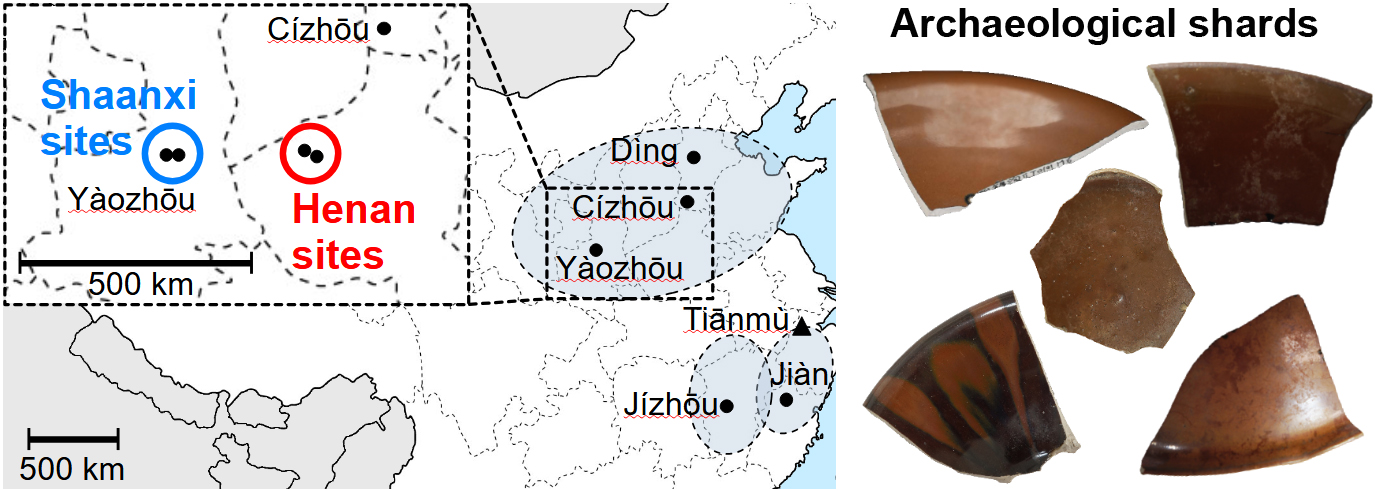
To address these challenges, this study examined 18 ceramic shards excavated from four archaeological sites in Shaanxi and Henan provinces in China (Figure 1). The samples were analysed at micrometre resolution using micro-X-ray diffraction (µ-XRD) and micro-X-ray absorption spectroscopy (µ-XAS) at the ID21 and ID13 beamlines, alongside reference samples that were analysed at the ID21 and ID22 beamlines. In addition, the Algorithm and Scientific Data analysis (ADA) group supported the processing of the diffraction dataset. This multi-technique strategy – enabled by strong internal collaboration and the “Historical Materials” BAG [1] – provides new and exciting insights into the manufacturing techniques mastered in North China during the Northern Song Dynasty.
Click image to enlarge
Fig. 1: Left: Map of China highlighting the areas manufacturing black-to-brown glazes with details of the four archaeological sites studied in this work. Right: Pictures of five ceramic shards studied.
The experiment
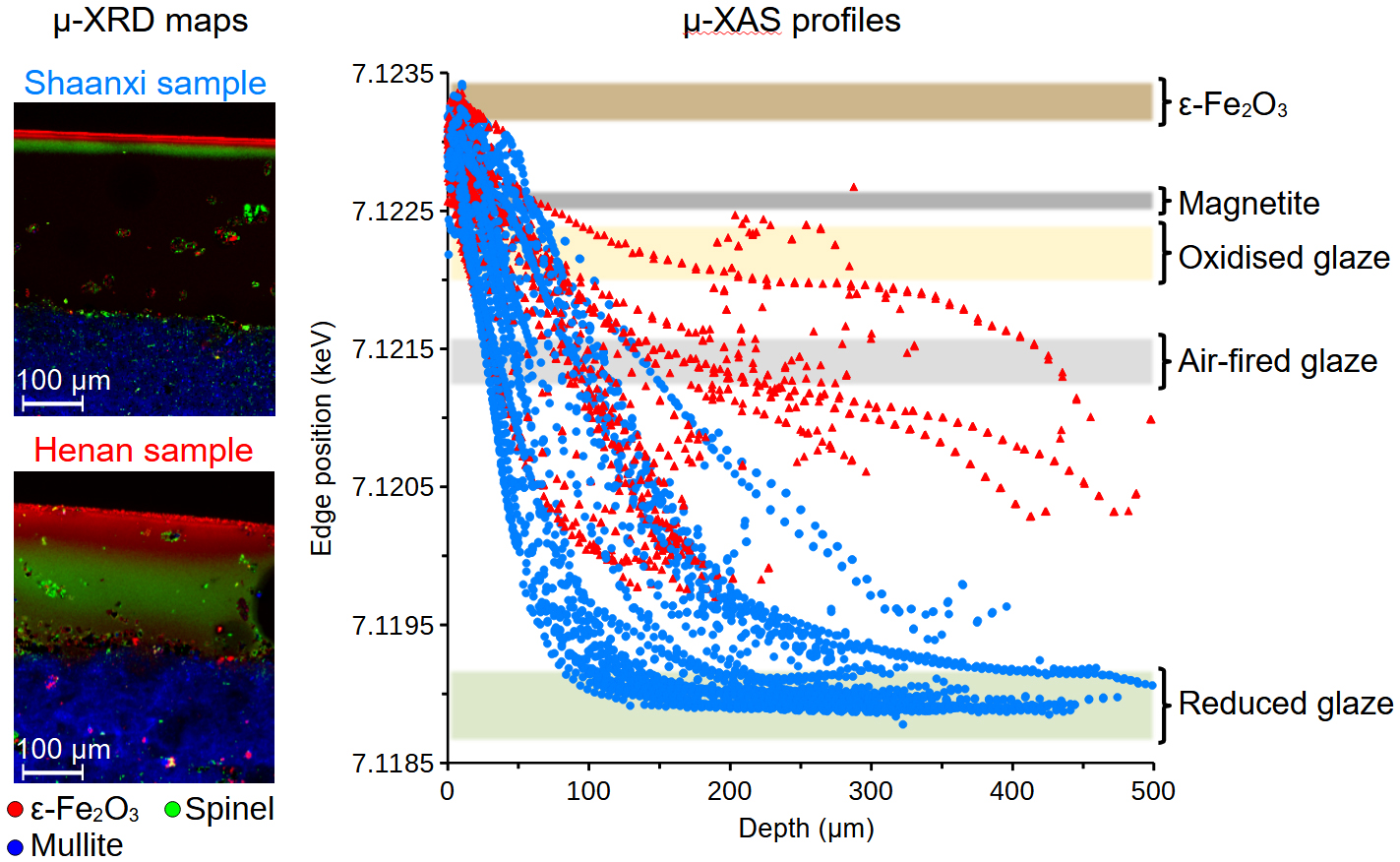
Sections of the archaeological samples were polished down to ~100 μm to allow transmission geometry measurements. Areas of approximately 800 x 800 μm were mapped using µ-XRD at ID13 with a 2 μm resolution to reveal the glaze stratigraphy and assess its homogeneity. These crystalline phase maps identified a spinel layer located below the superficial ε-Fe2O3 layer, confirming a diffusion-based growth mechanism proposed previously [2]. The glaze stratigraphy differs systematically between provinces: Shaanxi samples show only a thin spinel layer, whereas in Henan samples the spinel layer extends throughout the glaze (Figure 2, left). This indicates differences in the firing process – particularly in cooling conditions – between the two neighbouring regions.
Click image to enlarge
Fig. 2: Left: µ-XRD maps of Shaanxi and Henan samples. The spinel layer (green) is concentrated in the few microns just below the superficial ε-Fe2O3 (red) in the Shaanxi sample (top), while it extends through the whole glaze of the Henan sample (bottom). Right: µ-XAS profiles measured across the glazes of the whole sample corpus. Shaanxi profiles (blue) are comparable between samples, while Henan profiles (red) are much more dispersed and globally more oxidised.
In parallel, Fe K-edge µ-XAS measurements were collected at ID21 across the depth of the glazes. The oxidation-state profiles also separate clearly by province (Figure 2, right). The Shaanxi sample (blue) exhibits a sharp reduction gradient in the first ~150 μm of the glaze from the oxidised surface toward the more reduced inner glaze. Deeper down, the average oxidation state of iron is constant and corresponds to the reduced glaze reference, suggesting that the heating step of the Shaanxi firing was quite reductive. In contrast, the profiles recorded on samples from Henan firing are more dispersed and lack a clear plateau, suggesting that the conditions in these kilns were less reproducible between the different firings.
The impact
Beyond shining light on ancient ceramic manufacturing techniques in Song China, this study demonstrates the strong complementarity of ESRF beamlines. Further studies of the magnetic properties of ancient ε-Fe2O3 are underway, with data from ID14 under analysis and measurements planned at ID32. If technologically relevant magnetic behaviour is identified, these findings could provide new ‘archaeo-inspired’ synthesis routes for advanced materials.
Principal publication
Oxidation Gradients in Brown-Glazed Ceramics from the Song Dynasty: Potential X-ray Markers of Provenance and Technology, C. Holé et al., J. Am. Chem. Soc. 147(46), 42433-42440 (2025); https://pubs.acs.org/doi/10.1021/jacs.5c12132
References
[1] M. Cotte et al., Molecules 27(6), 1997 (2022).
[2] C. Holé et al., Mat. Today Com. 33, 104329 (2022).
| About the beamlines: ID21 and ID13 |
|
The ID21 beamline is dedicated to micro and nano-X ray spectroscopy, offering 2D X-ray fluorescence (XRF) mapping and X-ray absorption spectroscopy (XAS) in the tender X-ray energy range (2.1 - 10.5 keV). These techniques can be combined to produce multi-energy XRF maps, enabling both 2D elemental mapping and chemical speciation in 0D, 1D, and 2D. The beamline is optimised for the detection and chemical analysis of elements from phosphorus to zinc, while heavier elements can also be studied via their L- and M-edge absorption. Following a recent upgrade, ID21 now hosts two scanning X-ray microscopes. A newly installed nanoscope (nano-SXM) is optimised for high-resolution (down to 120 nm), high-speed nano-XRF mapping and nano-XAS, offering enhanced performance over the previous microscope. The original microscope has been retained and is now dedicated to the study of larger samples using micrometric and submillimetric beams. Both microscopes operate under vacuum and support measurements at room temperature or under cryogenic conditions. |
|
ID13 is dedicated to high-spatial-resolution diffraction and scattering experiments using focused monochromatic X-ray beams. Two end-stations: a microbranch and a nanobranch, are operated in serial mode. The principal aim is to provide small focal spots for diffraction and small-angle X-ray scattering (SAXS). Both single-crystal and scanning diffraction experiments are performed. Other applications, like scanning X-ray microfluorescence, are feasible. A broad range of materials can be examined, from bio- and synthetic polymers to composites and minerals. The current setups allow for the study of single crystals (including proteins), fibres or extended samples. Specific sample environments are also available, including stretching cells, micro-grazing-incidence small-angle X-ray scattering (GISAXS) and microfluidics (utilising both mixing-cell and microdroplet technologies). |
partners


European Synchrotron Radiation Facility - 71, avenue des Martyrs, CS 40220, 38043 Grenoble Cedex 9, France.