- Home
- News
- General News
- RIXS Interferometry:...
RIXS Interferometry: A window into quantum entanglement
06-02-2026
Scientists have observed the presence of entanglement in a pyrochlore iridate, using resonant inelastic x-ray scattering on ID20. The results are out now in Nature Materials.
Share
Quantum entanglement is one of the most fascinating and counterintuitive phenomena in physics. Entangled particles are so deeply connected that measuring one of them instantly affects the other, no matter how far apart they are. Einstein famously called this "spooky action at a distance", as it seemed to defy our everyday sense of causality and locality.
Entanglement shows that reality at the quantum level operates under rules profoundly different from those of our macroscopic world. Far from being a mere curiosity, it is a fundamental aspect of nature that underpins emerging technologies such as quantum computing, cryptography, and sensing. As these fields advance, entanglement may soon transform computing, communication, and sensing in ways we are only beginning to imagine.
 |
|
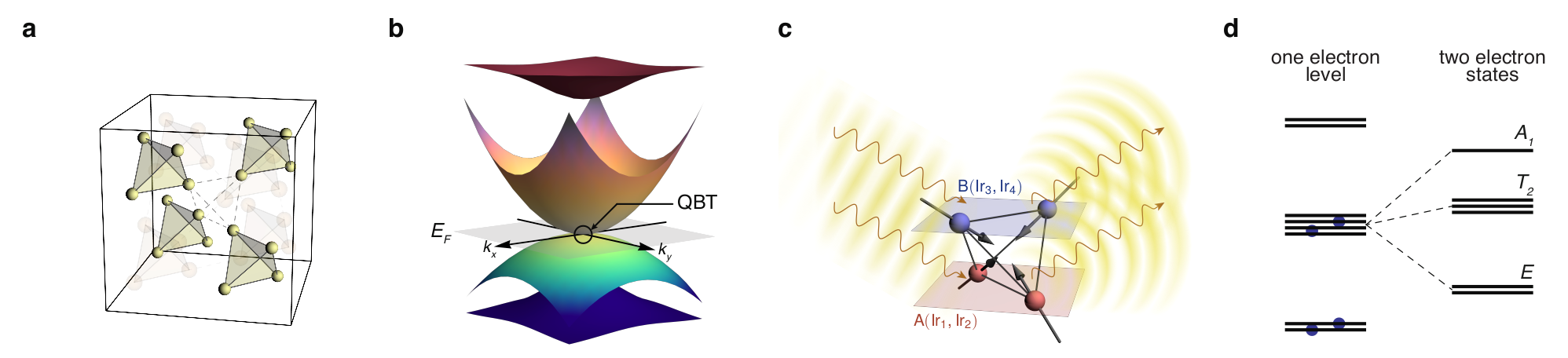
a) Crystal structure of Nd2Ir2O7 in which the pyrochlore network formed by Ir ions (yellow sphere) interpenetrates that of Nd ions (light orange). b) Electronic band structure featuring quadratic band touching (QBT) at the Fermi level. c) Bipartition of the tetrahedron into subsystems A(red) and B(blue). d) Electronic levels of an isolated tetrahedron. |
Now scientists led by Pohang University of Science and Technology carried out experiments on an ultra-pure sample of cubic Nd2Ir2O7, using resonant inelastic X-ray scattering (RIXS) at beamline ID20.
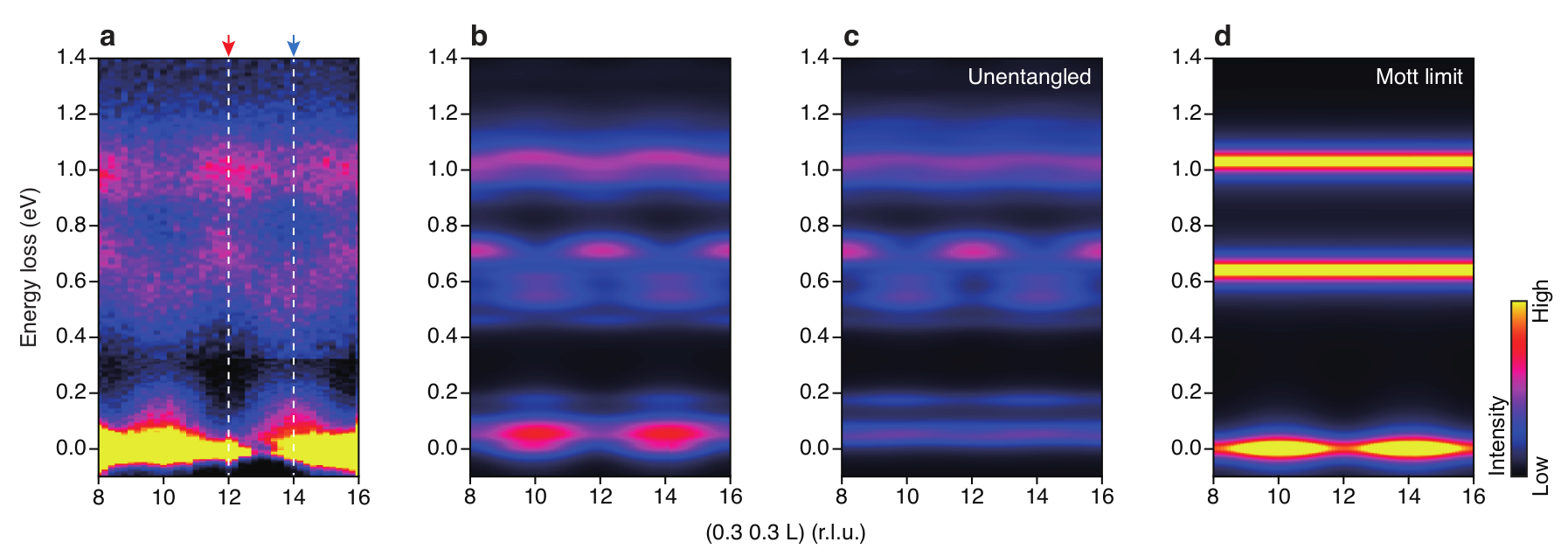
The results show RIXS interference patterns associated to the presence of entanglement across atomic sites. In particular, the RIXS interferometry signatures link to a highly entangled electronic phase emerging near a quantum metal–insulator transition in this pyrochlore iridate.
 |
|
a) RIXS spectra measured at T = 6K. Energy spectra are shown in e for the two momenta indicated by dotted vertical lines. b) Calculation of RIXS spectra using exact diagonalization on a cluster with parameters that best fit the experimental data. c) Calculation for an unentangled ground state. d) Calculation for the state approaching the Mott limit. |
Near this transition, the system exhibits pronounced fluctuations in the spin, orbital, and charge degrees of freedom, coexisting with the well-known all-in–all-out antiferromagnetic order. Model calculations based on exact diagonalization of a single-tetrahedron cluster reproduce the experimental results and allow the extraction of the full entanglement spectrum, thus revealing the nature of the underlying quantum states. Optical Raman spectroscopy provides complementary evidence for the presence of these hidden orders and their collective excitations, reinforcing the picture of a complex, entangled quantum state.
This works provides an experimental access to entanglement phenomena. It also establishes a direct link between quantum entanglement and emergent unconventional orders, which open new avenues for investigating quantum materials.
Reference:
Top image: Left: RIXS spectra measured at T = 6K. Energy spectra are shown in e for the two momenta indicated by dotted vertical lines. Right: Calculation of RIXS spectra using exact diagonalization on a cluster with parameters that best fit the experimental data.
partners


European Synchrotron Radiation Facility - 71, avenue des Martyrs, CS 40220, 38043 Grenoble Cedex 9, France.