- Home
- Users & Science
- User Guide
- Before your experiment
- Sample Transport at the ESRF
- Shipping your samples to the ESRF
Shipping your samples to the ESRF
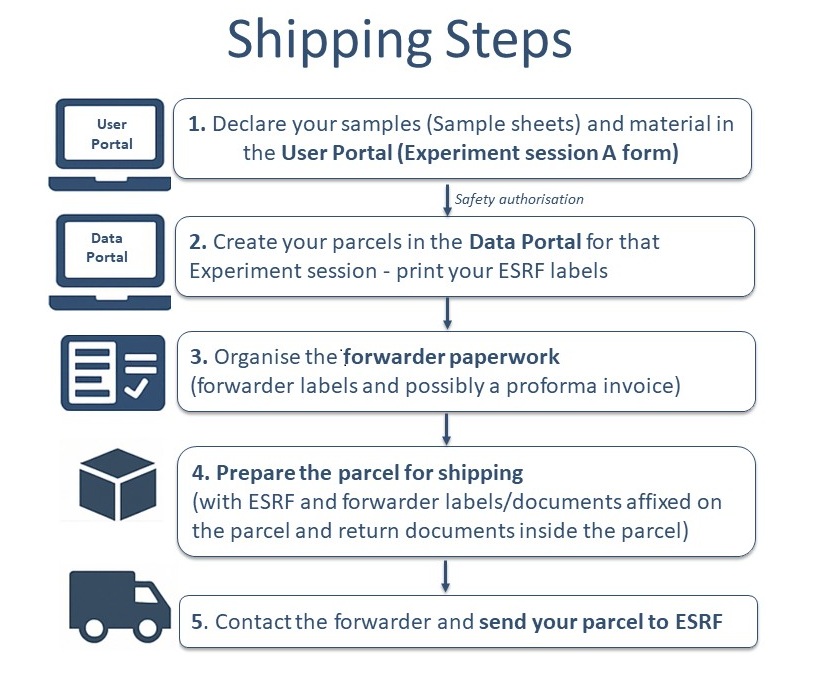
All samples and materials shipped to the ESRF must be declared and authorized in advance via the User Portal and possibly through a complementary email. Shipping documents must be prepared using the Data Portal (except for radioactive samples) and the forwarder’s website. Parcels should be properly packed with return paperwork enclosed and clearly labeled with both ESRF and forwarder labels.
Special case of radioactive samples and materials (regardless of the package classification). These samples are subject to the full requirements of the dangerous goods regulations: ADR (European Agreement concerning the International Carriage of Dangerous Goods by Road), or IATA DGR (Dangerous Goods Regulations). These shipments must be addressed to the Safety Group, not to the Stores. Please note that the standard ESRF sample tracking labels are not suitable for such cases.
If the transport of the samples is eligible for reimbursement (see the Sample reimbursement section below), it must be declared as such on the A form in the User Portal for that experiment session (see the Safety declaration section below) and in the Data Portal when creating the ESRF label (see the Label printing section below).
 When to declare?
6 weeks minimum before the experiment session for all samples and equipment declaration
3 working days minimum for structural biology sample declarations
 |
Registration of samples (User portal) |
All samples, references and chemical products for your proposal must be declared via the submission of a “Sample sheet” for each different type of sample, reference of chemical product. Multiple samples of the same type are declared in a single sample sheet (e.g. for 20 crystals of the same material, only one sample sheet is required).
Sample sheets are created via the User Portal by going to the list of your finalised proposals and clicking on the icon next to “Manage your samples” for the proposal in question.

Your sample sheet(s), once submitted, will be evaluated by the ESRF Safety Group and assigned a colour (green, yellow or red).
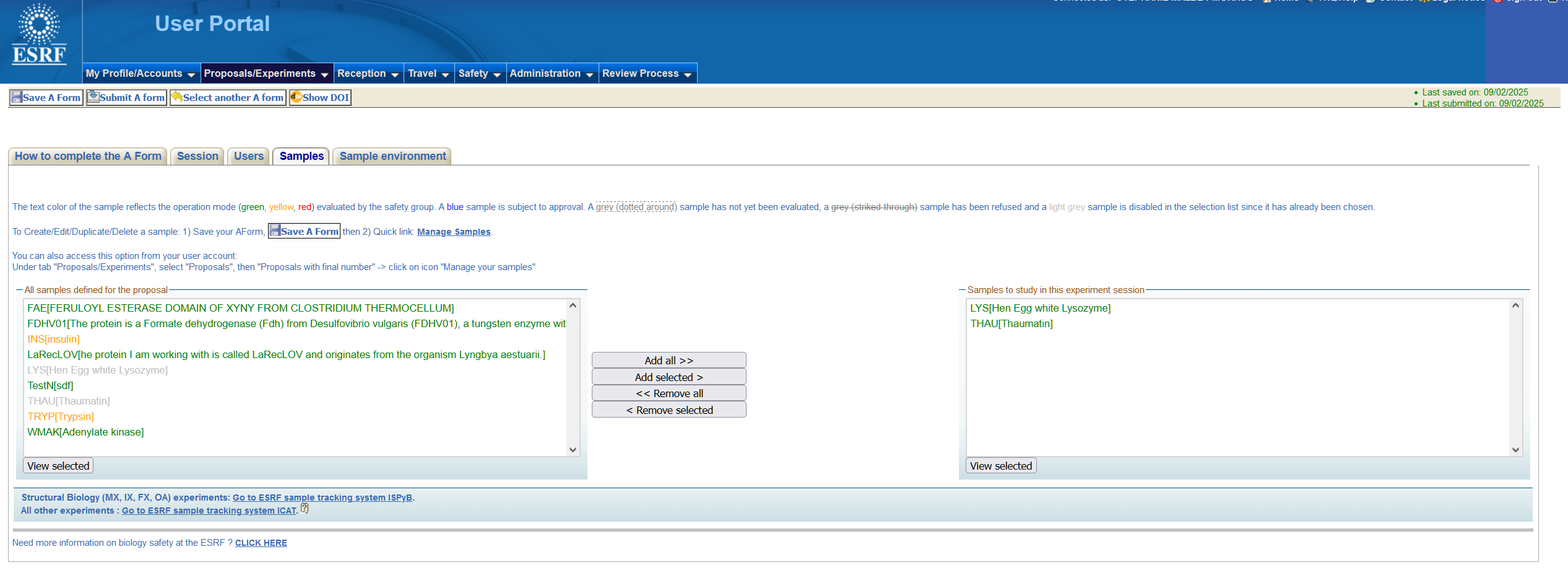
Once a sample sheet has been assigned a colour by the Safety Group, it can be added to the A-form by the Principal Investigator, from the “samples” tab by selecting all sample sheets relevant to that particular experiment session available for that proposal as shown below:
 |
Declaration of Equipment (E-mail) |
Ancillary equipment should be declared via a Risk Analysis Form and sent to the ESRF Safety group together with the conformity certificates.
A shipment is a set of parcels to be sent for a particular experiment session. The parcels in the shipment can be sent from the same or different addresses. The creation of a shipment and ESRF labels for each parcel is done within the Data Portal:
- Log-in to the ESRF Data Portal (https://data.esrf.fr) by clicking on the « Sign in with ESRF SSO » button using your personal ESRF credentials (same as User Portal).
Accessing the Data Portal from the User Portal sessions list is also possible by clicking on the Data Portal Logo  :
:

Instructions on how to create your parcels and shipments can be found in the video tutorial at the end of this section.
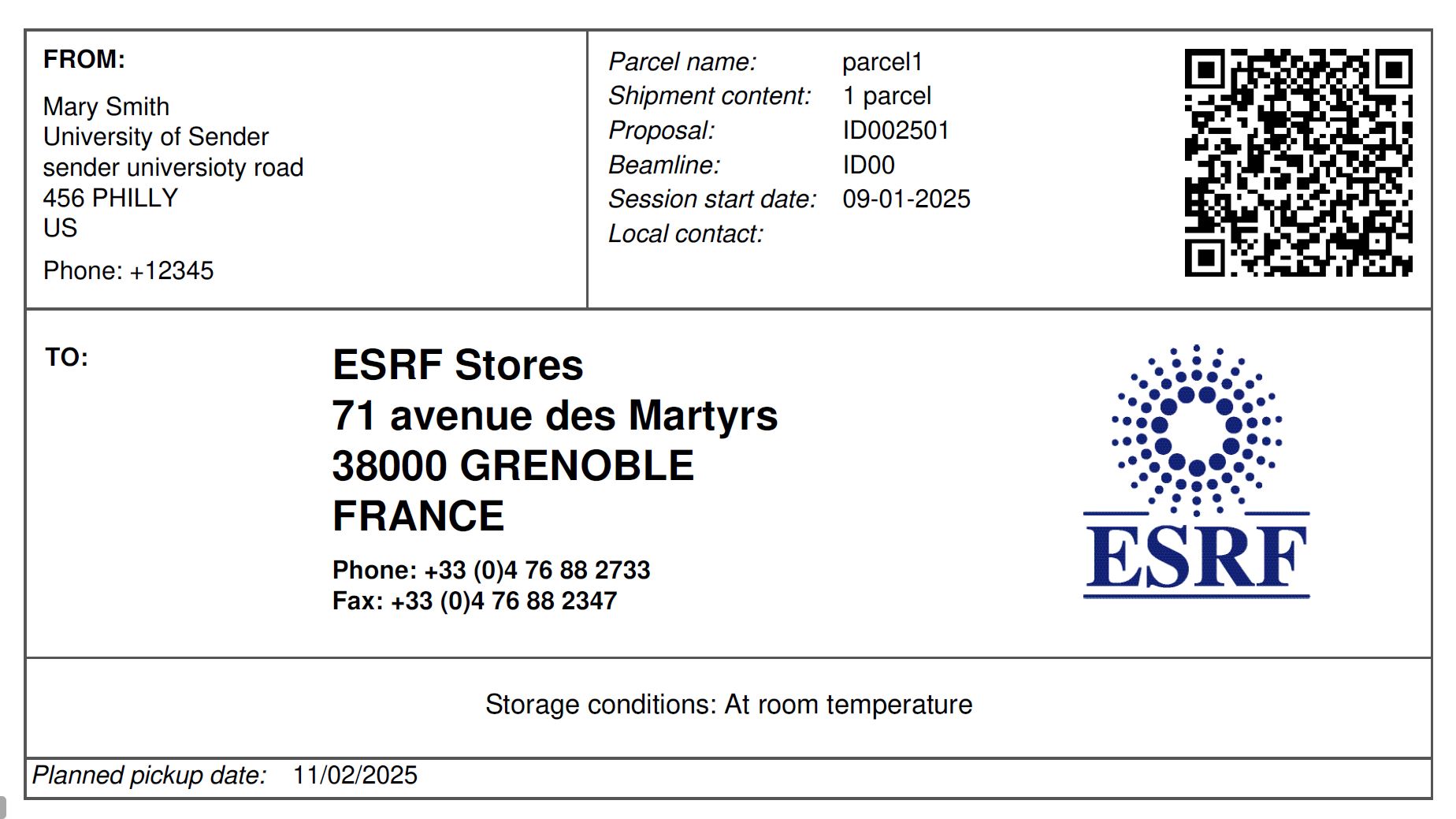
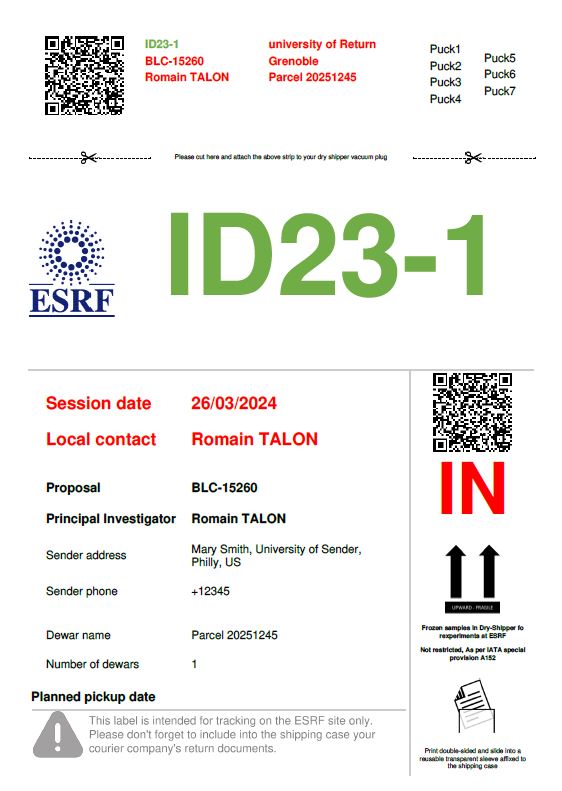
The purpose of the ESRF label is to track the parcel upon arrival at the ESRF until its departure from the ESRF, and inform you of its location at each step of its transport onsite. They are printed from the Data Portal and must be affixed on the parcel before its departure.
The Data Portal allows you to select a specific parcel for reimbursement and to inform the ESRF transport department on when to expect the parcel and what to do for its return to you, by selecting the appropriate option:

During the creation of your shipment in the Data Portal, and if you ask the transport to be paid by the ESRF, you will be given two numbers necessary for sending the reimbursed parcels to the ESRF: the ESRF forwarder account number and the session reference number. Please note them carefully as they will be necessary for the forwarder paperwork. This only applies to sample transport. Material transport will not be paid for by ESRF.
Detailed instructions can be found directly from within the Data Portal help button that appears in the top banner:

How-to videos:
 |
The step-by-step process for the creation of parcels and shipments, and the creation and printing of ESRF labels |
|
Structural biology: The step-by-step process for the creation of dewars and shipments including the ESRF labels creation & printing and diffraction plan description |
This step-by-step process is also described on this Confluence page.
The Data Portal synchronises with the User Portal's samples and parcel declaration every hour during 10 days leading to the experiment, and once per day before that period.
The "Print ESRF Label" option in the Data Portal is available only for parcels that include samples or equipment.
- Transport taken in charge by the ESRF: use the ESRF forwarder account provided in the Data Portal or use another forwarder providing equivalent services and get reimbursed via a reimbursement claim. Note that only a user can be reimbursed and not an institute. (See section on reimbursement rules for more details).
 : Instructions on how to use the ESRF forwarder account can be found here. Remember to use the option "FedEx International Priority shipping" or an equivalent. You must also correctly note the session reference number - this is provided by the Data Portal with the following syntax: Prop_ID/BL/Date (e.g. MX-1234/ID29/23-09-2025).
- Transport not taken in charge by the ESRF: use your own forwarder and your own laboratory account
Verify that all your travel documents are ready:
| What document | Documents "To the ESRF" |
Return documents "From the ESRF" |
|
|
Non MX: MX: |
ESRF label | affixed on parcel | inside parcel |
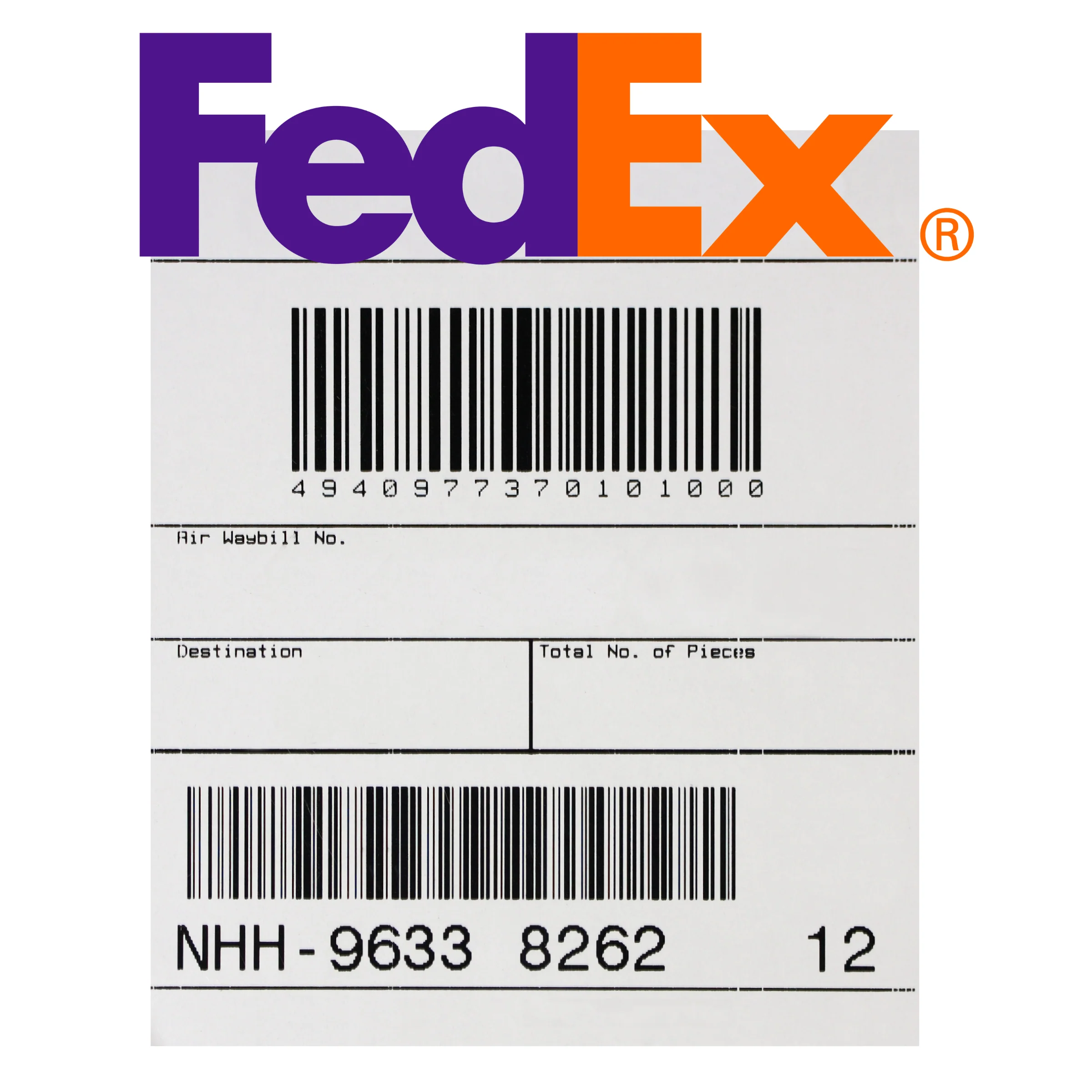 |
Forwarder label | affixed on parcel | inside parcel |
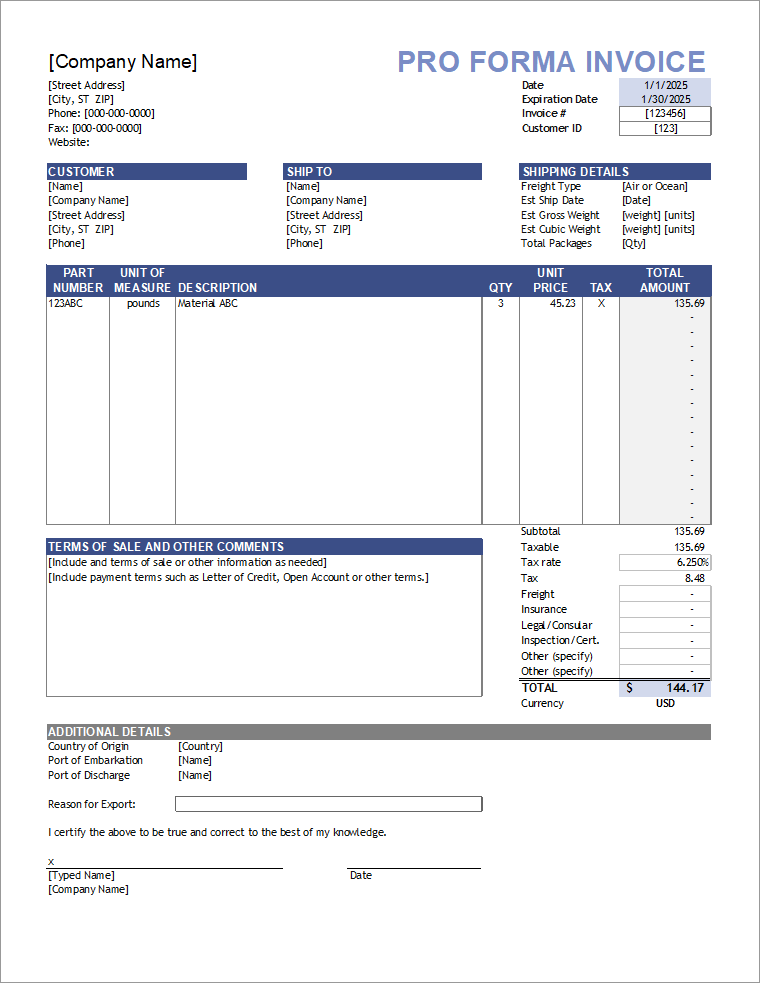 |
Proforma invoice (if necessary) | affixed on parcel | inside parcel |
Call your forwarder to organise your parcel pickup from your laboratory.
We recommend to ship your samples and material within EU at least 5 working days ahead of your experiment to guarantee its arrival before the beamtime begins. Expect more time for non-EU transport to ESRF.
Pack your samples and equipment ensuring they are as protected as possible. Remember to empty extra liquid LN2 from dewars to avoid transport issues.
Ensure that the "To ESRF" documents (forwarder documents, ESRF label, proforma invoice if necessary) are displayed on the parcel and that return documents (forwarder documents, ESRF label, proforma invoice if necessary) are packed inside the parcel.
Please note that deliveries to the ESRF by any type of transport service can only be made from Monday to Friday (08:00 to 17:00) outside French public holidays.
- Reimbursement rules
The financial support for sample transport is strictly limited to the transport of samples to/from ESRF member countries and does not cover the transport of any other goods such as equipment or chemicals, even if directly related to the experiment. The parcels do not necessarily have to be sent from the laboratories of the users on the A-form.
Moreover the ESRF will not reimburse any additional costs related to transport insurance or customs clearance for the shipment of the parcels; these costs must be covered by the user or the user institute.
Additionally, the reimbursement for sample transport is subject to the same conditions as for user travel in that the users are expected to comply with good management of public funds (i.e. costs that are reasonable and cost effective). The ESRF reimbursement will be based on the most economical solution and, in all cases, will not exceed the cost equivalent of user travel from the same country to the ESRF.
The ESRF will pay for either a user to travel to the ESRF or a parcel of samples to be sent to the ESRF, up to the maximum number of users/parcels allowed for the experiment:
- 3 in total for STD, MX-SAXS BAG, Rolling XRD, Bio-SAXS or SSX experiments
- 2 in total for Cryo-EM Rolling and BAG experiments
- 1 for offline experiments
- 4 in total for red experiments, LTP, HUB, BAG and SSX BAG experiments.
- On ID30A-1 (MASSIF-1): the ESRF pays the transport cost of 1 dewar per shift of beamtime used on this fully automated beamline. - Use the ESRF forwarder account number
Users and reimbursed parcels must be registered through the electronic A-form, and the users must create and manage the shipment of parcels using the Data Portal. ESRF-paid parcels must be sent using the ESRF's forwarder account number provided in the Data Portal interface as described in the step-by-step procedure “Fill in the forwarder's documents using the ESRF forwarder account".
Note: In case the ESRF forwarder is not ideal for your area, you may use any other forwarder that you are familiar with on the condition that the shipping cost is equivalent, in which case follow the instructions from the next section to get reimbursed.
- Request reimbursement of an eligible parcel that was not sent using the ESRF forwarder account
Warning: The ESRF cannot reimburse an institute, only a user. Therefore, the ESRF will reimburse the user who has submitted the reimbursement claim. All reimbursed users should arrange directly with their institute for reimbursement of costs if they have been paid by the institute.
To request reimbursement, one of the members of the user team must submit a reimbursement claim (Excel file downloadable here), indicating clearly the number of parcels for which reimbursement is requested, the individual cost for each parcel, and the total cost for the shipment of the parcels. Please send your reimbursement claim to the User Office. Detailed information on reimbursement claims can be found here (section 8. Reimbursement procedure).
1. Common reasons for parcel delays at customs in France:
• Missing essential information, as outlined in FAQ#2.
• Restricted terms like "restricted circulation" or "permanent import" can delay or block the customs process. Customs authorities need clarification on why these restrictions apply.
2. What information is required to prevent customs delays due to missing details?
A parcel may be held at the airport if key information or documentation is incomplete.
Proforma invoices should include the following: Value (with a non-zero currency), HTS code (customs code), Country of origin, and a detailed Material description (e.g. “protein sample for experiment”). It is crucial to provide an accurate description (number of items, type, etc.) of the material to help the forwarder process the shipment efficiently.
This, in addition to "Not restricted, as per IATA special provision A152 Dry shipper for experiments at ESRF" in the case of structural biology samples for example.
Forwarders typically classify issues caused by missing information as "customs blocked."
3. Why might the transit take longer than expected?
Heavy traffic at the airport's cargo hub can lead to delays. Peak periods such as Chinese New Year or Christmas, disruptions from other hubs, bad weather (e.g., snow), and strikes can all contribute to delays. Unfortunately, ESRF cannot expedite the process.
4. The parcel has arrived at CDG (Charles de Gaulle, Paris) airport, but the transport appears stalled without being marked "blocked":
In cases of heavy activity, the forwarder’s customs clearance team may not process the parcel right away, leading to delays in informing ESRF about the delivery. This can occur when the forwarder does not request customs clearance instructions from ESRF, or the ESRF’s prior instructions are overlooked.
Companies like FedEx, DHL and UPS are familiar with ESRF's stores team and customs clearance procedures. However, note that if the forwarder selected by the sender is not familiar with ESRF’s process, communication can be slower.
5. What if ESRF gives instructions, but the parcel remains blocked?
ESRF has limited direct access to the forwarder’s customer support. ESRF stores team must rely on hotlines or generic email addresses, and their inquiries are handled according to the forwarder’s queueing system.
6. When should I expect my parcel to arrive at ESRF after customs clearance?
The customs clearance always happens in Paris CDG and the parcel is then sent to the Lyon FedEx hub before it is distributed Grenoble. Therefore, custom-cleared parcels will most probably not reach ESRF on the same day as clearance but either 24h or 48h after clearance.
7. What is the impact of Brexit on Shipping?
We recommend allowing between 7 and 10 days to ensure timely delivery from UK (when it was 3 days maximum before Brexit).
8. Why can transport via CDG airport feel longer than through other EU hubs?
Each airport operates with its unique processes and staffing arrangements for customs and forwarders. The processing time also depends on the political situation in Europe, such as wars, strikes, and other disruptions.
9. Can the ESRF speed up the customs clearance process?
Unfortunately, we are unable to expedite customs clearance.
10. FedEx is not efficient and reliable in my area, can I change of forwarder and get reimbursed?
If you believe that FedEx may be contributing to the delays, you can use a different forwarder providing that their costs are comparable to those of FedEx. You can then request reimbursement afterwards. For further guidance on this process, feel free to contact useroff@esrf.fr.
You didn't find an answer to your question related to the transport of samples? Feel free to contact the ESRF Stores-Logistics.
partners


European Synchrotron Radiation Facility - 71, avenue des Martyrs, CS 40220, 38043 Grenoble Cedex 9, France.