- Home
- Users & Science
- Support and Infrastructure
- icOS - The in crystallo Optical Spectroscopy Laboratory
icOS - The in crystallo Optical Spectroscopy Laboratory
Overview
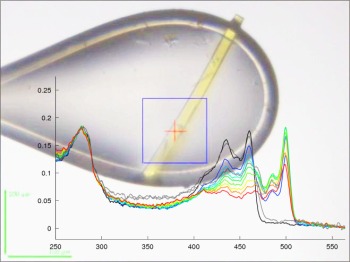
The icOS Lab (previously known as the Cryobench) is dedicated to various types of optical spectroscopy experiments on crystals of proteins, nucleic acids and smaller molecules, or on nanolitres of concentrated solution. Available spectroscopies include UV-Visible light absorption, fluorescence emission and Raman. Measurements can be performed on steady states at cryogenic or room temperature, or using a time-resolved approach (pump-probe or continuous) at room temperature. The lab is run in the context of a close collaboration between the MXIS Group of the ESRF and the Synchrotron Group of the IBS, as one platform of the Partnership for Structural Biology.
Techniques
UV-Vis absorption spectroscopy , Fluorescence emission spectroscopy, Raman spectroscopy
Typical sample types
Macrocrystals, microcrystals, concentrated solutions (nanolitres)
Spatial/temporal resolution
Focal spot on sample: between 25 and 250 micron diameter
Time resolution: continuous mode 50 to 500 ms (main icOS setup), pump-probe mode 2 us (TR-icOS setup)
Energy ranges
UV-Vis absorption: white light 250 - 1100 nm (deuterium-tungsten halogen, DH-2000-BAL, Ocean Optics), 250 - 1100 nm (xenon flash lamp, L11316-11, Hamatsu Photonics)
Experimental environments
For cryogenic temperatures (100 - 270 K): Oxford cryostream 800 series
For room temperature experiments: HC Lab, COC sandwich
Reference instrument and methodological publications
- Caramello N, Rose SL, Mathieu E, Petit L, Tews I, Engilberge S, Royant A. "Coupled on-line in crystallo UV–Vis absorption spectroscopy and X-ray crystallography to compare specific radiation damage in metal-containing proteins at room versus cryogenic temperature." (2026) Acta Crystallogr. D Struct. Biol. 82,187–198.
- Caramello N, Adam V, Pearson AR, Royant A. "The in crystallo optical spectroscopy toolbox." (2025) J. Appl. Crystallogr. 58,1068-1078.
- Caramello N, Royant A. "From femtoseconds to minutes: time-resolved macromolecular crystallography at XFELs and synchrotrons." (2024) Acta Crystallogr. D Struct. Biol. 80,60-79.
- Engilberge S, Caramello N, Bukhdruker S, Byrdin M, Giraud T, Jacquet P, Scortani D, Biv R, Gonzalez H, Broquet A, van der Linden P, Rose SL, Flot D, Balandin T, Gordeliy V, Lahey-Rudolph JM, Roessle M, de Sanctis D, Leonard GA, Mueller-Dieckmann C, Royant A. "The TR-icOS setup at the ESRF: time-resolved microsecond UV-Vis absorption spectroscopy on protein crystals." (2024) Acta Crystallogr. D Struct. Biol. 80,16-25
- von Stetten D, Giraud T, Bui S, Steiner RA, Fihman F, de Sanctis D & Royant A. ''Online Raman spectroscopy for structural biology on beamline ID29 of the ESRF.'' (2017) J. Struct. Biol. 200, 124-127.
- von Stetten D, Giraud T, Carpentier P, Sever F, Terrien M, Dobias F, Juers DH, Flot D, Mueller-Dieckmann C, Leonard GA, de Sanctis D and Royant A. “In crystallo optical spectroscopy (icOS) as a complementary tool on the macromolecular crystallography beamlines of the ESRF” (2015) Acta Cryst. D71, 15-26.
Spotlights, General News articles
The TR-icOS setup used to decipher the mechanism of the blue light photoreceptor cryptochrome: https://www.esrf.fr/home/news/general/content-news/general/scientists-unveil-the-mechanism-of-light-sensing-proteins-that-regulate-internal-clock.html
Online UV-Vis absorption at room temperature on an iron-containing protein: https://www.esrf.fr/home/news/spotlight/content-news/spotlight/marine-bacteria-manage-iron-scarcity-to-produce-half-worlds-oxygen.html
Spectroscopic characterization and TR-SFX of the photoenzyme DNA photolyase: https://www.esrf.fr/home/news/general/content-news/general/esrf-helps-unpack-mechanism-of-dna-repair.html
Tech talk on the TR-icOS setup: https://www.esrf.fr/home/news/tech-talk/content-news/tech-talk/techtalk17.html
icOS used to characterize the mechanism of the photoenzyme Fatty Acid Photodecarboxylase: https://www.esrf.fr/home/news/general/content-news/general/green-chemistry-and-biofuel-the-mechanism-of-a-key-photoenzyme-decrypted.html
partners


European Synchrotron Radiation Facility - 71, avenue des Martyrs, CS 40220, 38043 Grenoble Cedex 9, France.