New control system streamlines high-throughput BioSAXS experiments
A new web-based, open-source control system, BSxCuBE-Web, is now available at the BM29 BioSAXS beamline. The interface provides simplified experiment design, automated queuing, and real-time data analysis, thereby improving usability and operational efficiency for BM29 users.
Share
The challenge
The biological small-angle X-ray scattering (BioSAXS) beamline BM29 underwent extensive refurbishment during the ESRF-EBS upgrade to fully exploit the capabilities of the fourth-generation synchrotron source. This upgrade introduced advanced instrumentation, including an in-vacuum PILATUS3 2M detector, a robotic sample changer, a high-performance liquid chromatography (HPLC) and size-exclusion chromatography (SEC)-SAXS setup, and flexible sample exposure units.
Exploiting these new capabilities required moving away from the beamline’s legacy software stack and developing a system capable of handling the growing complexity of BioSAXS experiments, such as high-throughput screening, SEC-SAXS, and microfluidic time-resolved studies, without overwhelming the user with an overly complex control interface. The system also needed to decouple hardware control from the user interface, ensuring that user interactions do not interfere with ongoing data acquisition.
The development
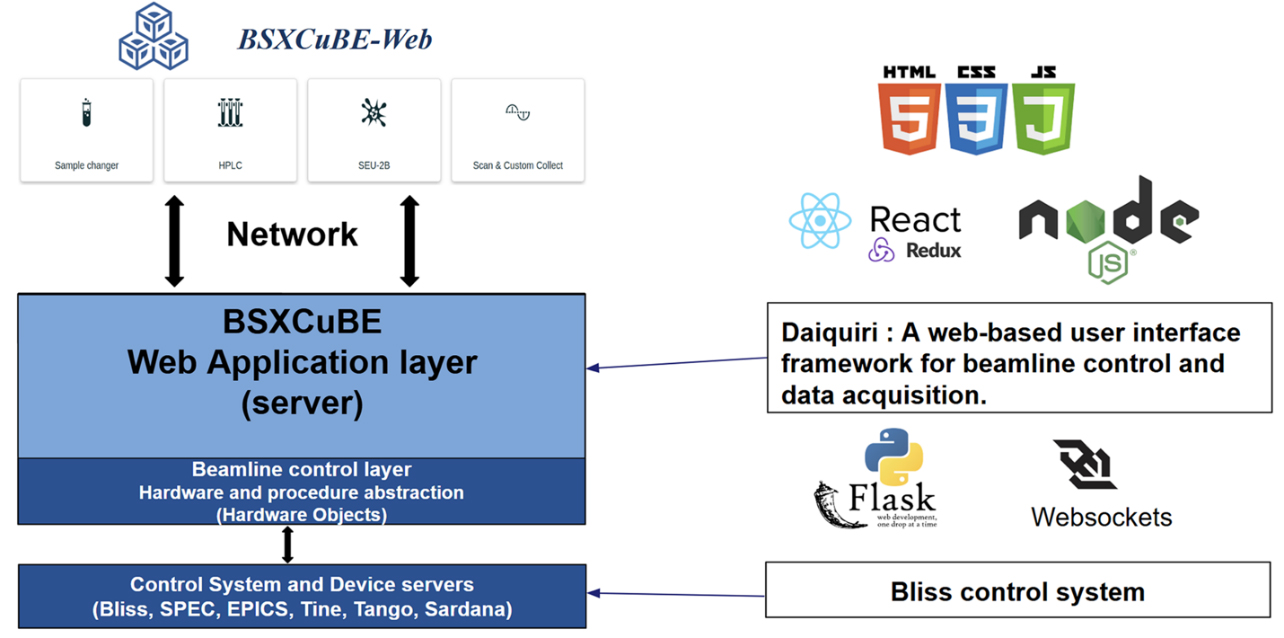
Developed through a close collaboration between the ESRF and EMBL Grenoble, the BioSAXS Customised Beamline Environment (BSxCuBE-Web) provides a modern, layered web-based architecture (Figure 1).
Click image to enlarge
Fig. 1: Schematic of the BSxCuBE-Web architecture and technology stack, showing the software components implemented in each layer.
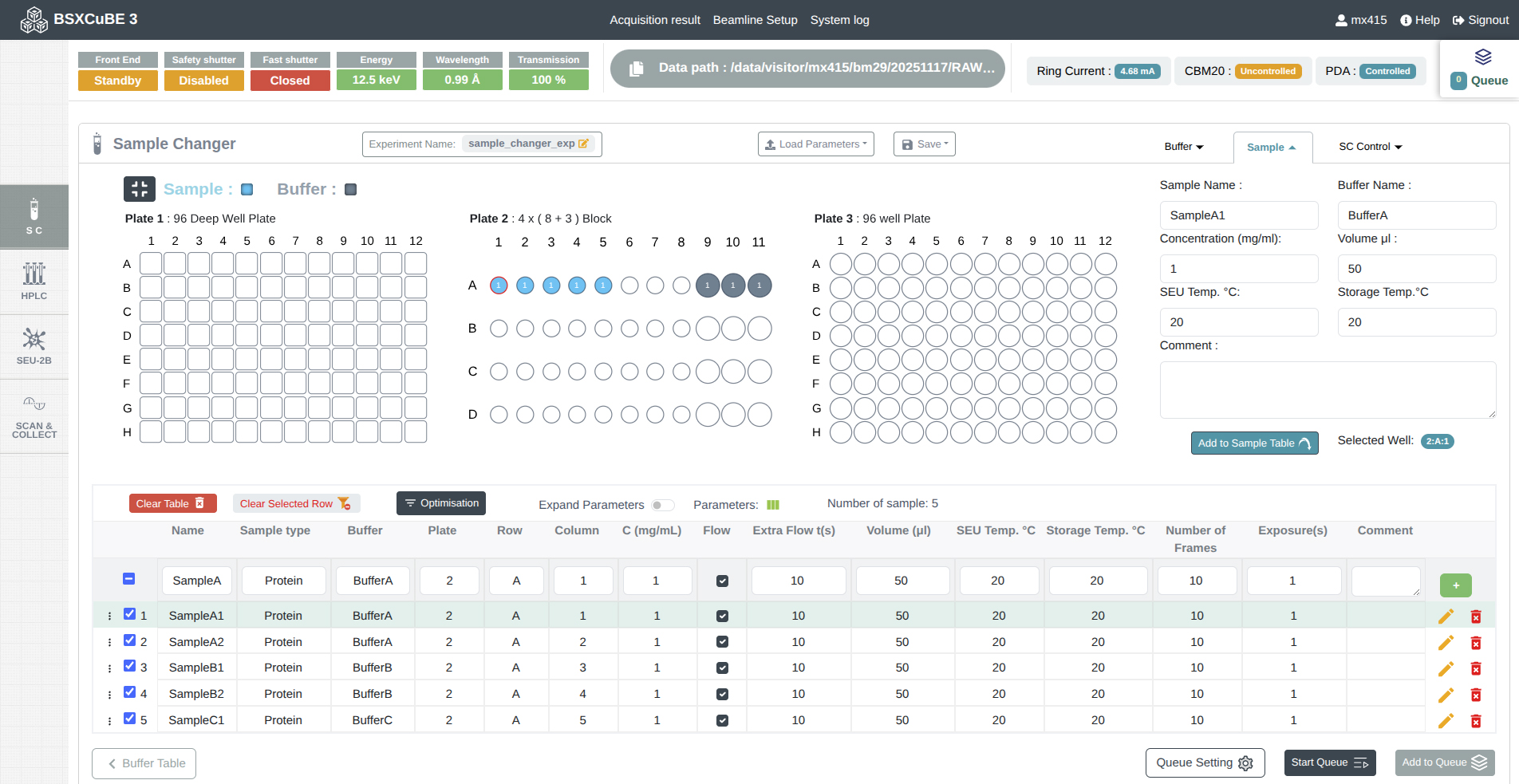
The front end utilises React and Redux to deliver an intuitive layout that visually mirrors the physical sample environments, such as the layout of the robotic sample changer (Figure 2).
Click image to enlarge
Fig. 2: The BSxCuBE-Web graphical user interface for batch data collection using the BioSAXS sample changer, designed to mirror the physical layout of the sample holders to enable intuitive automated queuing.
On the back-end, BSxCuBE-Web utilises the Daiquiri framework to interface securely with the ESRF-wide BLISS control system via a Flask REST API, using WebSockets for real-time synchronisation.
A central feature of BSxCuBE-Web is the dynamic queuing system, which enables unattended high-throughput data collection. Users can prepare sample batches, specify parameters, or even import entire experimental plans directly from JSON or CSV files. The queue incorporates robust error-handling mechanisms, such as skipping samples affected by local issues or pausing during transient events (e.g. beam loss), thereby maintaining continuous operation.
In addition to standard automated measurements, the platform integrates control of the Sample Exposure Unit 2B (SEU2B), allowing users to perform precise 2D spatial scans using piezo-driven stages and to coordinate CETONI microfluidic pumps directly from the browser. These capabilities enable advanced time-resolved studies of complex biological systems.
The impact
By isolating the complexities of hardware control from the user interface, BSxCuBE-Web improves experimental reliability and reduces the barrier for non-expert users. Immediate feedback is provided through an automated analysis pipeline driven by EWOKS and FreeSAS. Raw scattering curves undergo real-time processing, including background subtraction, Guinier fitting, and molecular weight estimation, allowing users to rapidly assess data quality and adjust acquisition parameters as needed.
Its web-based nature enables secure remote access – in 2025, the system supported 97 experiments involving 256 users. Furthermore, the Daiquiri middleware can interface with alternative control systems, making the open-source BSxCuBE-Web architecture adaptable and transferable to BioSAXS beamlines at other synchrotron facilities.
| Principal publication BSxCuBE-Web – a web application for BioSAXS high-throughput collection and experimental control. J.B. Florial et al., J. Synchrotron Rad. 33, 884-895 (2026); https://doi.org/10.1107/S1600577526003528 |
|
For more information on the ESRF-EMBL collaboration: https://www.embl.org/news/science-technology/working-together-to-facilitate-biosaxs-experiments/ Discover how BioSAXS at BM29 is helping scientists answer important biological questions, from understanding the immune system to improving future therapies: https://www.esrf.fr/home/news/general/content-news/general/controlling-the-brake-of-the-immune-system.html |
partners


European Synchrotron Radiation Facility - 71, avenue des Martyrs, CS 40220, 38043 Grenoble Cedex 9, France.