- Home
- News
- Spotlight on Science
- Unlocking legacy...
Unlocking legacy phosphorus in tropical soil
22-10-2025
Researchers used X-ray absorption spectroscopy at beamline ID21 to determine which species of phosphorus are available to maize crops in tropical soil. The results indicate that in some long-term management systems, phosphorus accumulates mainly as calcium-bound P, enhancing maize uptake over time. In contrast, phosphorus associated with iron and aluminium remains less available to plants. In addition, combining no-tillage soil management with reactive phosphate rock improved P-use efficiency, informing more sustainable fertiliser strategies in tropical agriculture.
Share
Phosphorus (P) is an essential element for plant growth and crop productivity. In many tropical soils (e.g., Brazil), total P content can be high, yet less than 3% is available to plants [1]. Farmers often apply large quantities of phosphate fertilisers, but only about half is absorbed by crops; the remainder accumulates as ‘legacy phosphorus’ – stored in organic and inorganic forms with varying bioavailability [2,3]. Identifying which legacy-P species crops can access is key to improve fertiliser efficiency and sustainability.
Which P species remain accessible to plants after years of fertilisation once inputs stop, and how do soil and phosphate fertiliser management practices influence their availability? This is difficult to resolve because legacy P occurs in several chemical forms (Ca-, Fe-, Al-bound, and organic) that conventional chemical fractionation methods cannot fully distinguish. Synchrotron-based P K-edge X-ray absorption near-edge structure (XANES) spectroscopy overcomes this limitation by directly identifying specific P species.
This study analysed a long-term field experiment on a Brazilian soil under continuous cultivation for 25 years – 17 years with phosphate fertilisation during maize and soybean rotations (35 kg ha⁻¹ yr⁻¹), followed by eight years of maize cropping without P inputs. Two soil management practices were compared: no-tillage and conventional tillage. Phosphate fertiliser was supplied as triple superphosphate or Gafsa reactive phosphate rock, applied either in the sowing furrow or broadcast. During the unfertilised period, maize relied entirely on legacy-P reserves.
Soil samples were examined using chemical fractionation, P K-edge XANES spectroscopy, and solution 31P-nuclear magnetic resonance to identify P species and their availability. At the ID21 beamline, enabled by the ESRF-EBS upgrade, rapid acquisition of high-quality XANES spectra, even at low P concentrations, allowed robust P speciation across treatments.
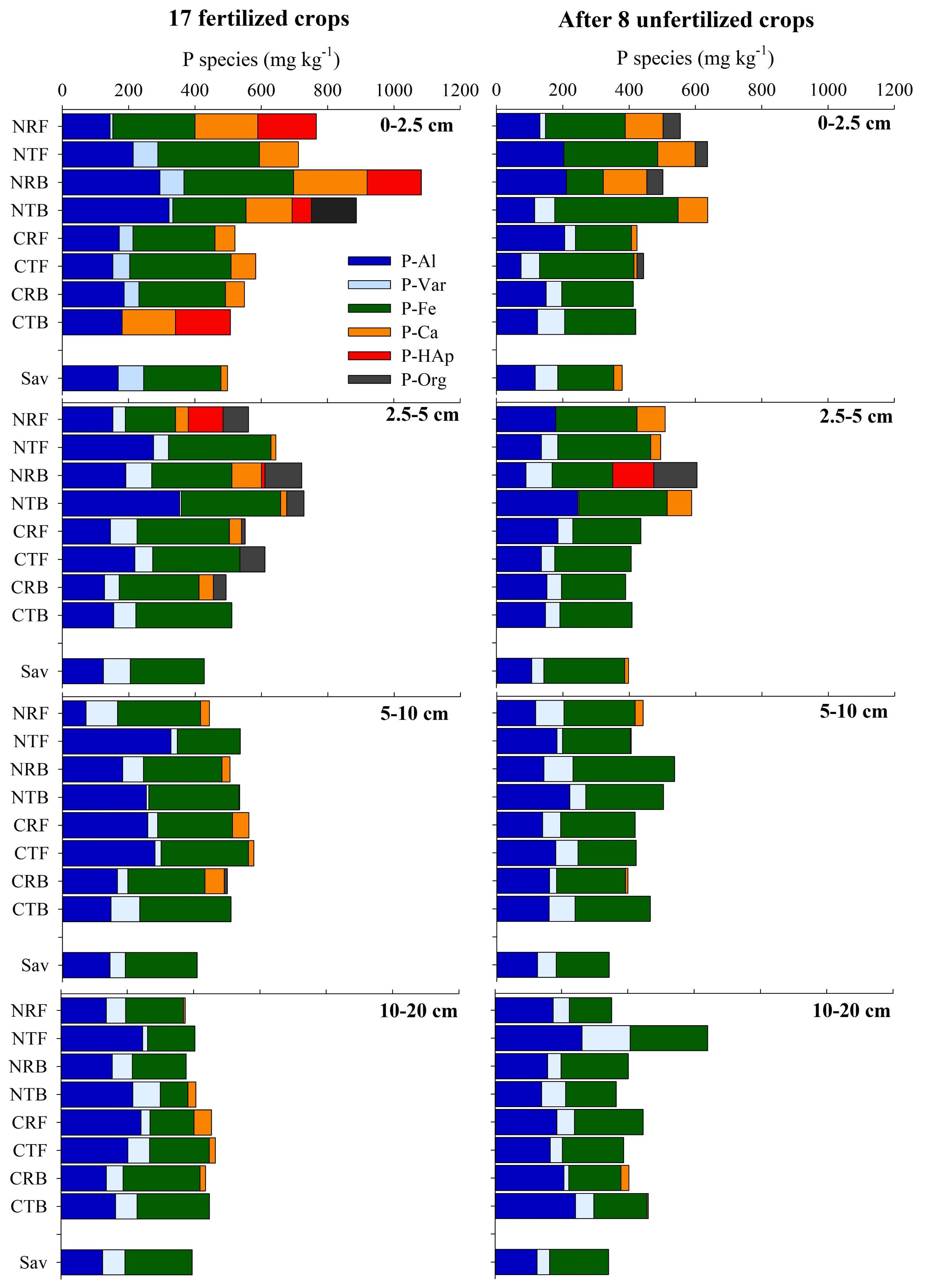
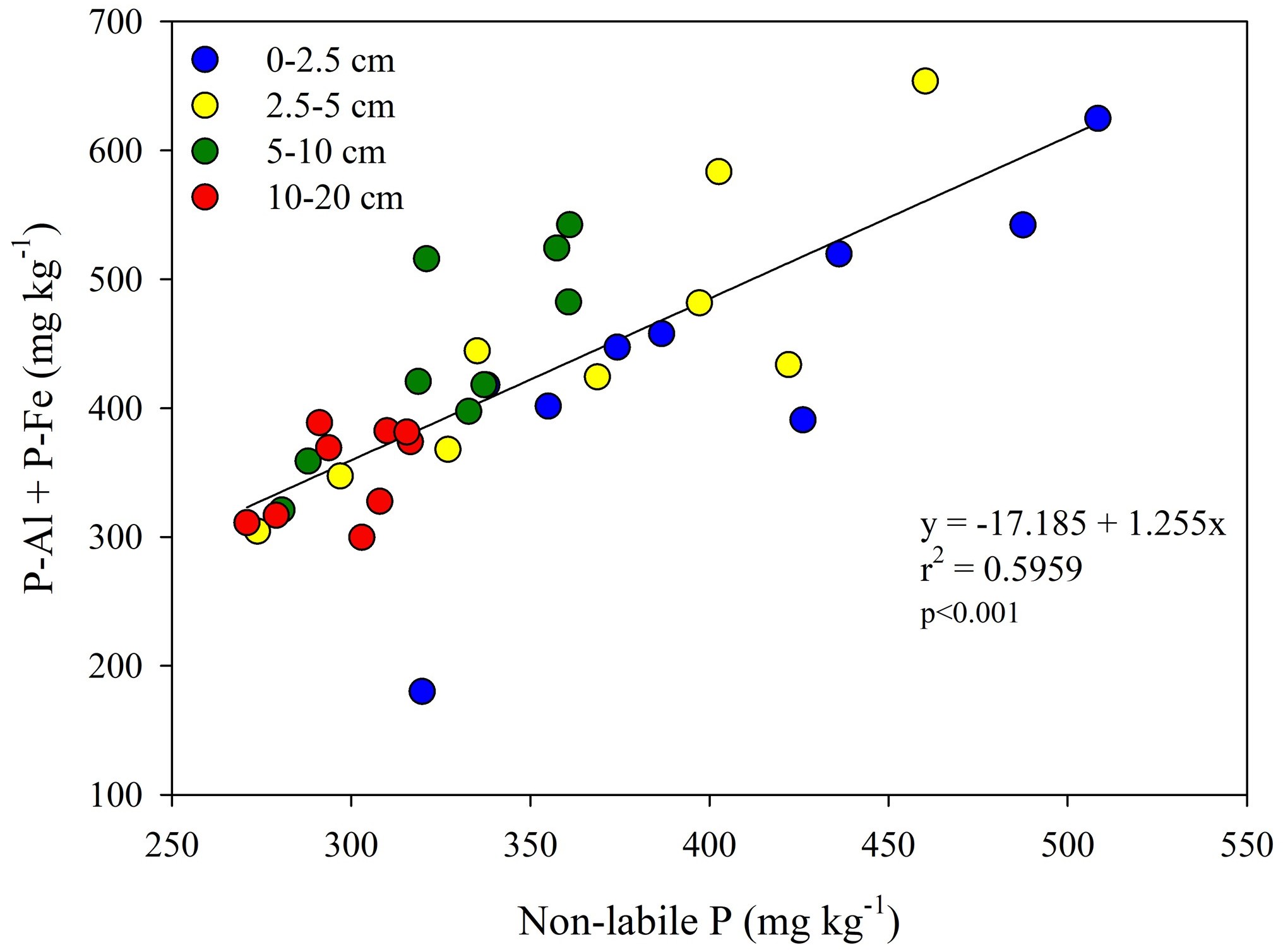
Linear combination fitting of the XANES spectra revealed that, after eight years without fertilisation, P accumulated mainly as Fe- and Al-bound species, while Ca-bound P decreased in relative proportion, particularly in surface layers. Under no-tillage combined with reactive phosphate rock, maize accesses Ca-bound P (dicalcium phosphate and hydroxyapatite), whereas conventional tillage retained more Fe- and Al-bound P (less available to plants) (Figure 1). A strong positive correlation between non-labile P (from chemical fractionation) and Fe + Al-bound P (from XANES spectroscopy) supported that these species dominate the non-labile P pool (Figure 2).
Click figure to enlarge
Fig. 1: Distribution of phosphorus species in soils after 17 years of fertilisation during maize and soybean rotations (35 kg ha⁻¹ yr⁻¹) followed by eight years of maize cultivation without P inputs. Soils were managed under no-tillage (N) or conventional tillage (C) and fertilised with triple superphosphate (T) or Gafsa reactive phosphate rock (R), applied in the sowing furrow (F) or broadcast (B). A native Savanna soil (Sav) was included as a reference. P forms identified: P-Al (Al-bound), P-Fe (Fe-bound), P-Ca (dicalcium phosphate), P-HAp (hydroxyapatite), P-Var (variscite), and P-Org (organic P, mainly inositol hexaphosphate).
Click figure to enlarge
Fig. 2: Relationships between non-labile P extracted by chemical P fractionation and iron (Fe)- and aluminium (Al)-bound P estimated by P-K-edge XANES spectroscopy in the soil sampled after 17 fertilised crops (35 kg ha−1 yr−1 of P).
Overall, these findings clarify which legacy-P species maize can access after prolonged fertilisation followed by cessation of inputs. They indicate that Ca-bound P acts as a key plant-available reserve, while Fe- and Al-bound P remain less accessible. No-tillage practices combined with reactive phosphate rock enhanced legacy-P use, providing guidance for more efficient, sustainable phosphorus fertiliser management in tropical systems.
Principal publication
Assessment of legacy phosphorus speciation under long-term tillage and phosphate fertilizer management in a tropical soil, L.F. Gotz, et al., Soil Tillage Res. 256, 1-12 (2026). https://doi.org/10.1016/j.still.2025.106877
| About the beamline: ID21 |
|
ID21 is dedicated to micro- and nano-X ray spectroscopy, offering 2D X-ray fluorescence (XRF) mapping and X-ray absorption spectroscopy (XAS) in the tender X-ray energy range (2.1 - 10.5 keV). These techniques can be combined to produce multi-energy XRF maps, enabling both 2D elemental mapping and chemical speciation in point (0D), line (1D), and area (2D) modes. The beamline is optimised for detecting and chemically analysing elements from phosphorus to zinc; heavier elements can also be studied via their L- and M-edges. Innovative beamline optics, including a next-generation double-crystal monochromator and advanced detectors, enhance beam stability, detection limits, and acquisition speed. Following a recent upgrade, ID21 now hosts two scanning X-ray microscopes. A newly installed nanoscope (nano-SXM) is optimised for high-resolution (down to 120 nm), high-speed nano-XRF mapping and nano-XAS, offering enhanced performance over the previous microscope. The original microscope has been retained and is now dedicated to larger samples, using micrometric and submillimetric beams. Both microscopes operate under vacuum and support room temperature and cryogenic measurements. |
partners


European Synchrotron Radiation Facility - 71, avenue des Martyrs, CS 40220, 38043 Grenoble Cedex 9, France.