- Home
- News
- Spotlight on Science
- Pressure and compositionally...
Pressure and compositionally driven pathway to a new hexagonal GeSn alloy class
26-11-2025
High pressure and compositional control were used to synthesise new Ge–Sn alloys, which were characterised using X-ray diffraction at beamline ID11. A previously unknown class of hexagonal Ge–Sn materials (2H, 4H, and 6H polytypes) was created and stabilised under ambient conditions. The results open a route to silicon-compatible, efficient, light-emitting materials for integrated photonic technologies.
Share
The challenge
The rapidly growing demand for information processing and electronic power requires novel materials capable of enhancing light-based data transmission. Modern technology continuously strives to pack more information into smaller spaces, often reaching extreme conditions – for example, very high temperatures are required for tin (Sn) to reach a plasma state and emit short-wavelength radiation suitable for producing ever-smaller patterns in silicon (Si), so that more information units can be integrated into a chip. However, this miniaturisation is approaching physical limits, and as circuit density increases, so does the energy required for cooling, particularly in high-performance computing and data centres.
Light-based communication offers a potential solution: it carries more information than electrical signals, owing to its higher frequencies, and dissipates less energy as heat because it avoids resistive losses in metallic interconnects. Yet the materials forming the backbone of electronics – cubic diamond-structured Si and its group-IVA counterparts, germanium (Ge) or SiGe – are inefficient light absorbers and emitters. Therefore, a key objective is to create materials that efficiently emit light, can be compositionally tuned, and are compatible with group IVA cubic diamond structures to enable seamless integration of optical and electronic functions on the same chip.
A volume-expanded hexagonal form of Ge has previously been predicted to exhibit superior light emission properties but was considered almost impossible to realise experimentally. A promising route involves incorporation of a larger element, Sn.
However, Sn does not react with Ge at ambient pressure and cannot readily be recovered in a hexagonal form under any known conditions. High pressures and temperatures are capable of altering phase relations and creating reactivity between elements, leading to previously inaccessible structures [1]. The challenge nonetheless lay in specifically stabilising a hexagonal GeSn alloy within a binary system where only cubic and tetragonal phases are known to form.
The experiment
The key to producing a binary GeSn phase with hexagonal symmetry is controlling whether a pressure-induced transformation is reversible or irreversible. Covalently bonded materials (such as Ge and SiO2) typically undergo irreversible transitions, whereas metallically bonded materials (such as Sn and iron) show reversible behaviour. Covalently bonded (sp3-hybridised) cubic diamond Ge (Fd-3m) transforms into a metallic tetragonal phase (I41/amd) near 10 GPa. Upon pressure release, electrons favour re-localisation in intermediate-energy covalent structures that impede reversal to the cubic phase. One such intermediate candidate phase has hexagonal symmetry.
By contrast, metallic Sn – already tetragonal (I41/amd) at ambient conditions – transforms reversibly to another tetragonal phase (I4/mmm) at about 10 GPa. Because electrons remain delocalised in both metallic phases, no intermediate covalent structures form, and the transition is easily reversible.
Pressure reduces the electronic and structural disparity between Ge and Sn, enabling the formation of Ge1-xSnx solid solutions, not otherwise formable. By carefully tuning pressure, temperature, and composition, the amount of Sn incorporated can be regulated. Below a threshold Sn concentration, back-transformation from tetragonal I41/amd Ge-Sn on decompression can produce a hexagonal P63/mmc phase. At and above this threshold, intermediate metastable candidate phases between the tetragonal and cubic phases are no longer options, resulting in the stable cubic Fd-3m form on recovery.
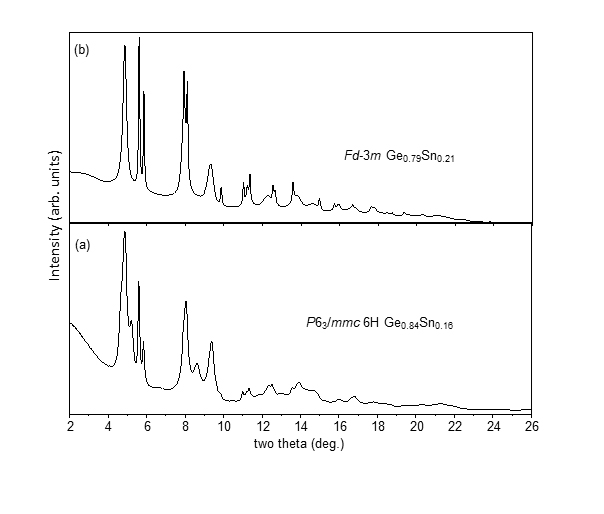
Fig. 1: Angle-dispersive X-ray diffraction patterns of (a) a hexagonal Ge-Sn solid solution (P63/mmc, 6H polytype) and (b) a cubic Ge-Sn (Fd-3m) solid solution, recovered from high-pressure and high-temperature experiments.
To test this, Ge and Sn were subjected to pressures of 9 – 24 GPa and temperatures up to 1500 K using large-volume press methods. Structural and chemical analyses were carried out using synchrotron angle-dispersive X-ray diffraction at beamline ID11 (Figure 1), precession electron diffraction (PED) (Figure 2), and electron microscopy. The experiments revealed the recovery of hexagonal 2H, 4H, and 6H Ge-Sn solid solutions (P63/mmc) at ambient pressure for compositions below 21 at% Sn, while higher Sn contents produced cubic (Fd-3m) solid solutions.
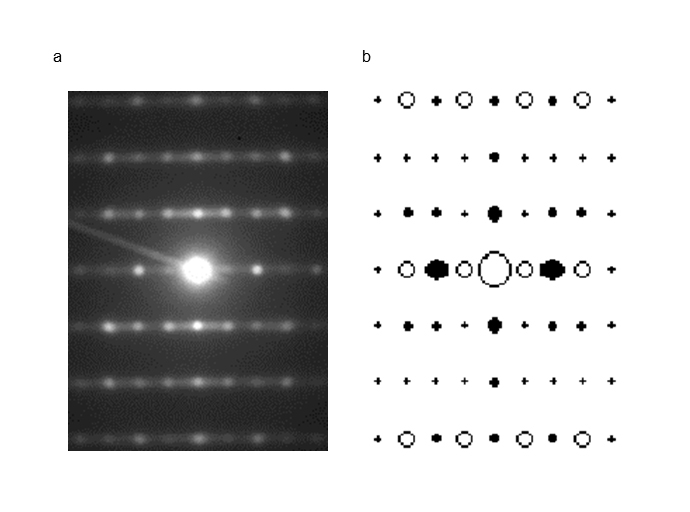
Fig. 2: (a) Experimental (PED) and (b) simulated zone-axis diffraction patterns of the [010] zone axis of a hexagonal Ge-Sn crystal (P63/mmc, 2H polytype) recovered from high-pressure and high-temperature conditions.
The establishment of a completely new hexagonal Ge-Sn landscape represents a significant advance in materials design. The structural versatility of this alloy system allows band-gap characteristics, lattice stability, and compatibility with Si and SiGe substrates to be tuned through both composition and crystal polytype. These properties make hexagonal Ge–Sn alloys promising candidates for efficient, Si-compatible light-emitting materials – critical components for on-chip optical interconnects and next-generation optoelectronic devices.
Beyond the specific case of Ge–Sn, this work demonstrates a general strategy for creating novel materials by coupling pressure-induced reactivity with compositional control. The ability to kinetically direct phase recovery and stabilise new crystal symmetries provides a powerful route towards targeted materials design with tailored electronic and optical functionalities.
Principal publication
High Pressure and Compositionally Directed Route to a Hexagonal GeSn Alloy Class, G. Serghiou et al., J. Am. Chem. Soc. 147, 38413-38418 (2025); https://doi.org/10.1021/jacs.5c11716
References
[1] G. Serghiou et al., J. Am. Chem. Soc. 143, 7920-7924 (2021).
| About the beamline: ID11 |
| Beamline ID11 specialises in high-energy X-ray diffraction (XRD) and imaging for materials science. The beamline has been upgraded with the addition of a nano-resolution station located 100 metres from the source, enabling diffraction measurements with very high spatial resolution (< 100 nm). ID11 offers a comprehensive suite of X-ray diffraction techniques, including 3DXRD, diffraction contrast tomography, diffuse X-ray scattering, imaging, pair distribution function (PDF) analysis, and powder diffraction. The beamline supports the analysis of a wide range of samples, from amorphous and powder materials to polycrystals and single crystals with sample size ranging from nano- to micro- to larger-scale specimens. |
partners


European Synchrotron Radiation Facility - 71, avenue des Martyrs, CS 40220, 38043 Grenoble Cedex 9, France.