- Home
- News
- General News
- Alexandra Pacureanu...
Alexandra Pacureanu gets Wellcome Discovery Award in collaboration with the Francis Crick Institute
27-10-2025
ESRF scientist Alexandra Pacureanu is the recipient of the Wellcome Discovery Award, together with a team at the Francis Crick Institute, to develop X-ray nanoimaging technology to study the mechanisms of information processing in the neural circuits of olfaction.
Share
The grant, worth £3.9 million shared between the two institutions, will support computational research in X-ray nanotomography and coherent X-ray imaging, sample preparation and data analysis developments, and the study of how neural circuits transform sensory information in the mouse olfactory system.
The team will aim to accurately link neuronal activity with comprehensive cell connectivity, and to uncover how smells are represented in the brain and how the olfactory bulb transforms the sensory signals.
The project has two overarching aims: to develop X-ray nanoimaging technology for connectomics (ESRF leadership) and to apply the technology to uncover the neural circuit mechanisms of odour representation (Francis Crick Institute leadership). Alexandra Pacureanu is leading the ESRF team and Andreas Schaefer is leading the Francis Crick Institute team.
Pacureanu says: “Both the X-ray microscopy and the connectomics fields are at a turning point. The implementation of the 4th generation synchrotron sources makes possible groundbreaking advances in coherent X-ray imaging, in terms of achievable spatial resolution and scalability. Recently generated landmark brain wiring diagrams in the fruit fly are already revolutionizing neuroscience. Great leaps in advancing machine learning concepts are opening the way towards automated analysis of these large, and complex, image datasets.”
And she adds: “Thanks to this Wellcome Discovery Award, we will be able to work on pushing the limits of coherent X-ray microscopy and its application to the connectomics field to the next level, in order to uncover the mechanisms of brain information processing.”
The ESRF funding will cover the X-ray nanoimaging developments for large scale connectomics, including machine learning based data analysis methods. These developments are in line with the vision for the new nanoimaging beamline ID18. Alexandra Pacureanu’s group works in close collaboration with the ID16A and ID18 teams, led by Peter Cloetens.
Link to the X-ray Nanoscale Neuroimaging Group page
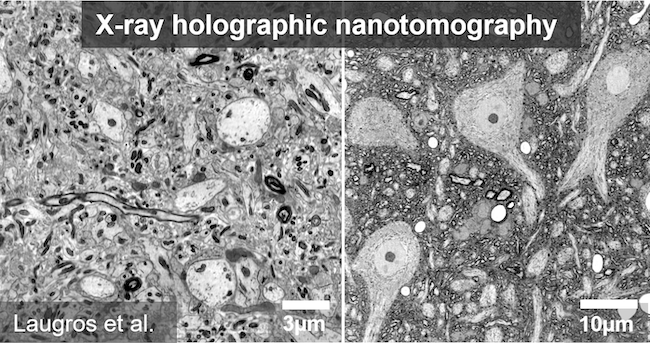
Figure caption:
X-ray holographic nanotomography (XNH), developed at the ESRF, enables 3D imaging of large biological tissue volumes at the nanoscale. Details from XNH volumes of neuronal tissues imaged with voxel sizes of 15 nm and 30 nm. The images were acquired at the ID16A beamline.
partners


European Synchrotron Radiation Facility - 71, avenue des Martyrs, CS 40220, 38043 Grenoble Cedex 9, France.