- Home
- Users & Science
- Find a beamline
- Collaborating research group beamlines
- BM07 - FIP2 - French Beamline for Investigation of Proteins
- Beamline Layout & Instrumentation
Beamline Layout & Instrumentation
Optical layout
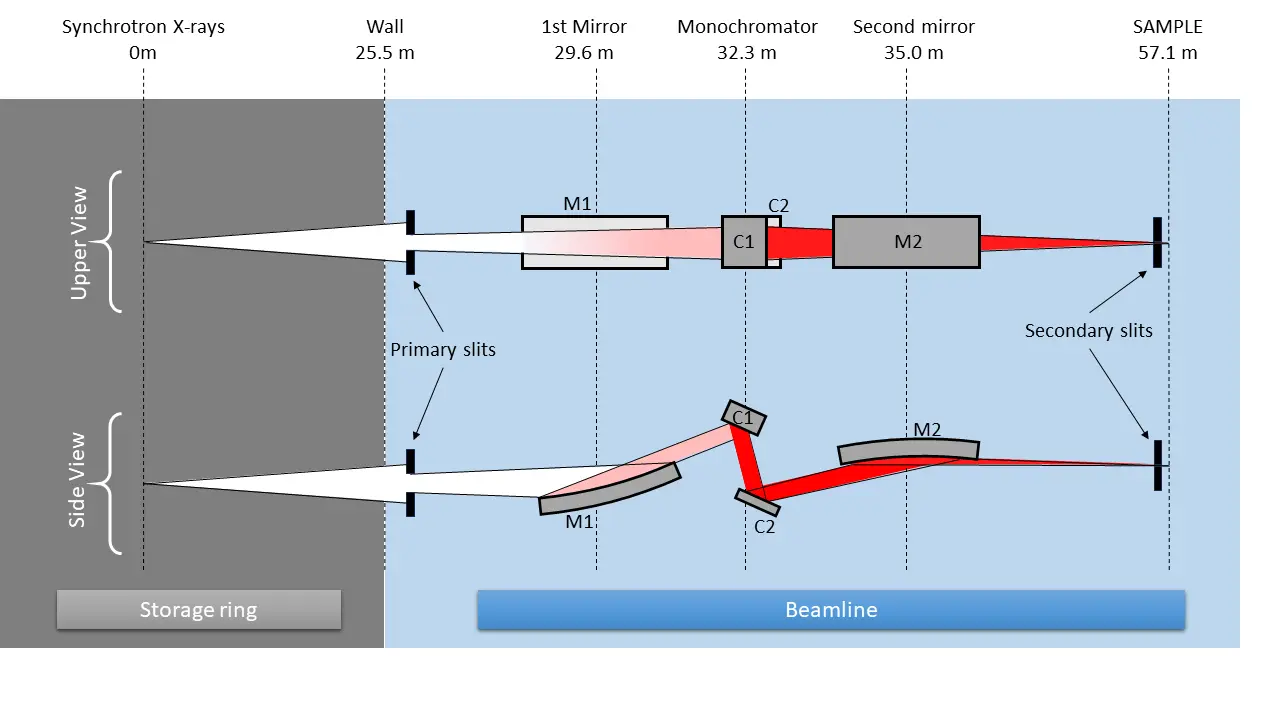
A first mirror rejects high energies and collimates the beam (mirror is 1.3 m long with Rhodium coating). The monochromator is at fixed exit and composed of 2 Si111 crystals. The second crystal can bend to make the sagittal focusing. The second mirror is facing down and brings the beam back to horizontal (mirror is 1.3 m long with Rhodium coating).
The beam size is adjustable from 0.1x0.1 mm² to 0.3 x 0.3 mm². The usual size is typically 0.25 x 0.25 mm²
Instrumentation
The detector is a Dectris Pilatus 3 6M
Sample changer: Flex-HCD design (EMBL + ESRF). Can host up to 18 unipucks
Diffractometer: Aerotech translation and rotation stages. Horizontal axis for spine loops collection. Vertical axis for heavy systems such a High Pressure Cell
UV-VIS spectrometer: 2 reflective optics with SMA ports can be automatically introduced to perform in-line absorption measurements.
Cryo stream: Oxford 1000 cryostream to keep sample at cryo temperature. Temperature can be adjusted from 77 to 300 K.
Humidity controlled air stream: 2 systems are available for room temperature measurements under high humidity streams: HC-Lab (Arinax) and a new design based on a Cellkraft P-10A system for temperatures up to 50°C.
X-Ray flux diode: A calibrated Canberra PD300-500CB diode is available for monitoring of the total X-ray flux and dose computation.
Nano droplet injector: an injector is available on request for injection of chemicals. Droplet size from 10 nL.
In-line light injection: 2 SMA ports are available for visible light injection through the On-axis viewer (OAV). Usually, one port is used for light injection and the second for fluorescence signal measurement.
High Pressure cell: on demand, high pressure cell measurements can be performed, using the vertical goniometer axis.
Sample preparation
A preparation room at 20°C is available for the sample preparation. It includes:
- Leica microscopes with cold light sources.
- cryo-tools (crystalcap HT, crystalwand magnetic), foam bowls, gloves and other accessories for samples flash freezing and handling.
- ESRF-EMBL standard baskets (UNIPUCK) for the FIP sample changer robot.
- A high pressure cell (up to 15 bars). It can be used to introduce in your crystal Krypton gas (the only one available on the beamline) or any non hazardous gaz (bring a bottle with you) prior to freezing. It requires that crystals are mounted on Hampton CrystalCap Copper.
- A 4°C fridge and a -20°C freezer.
- A 20°C vibration-free incubator for crystallization trays storage.
No chemical solvent, heavy atom salt, gas or acid are available. So bring any solution you may need with you, and do not forget to get it back at the end of the experiment as well as crystals. Special yellow bins are provided for specific waste (biological matters, sharp and pointed tools, needles, …….).
Sample mounting
Frozen samples must be stored in UNIPUCK baskets. They are placed in the sample changer Dewar (17 baskets at a time, although more than 10 unipucks per 24 hours is not realistic) for automated mounting with the Flex-HCD sample changer.
Room temperature samples can be mounted by hand (the goniometer head retracts for easy access)
partners


European Synchrotron Radiation Facility - 71, avenue des Martyrs, CS 40220, 38043 Grenoble Cedex 9, France.