- Home
- News
- General News
- A new kind of metal...
A new kind of metal with unique light-converting powers
22-09-2025
Using high-pressure X-ray diffraction at ESRF beamlines ID15B, ID11, and ID27, researchers have found a metal that combines electrical conductivity with internal polarity, enabling it to perform second harmonic generation – an optical trick usually reserved for non-metals.
Share
An international team of scientists from Germany, Sweden, the UK, and the ESRF have discovered an unusual material, magnesium chloride (Mg3Cl7) that defies the usual rules of metals.
Unlike ordinary metals, which conduct electricity using a “sea” of free electrons from their metal atoms, Mg3Cl7 conducts through electrons provided by chlorine ions, making it an anionic metal. This surprising mechanism weakens the normal electrical screening found in metals and allows the crystal to maintain a permanent internal separation of charges – a property known as polarity.
Even more remarkably, this polar metal does more than just conduct: when light shines on it, the material emits light at twice the frequency, a technologically valuable optical effect. The rare coexistence of metallicity, polarity, and frequency-doubling optics in a single compound could pave the way for advances in next-generation electronics, sensors, and energy technologies.
“It is very exciting that we have discovered a metal that not only conducts electricity but also emits light in unexpected ways,” explains Yuqing Yin, scientist at the University of Bayreuth in Germany and first author of the study. “Such a combination is extremely unusual in nature and offers completely new perspectives for designing materials with multifunctional properties.”
The discovery was made under high pressure inside a diamond-anvil cell – an instrument capable of generating pressures comparable to those deep inside planets. Using intense synchrotron X-ray beams at ESRF beamlines ID15B, ID11, and ID27, the team was able to determine the crystal structure of Mg3Cl7 in situ, as it exists only under extreme conditions. “Thanks to the enhanced brilliance of the EBS source, we were able to collect high-quality diffraction data from the microcrystalline samples and solve the structure of Mg3Cl7,” explains Yuqing Yin.
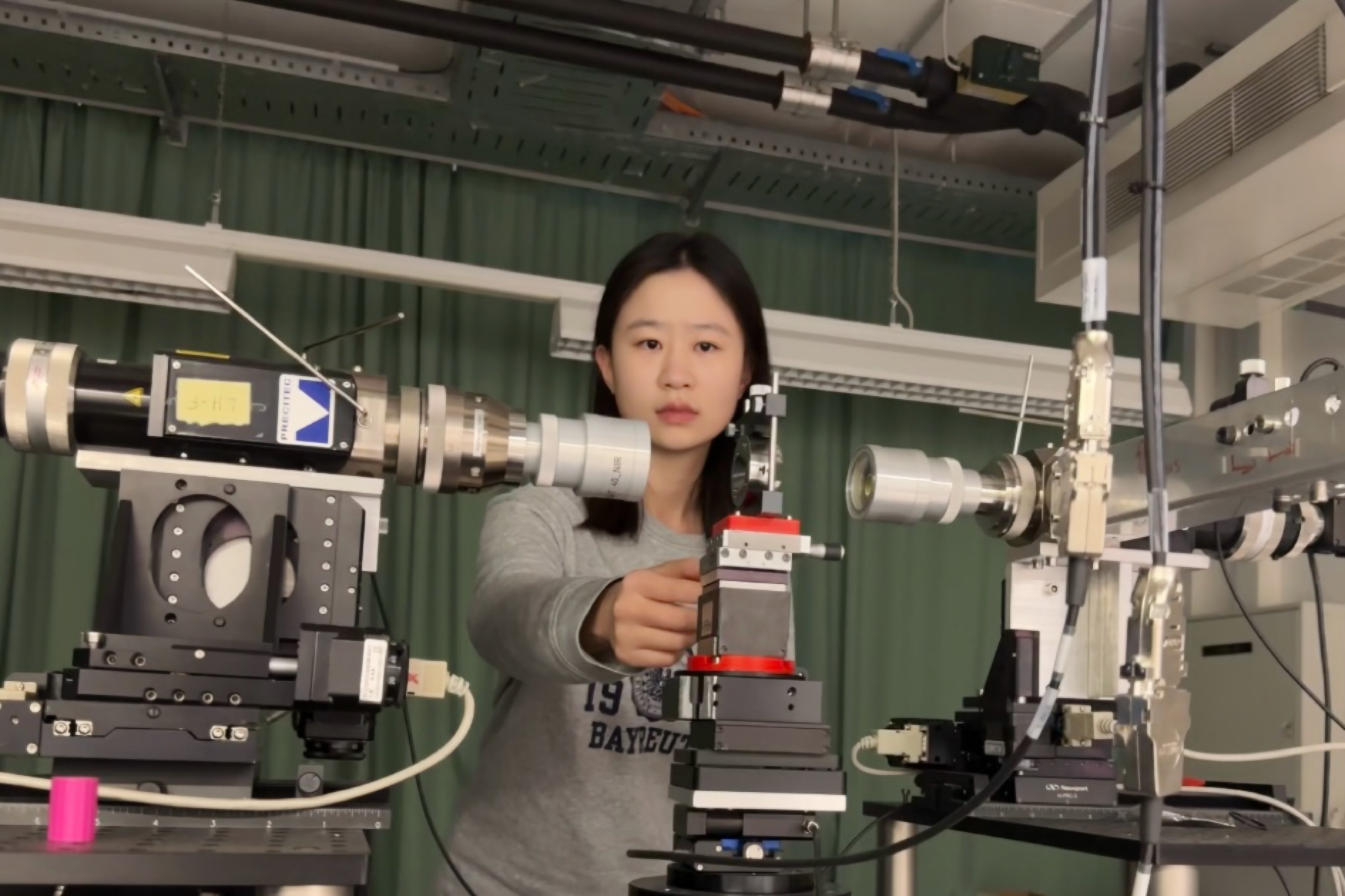
Fig. 1: Yuqing Yin mounting a diamond anvil cell on the laser-heating setup. Credit: Y. Yin
“Successfully obtaining single-crystal diffraction data from microcrystalline grains requires combining the exceptional performance of the EBS source with state-of-the-art beamline capabilities, such as submicron X-ray focusing, precise sample alignment, and advanced diffraction detection. These breakthroughs have only recently become possible, and this newly discovered polar metal serves as an excellent example,” adds Gaston Garbarino, ESRF scientist at beamline ID15B. Additional experiments were carried out by the researchers at the synchrotron Petra III in Hamburg, Germany.
Although the material cannot yet be produced in industrial quantities, the finding opens the door to a new class of materials that merge metallic conductivity with optical nonlinearity. Such polar metals could one day find use in advanced photonics, quantum devices, or energy technologies.
“We are only at the beginning,” notes Leonid Dubrovinsky, professor at the University of Bayreuth and senior co-author of the publication. “This compound is unlikely to be made on a large scale today, but the principles we uncovered show us new ways of thinking about chemistry and materials design. Our work demonstrates that even very simple elements like magnesium and chlorine can, under the right conditions, form completely unexpected structures with unique properties.”
The study highlights how high-pressure research continues to reveal the surprising behaviour of seemingly ordinary elements and compounds. By pushing materials beyond the limits of everyday chemistry, scientists are uncovering new rules – and new possibilities – for the design of functional materials of the future.
Reference:
Y. Yin et al., High-Pressure Mg3Cl7 Synthesized in a Diamond Anvil Cell as a Polar Metal with Second-Harmonic Generation, J. Am. Chem. Soc. 147, 36, 32591-32599 (2025); https://doi.org/10.1021/jacs.5c07812
Top image: Schematic illustration of the discovery: a new magnesium chloride phase with unusual composition, Mg₃Cl₇, synthesised in a laser-heated diamond anvil cell under high pressure and temperature, was identified as a polar metal exhibiting second-harmonic generation (SHG). Figure courtesy of Y. Yin
partners


European Synchrotron Radiation Facility - 71, avenue des Martyrs, CS 40220, 38043 Grenoble Cedex 9, France.