New deposition method unlocks higher X-ray reflectance in ultra-short-period multilayer mirrors
W/SiC multilayer mirrors grown by High-Power Impulse Magnetron Sputtering (HiPIMS) have achieved up to 79% reflectivity at 40 keV. Compared with conventional direct-current magnetron sputtering (dcMS), HiPIMS reduces interfacial roughness by a factor two, enhancing the performance of hard X-ray reflective optics. Reflectivity measurements were performed at ESRF beamline BM05.
Share
Multilayer mirrors with ultra-short periods of around one nanometre are essential components for high-resolution X-ray applications, including synchrotron and free-electron laser instrumentation, plasma diagnostics, and astrophysics. Their performance, however, is severely limited by interfacial roughness at the sub-nanometric scale. As the multilayer period decreases, roughness and interdiffusion significantly reduce both reflectivity and bandwidth.
Several interface-engineering strategies have been explored, including ion-assisted deposition and interface nitridation, but these approaches are generally complex, costly, or unsuitable for large-scale optical fabrication. To clarify the experimental conditions described below, the present comparative study used multilayers with a period of about 3 nm for process benchmarking, while the HiPIMS approach targets periods down to ~1 nm.
High-Power Impulse Magnetron Sputtering (HiPIMS) offers a promising alternative. By generating short, high-power pulses that create a dense, highly ionised plasma, HiPIMS improves film density and modifies the microstructure. This study demonstrates the effectiveness of HiPIMS in producing ultra-short-period W/SiC multilayer mirrors with smoother interfaces, addressing the long-standing challenge of achieving high reflectance in the hard X-ray domain.
HiPIMS was used to fabricate ultra-short-period W/SiC multilayers exhibiting significantly improved interface quality. Comparative studies between direct current magnetron sputtering (dcMS) and HiPIMS depositions were carried out at Laboratoire Charles Fabry using W/SiC multilayers comprising 40 periods with a d-spacing of about 3 nm (comparative stack). Absolute reflectivity measurements were performed at ESRF beamline BM05 (40 keV) and the BESSY II BAMline (30 keV).
HiPIMS reduced interfacial roughness from approximately 0.4 nm to 0.2 nm, confirmed by X-ray reflectometry and diffuse scattering, while simultaneously increasing material density contrast.
The method is fully compatible with existing dcMS systems, requiring only the addition of a pulsing unit, making it both scalable and straightforward to implement for advanced X-ray mirror fabrication.
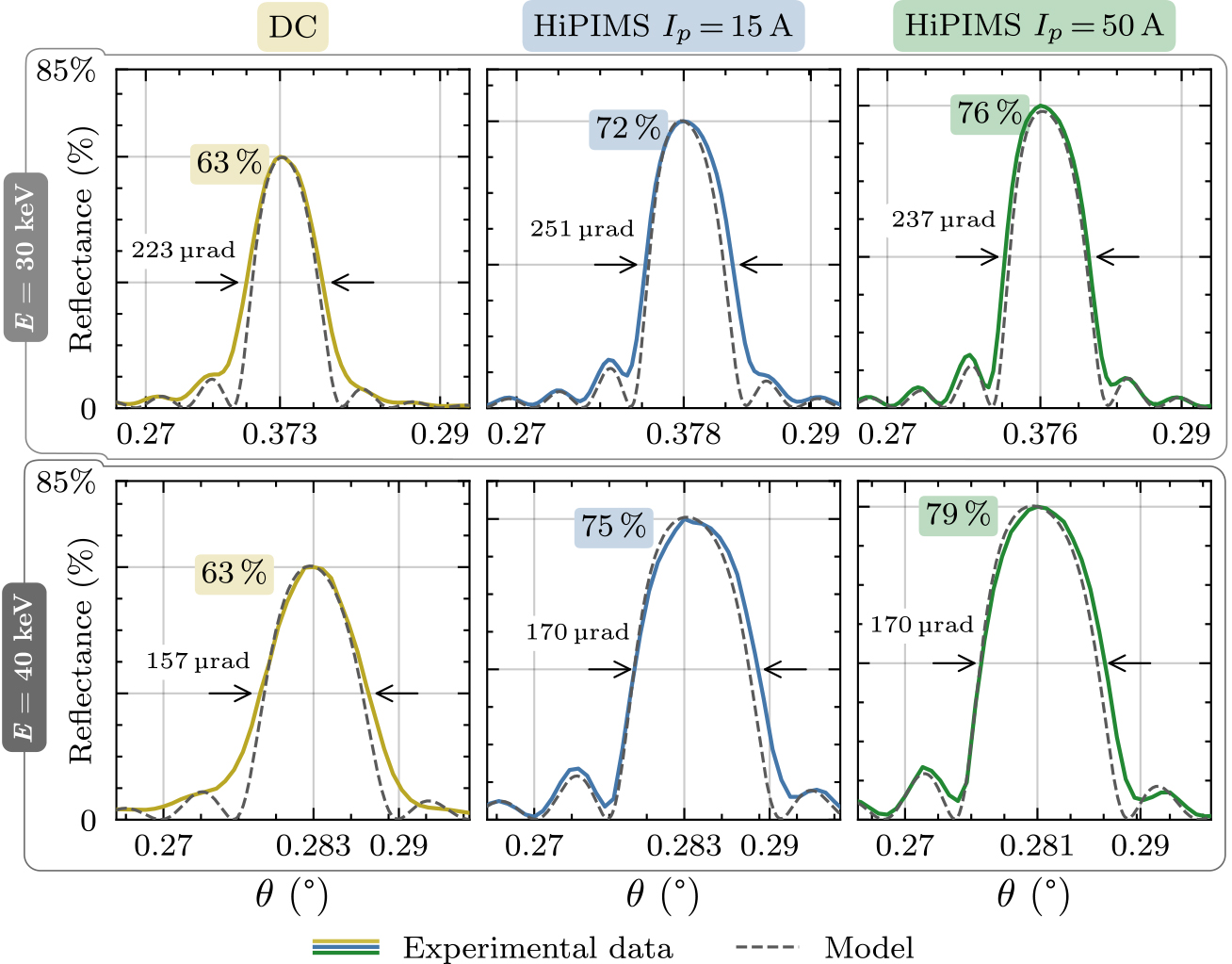
As a result, the peak reflectivity rose from 63% (dcMS) to 79% (HiPIMS) at 40 keV (Figure 1), approaching theoretical limits. In addition, HiPIMS-deposited mirrors exhibited a broader angular bandwidth, improving both the field of view and flux throughput in reflective optical systems.
Click image to enlarge
Fig. 1: Reflectivity measurements at 30 keV (top) and 40 keV (bottom) of the first Bragg peak for three samples (left column: dcMS; middle column: HiPIMS with peak current of 15 A; right column: HiPIMS with peak current of 50 A). Peak reflectivity (Rpeak) and angular full width at half maximum (FWHM) are indicated in each graph. Dashed lines represent the fitting model.
This development represents a significant advance in the deposition of nanometre-scale multilayers for hard X-ray optics. By halving interfacial roughness and enhancing reflectivity, HiPIMS extends the accessible energy range of multilayer mirrors and supports the design of next-generation reflective elements for high-energy applications. The resulting gains in reflectivity and bandwidth are particularly advantageous for imaging, spectroscopy, and plasma diagnostics at tens of keV.
Given its compatibility with existing sputtering infrastructure and its demonstrated reproducibility, HiPIMS offers an attractive route for the large-scale production of high-performance mirrors. Beyond W/SiC systems, the technique opens new perspectives for optimising other multilayer material combinations.
Principal publication
HiPIMS deposition method unlocks higher X-ray reflectance in ultra-short-period multilayer mirrors, C. Nannini et al., Optics Lett. 50(21), 6513-6516 (2025); https://doi.org/10.1364/OL.571400
partners


European Synchrotron Radiation Facility - 71, avenue des Martyrs, CS 40220, 38043 Grenoble Cedex 9, France.