Digital twin enables X-ray Raman imaging of sensitive organic samples
As part of a long-term ESRF project, researchers have optimised the acquisition conditions for X-ray Raman spectral imaging, enabling a tenfold reduction in dose. This paves the way for advanced studies of photosensitive samples using photon-demanding X-ray techniques.
Share
X-ray Raman scattering (XRS) enables chemical speciation deep within materials, including low-Z elements, which are often inaccessible to conventional soft X-ray techniques. However, the low efficiency of the inelastic X-ray scattering process requires high-intensity fluxes, putting sensitive samples – particularly organic materials – at risk. For this reason, XRS imaging has so far been limited to samples not susceptible to photochemical or photophysical alterations under prolonged irradiation.
While conventional measures, such as cryogenic cooling, can reduce radiation damage, researchers have now explored an alternative route through statistical optimisation of acquisition conditions, taking advantage of the unique 3D imaging setup on the ID20 beamline.
A digital twin of an XRS imaging experiment was developed to determine acquisition parameters that minimise the dose on the sample (Figure 1). The tool was focused on collecting the minimal data required to differentiate between the different materials in paint stratigraphy. For each configuration and sample, the tool calculates an optimised energy grid in real time, leading to better phase classification than grids defined by conventional criteria.
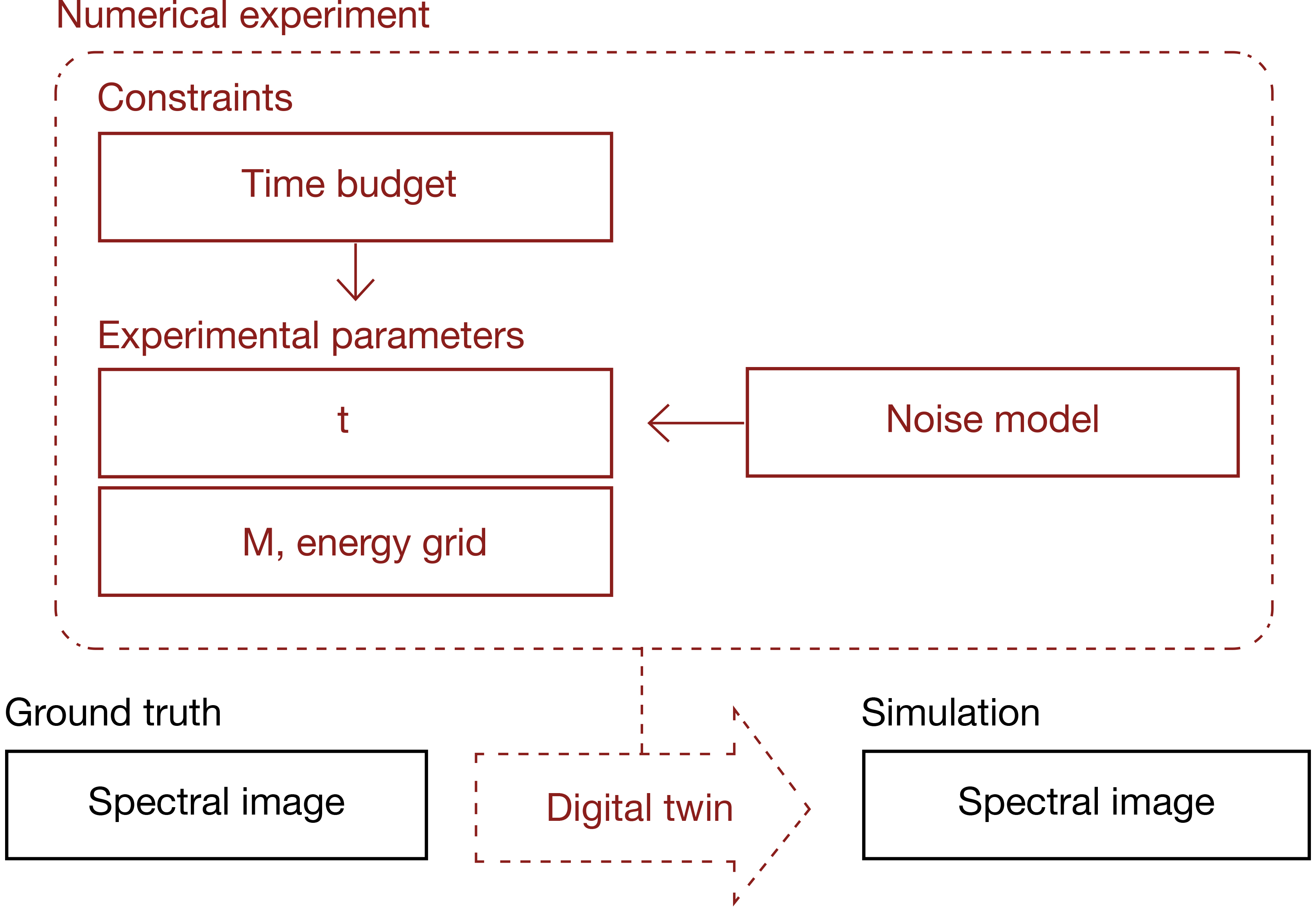
Fig. 1: Schematic representation of the digital twin used in the simulation and optimisation of experimental acquisition parameters.
A key conclusion from this study is that, for constant irradiation times with a fixed incident flux, multispectral imaging (using an optimally selected discrete energy grid) delivers superior segmentation performance compared to traditional hyperspectral data collection (Figure 2). The approach enables rigorous selection of scanning parameters directly on the beamline, making bulk carbon speciation possible in sensitive organic samples.
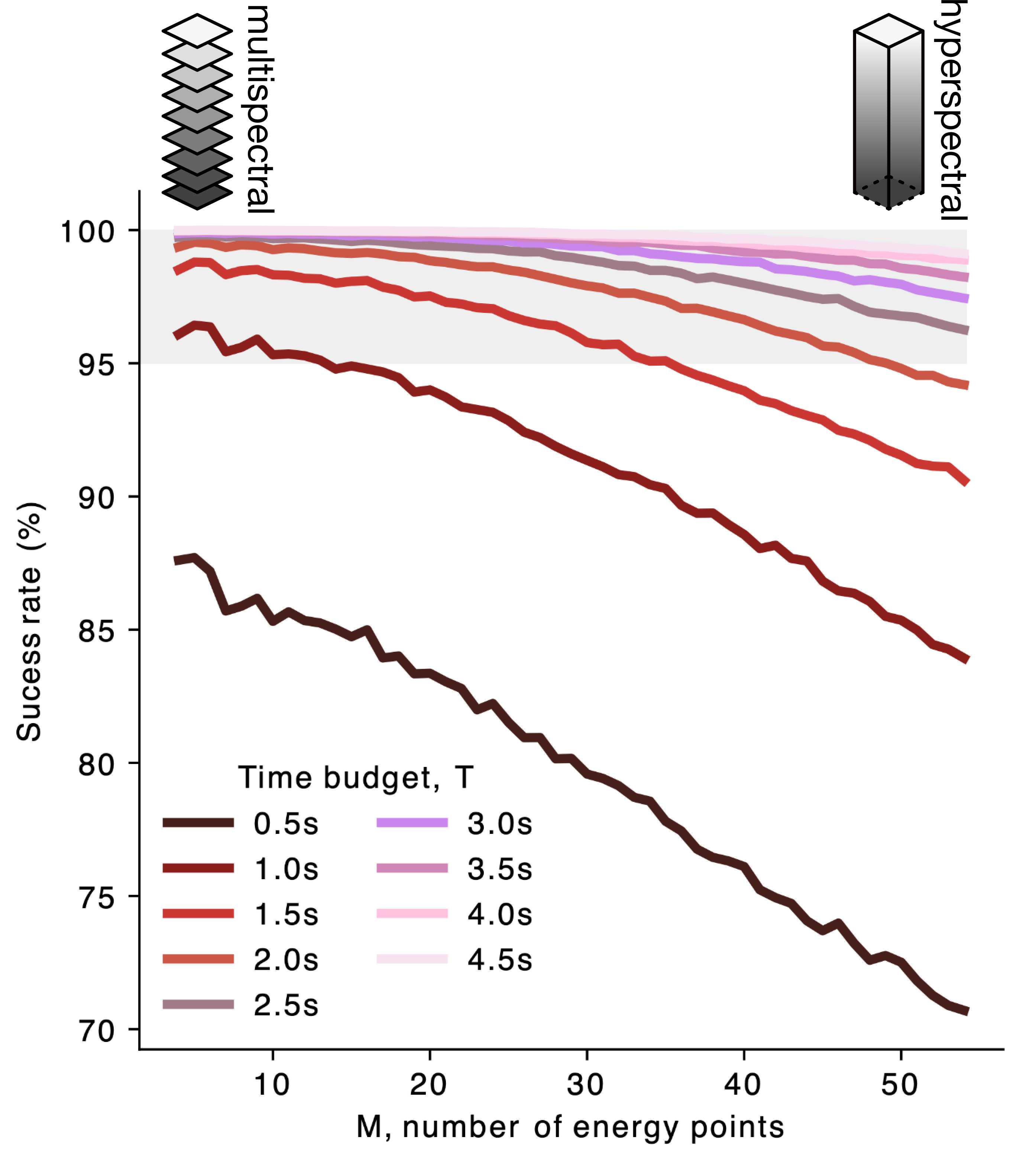
Fig. 2: Success rate as a function of number of energy points (M) and total acquisition time. Optimal energy grids combined with mean filtering were used as the framework for phase recovery. The resulting curves represent the average of 100 numerical experiments for each value of M. The grey area indicates the region where the success rate exceeds 95%.
This tool was created through a collaboration between ENS Paris-Saclay, CNRS, ESRF, and the University of Helsinki, as part of the ESRF Long-Term Project aimed at establishing a user platform for XRS imaging in cultural heritage research. Funding came from the European Commission’s GoGreen project, which develops new methodologies for studying heritage materials.
By combining real-world experimentation with the synthetic capabilities of a digital twin, researchers can now perform experiments once considered impossible. Its implementation on the ID20 beamline will open the door to novel XRS studies on beam-sensitive samples in fields ranging from biology to environmental sciences and cultural heritage.
The same approach can also be applied to radiation-resistant samples, either to further adhere to the ‘as low as reasonably achievable’ principle or to optimise experimental time by increasing the number of samples scanned during a beamtime session. The software, developed and implemented at ID20, will gradually be made available to international users at other facilities, in line with ESRF’s tradition of pioneering developments supported by its innovative data policies.
Principal publication
Digital twin enables radiosensitive organic speciation in 3D, L. Cazals et al., Sci. Adv. 11, 14 (2025); https://doi.org/10.1126/sciadv.adw5444
partners


European Synchrotron Radiation Facility - 71, avenue des Martyrs, CS 40220, 38043 Grenoble Cedex 9, France.