A new catalytic reactor for in situ and operando high-energy X-ray scattering studies
A new reactor has been designed at the ID31 beamline to enable the investigation of catalysts under realistic operating conditions, with a modular design that allows measurements at different positions within the catalyst bed.
Share
The investigation of catalytic reactions under real, industrially relevant operating conditions remains challenging because of the combined requirements of elevated temperatures and pressures, liquid and/or gas flow, and technique-specific experimental constraints.
To address these challenges, an industrial-scale reactor for in situ and operando X-ray scattering studies has been developed at the ID31 beamline, allowing the effects of temperature, pressure, mixed liquid–gas flow, catalyst-bed position, and catalyst treatments to be investigated.
Developed in collaboration with the ESRF Sample Environment Group and the company Hydrogenious, the reactor enables studies of catalyst structure during the dehydrogenation of liquid organic hydrogen carriers (LOHCs), providing direct insight into reaction pathways, catalyst evolution, and long-term stability under realistic operating conditions.
The system can reach temperatures and pressures relevant to LOHC dehydrogenation processes while providing a reactor volume significantly larger than that of conventional synchrotron and laboratory reactors, thereby reducing the mass-transport and kinetic limitations often encountered in smaller systems.
With a volume of 500 mL and a total length of 750 mm, it is designed to combine X-ray scattering measurements with gas and liquid analyses, providing both structural information on the catalyst and detailed information on the catalytic reaction under investigation.
The reactor has been tested under operating conditions at temperatures of 260–320°C and pressures of 1–5 bar using a Pt/Al₂O₃ model catalyst. Its flexible mounting system allows investigation of the catalyst at different positions along the bed, including near the inlet, at the centre, and near the outlet. This capability enables the influence of reactor position on catalyst structural evolution during operation to be studied (Figure 1).
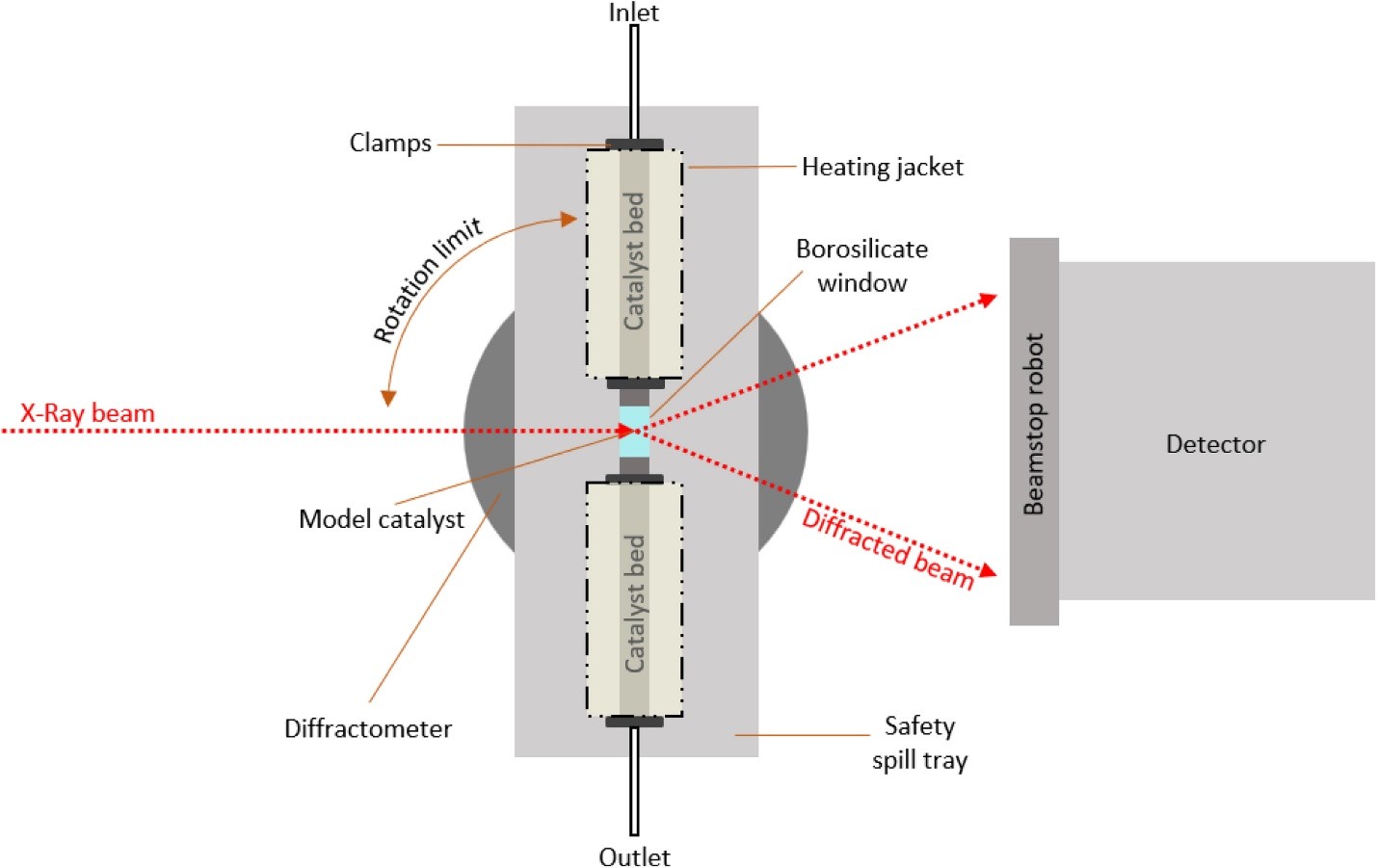
Fig. 1: One configuration of the reactor showing measurements performed at the centre of the catalyst bed. With an exit angle of approximately 60°, scattering measurements including X-ray diffraction, small-angle X-ray scattering, and pair distribution function analysis can be performed using a two-dimensional detector.
Although initially tested for LOHC dehydrogenation, the reactor can be applied to a wide range of academic and industrial applications, enabling in situ and operando investigations of catalysts during a variety of reactions involving both liquids and gases. Extending these studies from model systems to commercially relevant, high-loading catalysts enables direct assessment of degradation mechanisms within functional industrial devices.
The high photon flux provided by the ESRF-EBS also enables time-resolved measurements under demanding operating conditions. Such measurements have the potential to reveal previously inaccessible structure–activity relationships governing LOHC dehydrogenation and other thermocatalytic reactions.
| Principal publication A catalytic reactor suitable for in situ and operando high energy X-ray scattering studies, O. Irrazabal Moreda et al., Int. J. Hydrogen Energy 228, 154567 (2026); https://doi.org/10.1016/j.ijhydene.2026.154567 |
partners


European Synchrotron Radiation Facility - 71, avenue des Martyrs, CS 40220, 38043 Grenoble Cedex 9, France.