- Home
- News
- Spotlight on Science
- X-rays reveal redox-driven...
X-rays reveal redox-driven local symmetry breaking in a molybdenum coordination framework
13-03-2026
Characterisation of a 4d transition-metal coordination solid reveals ligand redox activity, local structural distortions, antiferromagnetism, and semiconducting behaviour. X-ray absorption spectroscopy at beamline ID12 determined the molybdenum valence state and electronic structure. The results lay the foundation for exploring molecular quantum materials incorporating heavier transition elements with chemically tunable electronic structures.
Share
The challenge
Metal-organic coordination solids can exhibit exotic electronic phenomena, such as unconventional magnetism and correlated electronic phases. In particular, solids based on 4d and 5d transition metals can display unusual effects due to their larger orbitals and strong spin–orbit coupling. So far, these effects have mainly been studied in purely inorganic materials, such as metal oxides and halides. Molecule-based coordination solids offer an advantage through the inherent tunability of molecular building blocks. Discovering coordination frameworks incorporating heavier transition metals could therefore combine chemical design with novel quantum phenomena.
Pyrazine-bridged square-lattice frameworks, M(pyrazine)2X2 have been studied extensively because of their magnetic and charge transport properties [1–3]. Several examples show strong magnetic interactions arising from the free-radical character of the bridging pyrazine ligands. However, no such framework incorporating a paramagnetic 4d transition metal had previously been reported. In addition to the synthetic challenge of incorporating a heavy transition metal, discovering a Mo-based square-lattice framework requires precise determination of the metal oxidation state and electronic configuration. For this, X-ray absorption spectroscopy at the Mo L-edges on the ID12 beamline was essential.
The experiment
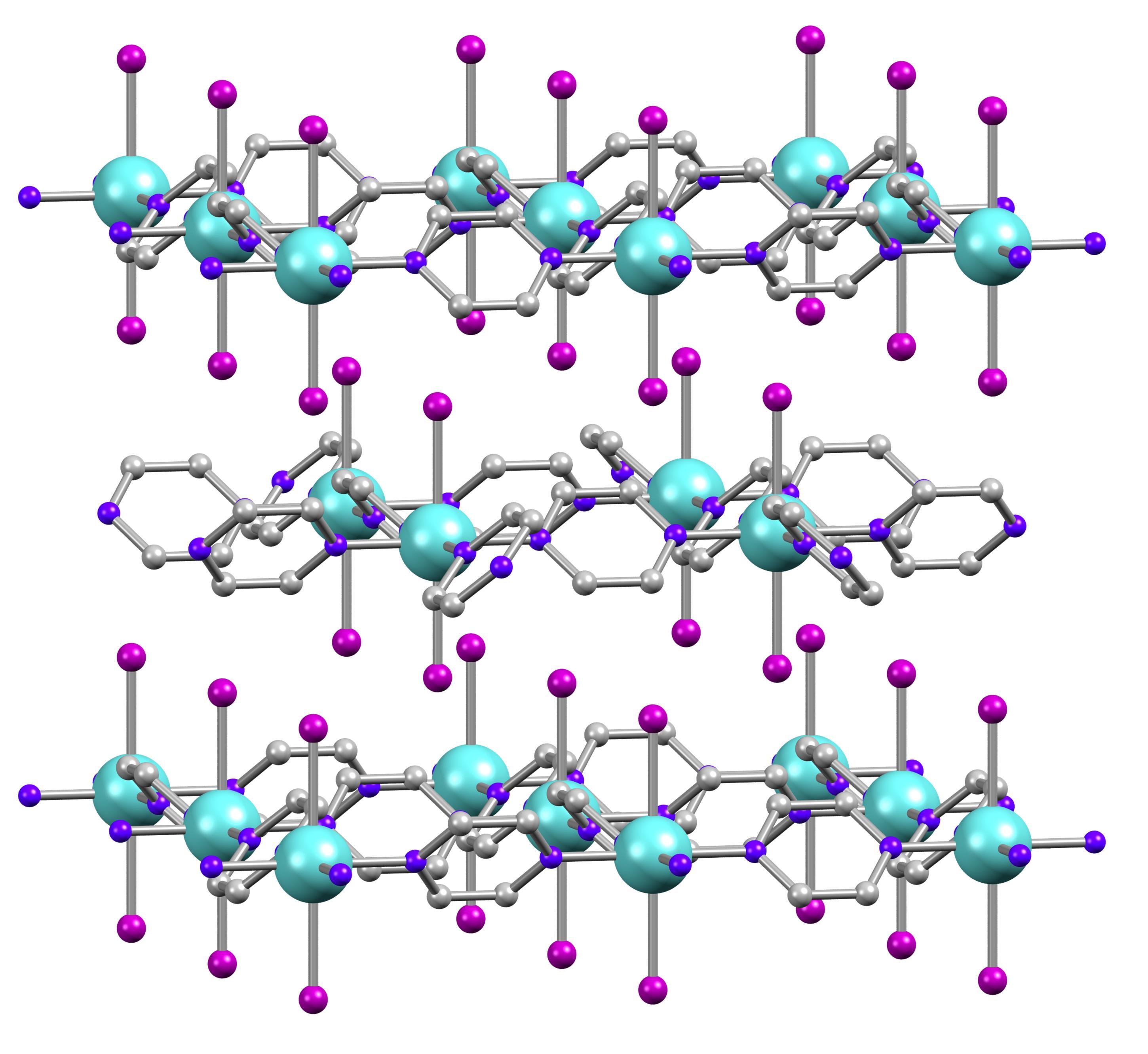
A new square-lattice coordination solid, Mo(pyrazine)2I2, was synthesised starting from a molecular Mo(II) precursor. The structure resembles that of the 3d analogues and contains octahedrally coordinated metal centres bridged in the equatorial plane by pyrazine linkers (Figure 1).
Click figure to enlarge
Fig 1: The crystal structure of Mo(pyrazine)2I2 determined from electron diffraction data, showing the layered framework and packing of the coordination network.
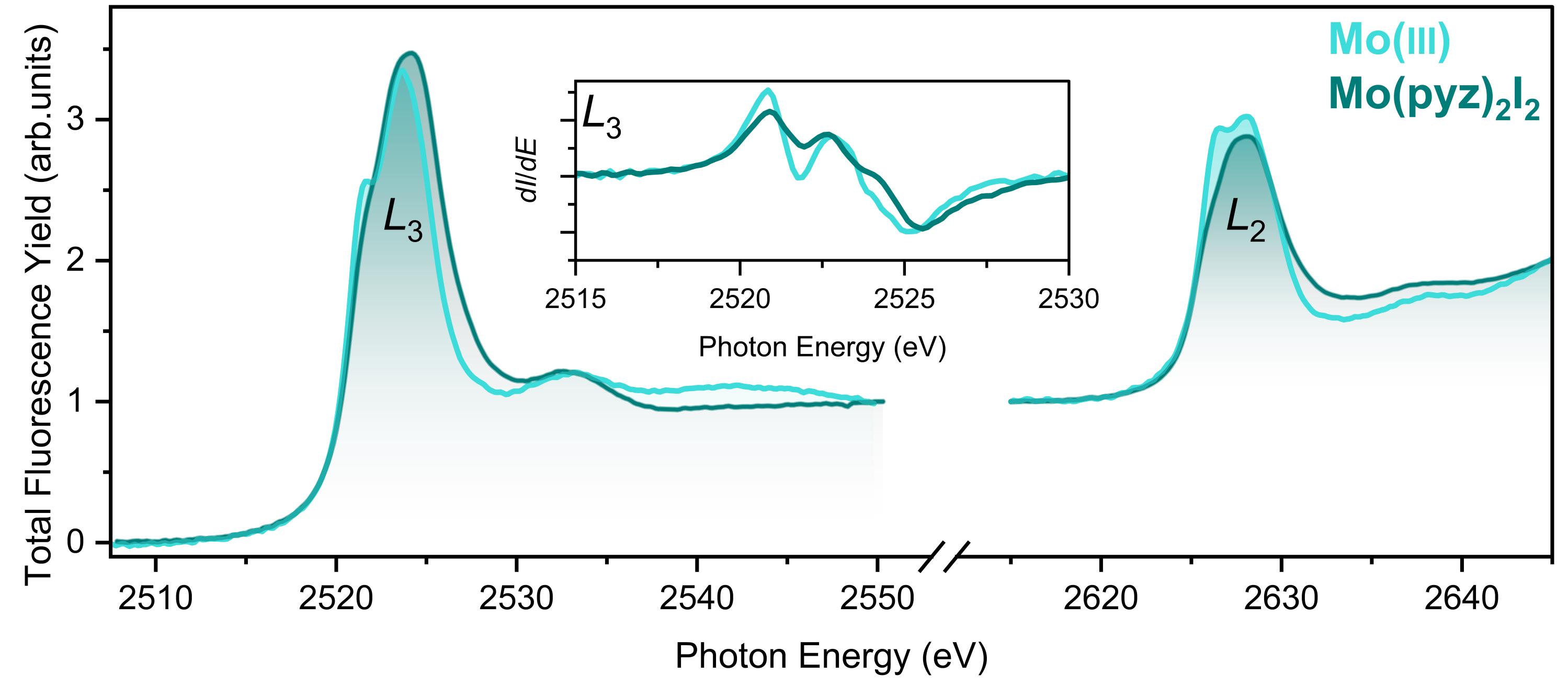
X-ray absorption spectroscopy at the Mo L2,3 edges on beamline ID12 enabled a deeper understanding of the electronic structure. The spectral shape and edge energy closely matched those of a reference Mo(III) compound with a similar chemical environment (Figure 2). The metal ion was therefore assigned as Mo(III) in the coordination solid.
Click figure to enlarge
Fig 2: X-ray absorption spectra at the L2 and L3 edges of Mo recorded at beamline ID12. The close resemblance between the spectra of Mo(pyrazine)2I2 and the molecular reference confirms that the oxidation state in the framework is Mo(III).
Combined analysis of 3D electron diffraction, total X-ray scattering, and spectroscopic data revealed that approximately half of the pyrazine linkers are reduced to radical anions. These reduced ligands are randomly distributed throughout the framework, driving the emergence of local lattice distortions and symmetry breaking.
Magnetisation measurements revealed strong antiferromagnetic interactions between the Mo(III) centres and the radical ligand scaffold, while charge-transport data indicated narrow band-gap semiconducting behaviour. Mo(pyrazine)2I2 therefore represents the first pyrazine-based framework containing a 4d transition metal that exhibits both magnetism and local symmetry breaking driven by ligand redox non-innocence.
The impact
These results demonstrate that pyrazine-based magnetic frameworks can extend beyond first-row transition metals. This opens access to stronger spin–orbit coupling and enhanced orbital delocalisation within chemically tunable molecular lattices. The observed link between ligand redox activity and local symmetry distortions introduces new structural and magnetic degrees of freedom in coordination frameworks. Together, these findings establish Mo(pyrazine)2I2 as a promising platform for exploring exotic quantum states in molecule-based materials, bridging coordination chemistry and quantum materials research.
|
Principal publication References |
|
About the beamline: ID12 A wide array of dichroic experiments can be performed, probing magnetism, chirality, or both, under extreme conditions, including magnetic fields up to 17 T, temperatures spanning from 2K to 800K, and pressures reaching 60 GPa. The beamline’s exceptional optical stability, combined with a highly efficient detection system, enables the reliable measurement of dichroic signals with very high signal-to-noise ratios. Using a focused ESRF-EBS beam, twin domain mapping in chiral systems can be conducted with micrometric resolution. Additionally, the ULMAG setup allows users to perform X-ray magnetic circular dichroism, X-ray diffraction, and bulk property measurements – including magnetisation, magnetostriction, magnetocalorics, and magnetoresistance – under strictly identical experimental conditions. This unique and versatile tool provides crucial insights into the interplay between magnetic, structural, and electronic subsystems in a wide range of magnetic materials. |
partners


European Synchrotron Radiation Facility - 71, avenue des Martyrs, CS 40220, 38043 Grenoble Cedex 9, France.