- Home
- News
- Spotlight on Science
- Unravelling the...
Unravelling the coexistence of insulating and metallic-like excitations in SrIrO₃
03-11-2025
Resonant inelastic X-ray scattering at beamline ID20 probed spin and charge fluctuations in SrIrO₃/SrTiO₃ heterostructures. Two distinct collective excitations — an insulator-like paramagnon and a metallic-like spin–orbit exciton — were found to coexist in semimetallic SrIrO₃. The results reveal that strongly damped spin and charge modes can simultaneously emerge in a correlated 5d semimetal, redefining understanding of “strange metal” behaviour in spin–orbit coupled systems.
Share
The challenge
Quantum materials are systems in which the collective behaviour of electrons gives rise to phenomena beyond the reach of conventional theories. In 3d transition-metal oxides, strong electron-electron correlations can drive insulating or superconducting ground states. For 5d oxides such as iridates, these correlations are expected to be weaker due to more extended orbitals. However, strong spin–orbit coupling (SOC) in iridium significantly alters the electronic landscape, intertwining spin, orbital, and charge degrees of freedom.
Among 5d oxides, the Ruddlesden–Popper iridates (e.g., Sr2IrO4and Sr3Ir2O7) are correlated insulators with antiferromagnetic order. The series’ end member, SrIrO3, behaves differently: it is a semimetal with no long-range magnetic order and has long been considered weakly correlated. Despite its metallicity, SrIrO3 exhibits unusual electronic properties, including enhanced quasiparticle mass and non-Fermi-liquid behaviour. Electron scattering is so intense that electrical resistivity approaches the Planckian limit — the theoretical maximum rate at which electrons can dissipate energy. These features mark SrIrO3 as part of a broader class of “strange metals.”
Studying SrIrO3 is challenging because its bulk perovskite form is difficult to grow as single crystals. An alternative approach is to grow the material in the form of a thin film or a heterostructure. In this case, when confined to fewer than three unit cells in thickness, it undergoes a transition to an insulating antiferromagnetic state (Figure 1b).
The experiment
To reveal the electronic properties of SrIrO3, artificial heterostructures were constructed by stacking layers of SrIrO3 and SrTiO3 with atomic precision (Figure 1a). By varying the number of SrIrO3 layers (m), it was possible to tune the system from a near-insulating state to one closely resembling the bulk semimetallic limit.
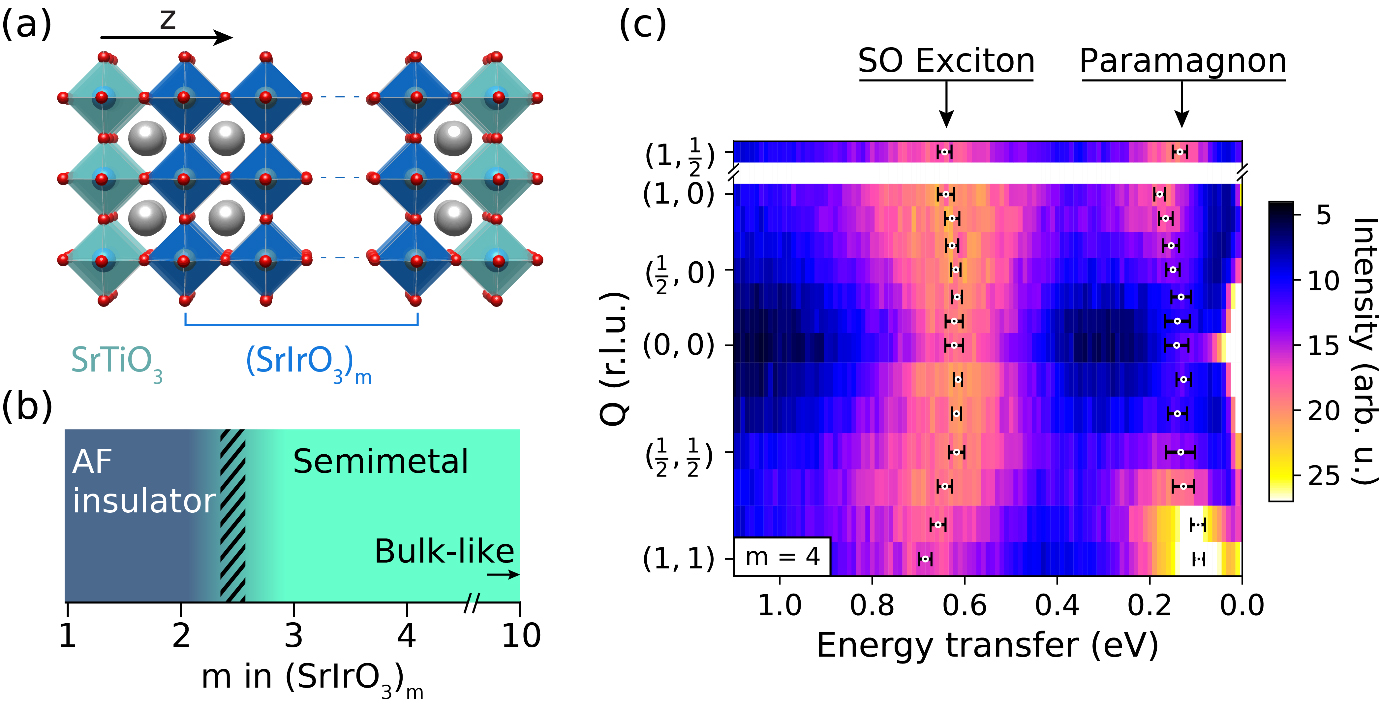
Fig. 1: RIXS investigation of iridate/titanate heterostructures. (a) Representation of (SrIrO3)m(SrTiO3)1 superlattices grown on a (001)-oriented SrTiO3 single-crystal substrate. (b) Phase diagram of the (SrIrO3)m(SrTiO3)1 system, showing the bandwidth-controlled metal–insulator transition that occurs as the confinement increases from m = 3 to m = 2. (c) Intensity map of Ir L3-edge RIXS spectra for the m = 4 sample at T = 20 K, plotted as a function of energy transfer and momentum transfer Q. Two distinct excitations are observed: a low-energy paramagnon and an SOE at intermediate energies.
Resonant inelastic X-ray scattering (RIXS) measurements were performed at the ID20 beamline. The incident X-rays were tuned to the Ir L3-edge, and the energy lost upon scattering was measured. This energy loss directly reflects the spectrum of elementary excitations, making the technique particularly powerful in materials lacking long-range order.
Across all heterostructures, two robust collective excitations were observed (Figure 1c): a low-energy paramagnon and a higher-energy spin-orbit exciton (SOE). The paramagnon corresponds to propagating magnetic waves of pseudospins (hybrid spin-orbital moments), while the SOE corresponds to the propagation of a hole across SOC-split energy levels. Both modes are heavily damped, with linewidths comparable to their energies. The paramagnon is reminiscent of an antiferromagnetic insulator (Figure 2a), while the SOE shows an upward dispersion away from the zone centre and a single-site periodicity (Figure 2b), fingerprint of a non-magnetic metal. Interestingly, these seemingly contradictory excitations coexist in the same semimetallic system.
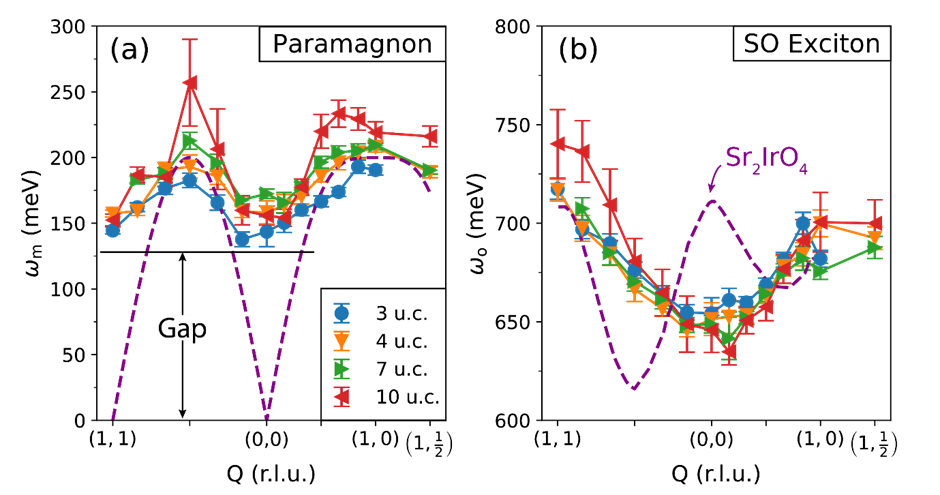
Fig. 2: Dispersion of paramagnon and SOE modes. (a) Momentum dependence of the paramagnon energy ωm(Q), for all four (SrIrO3)m(SrTiO3)1 samples. The dashed purple line represents the dispersion of a square-lattice Heisenberg antiferromagnet with J = 100 meV, while the solid black line indicates the finite-size gap arising from ultrashort-range magnetic correlations. (b) Momentum dependence of the SOE energy, ωo(Q), for all four samples. The purple line shows the SOE dispersion in Sr2IrO4 [from Kim et al., Phys. Rev. Lett. 108, 177003 (2012); https://doi.org/10.1103/PhysRevLett.108.177003] for comparison.
The paramagnon dispersion is compatible with a nearest-neighbour magnetic model, with ultrashort-range correlations producing a finite-size gap and broadening of the linewidths. This critical damping arises from metallic charge fluctuations in the non-Fermi-liquid phase, which also governs the upward dispersion of the SOE. The SOE dispersion in SrIrO3 differs substantially from that of antiferromagnetic insulators such as Sr2IrO4, where the dispersion is governed by the underlying magnetic order.
These observations demonstrate that the coexistence of paramagnon and SOE modes is an intrinsic property of semimetallic SrIrO3. The findings illuminate the interplay between strong pseudospin and charge fluctuations in high-SOC materials and have implications for correlated “strange” metals. Understanding such interactions could also inform the design of spintronics devices in which both charge and spin are manipulated.
Principal publication
Coexistence of Insulator-like Paramagnon and Metallic Spin-Orbit Exciton Modes in SrIrO3, E. Paris et al., Phys. Rev. Lett. 135, 186506 (2025); https://doi.org/10.1103/96fl-5zlh
| About the beamline: ID20 |
| ID20 is dedicated to exploring electronic and magnetic excitations in matter through resonant and non-resonant inelastic X-ray scattering (RIXS and IXS) as well as X-ray emission spectroscopy (XES). Its primary research areas include the investigation of strongly correlated electron systems, functional materials, and the behaviour of matter at extreme conditions. The beamline is equipped with two advanced spectrometers: 1. RIXS spectrometer: A versatile instrument with interchangeable 1m and 2m configurations, featuring five spherical crystal analysers. It operates in both horizontal and vertical scattering planes, with an energy resolution that depends on the monochromatisation scheme and the crystal reflection, ranging from 25 meV to 2 eV. 2. IXS spectrometer: A 1m spectrometer designed for non-resonant IXS studies, equipped with 72 crystal analysers arranged in six independent modules. It covers both horizontal and vertical scattering planes, with an energy resolution spanning 0.4 to 2 eV. The beamline enables the measurement of a variety of experimental observables, including magnons, d-d and charge transfer excitations, plasmons, core- and valence-level emission lines, as well as monopole, dipole, and multipole transitions from core levels. |
partners


European Synchrotron Radiation Facility - 71, avenue des Martyrs, CS 40220, 38043 Grenoble Cedex 9, France.