- Home
- News
- Spotlight on Science
- Uncovering how calcium...
Uncovering how calcium shapes gellan gel structure and elasticity
27-10-2026
Low acyl gellan gum forms gels whose mechanical properties depend on calcium concentration. Small-angle X-ray scattering at beamline BM26 linked changes in the supramolecular organisation of calcium-induced gellan networks to their mechanical properties, providing insight into the relationship between network structure and elasticity, which could help guide the development of gellan-based materials for applications ranging from food production to drug delivery.
Share
The challenge
Low acyl gellan gum (LAGG) is a negatively charged biopolymer produced by microbial fermentation. In the presence of cations, it forms elastic, transparent gels. Previous studies have suggested that gelation involves the aggregation of single helices into double helices [1]. When a sufficiently strong shear field is applied during gelation, a suspension of jammed soft particles, known as a fluid gel, can form. Owing to its gel-forming properties, LAGG is used in several industrial sectors, including food production, pharmaceuticals, art restoration and coal mining [2]. Understanding the relationship between its supramolecular structure and rheology is therefore important for designing materials with specific properties.
Calcium is commonly used to induce gelation in LAGG formulations. However, how its concentration affects the network structure and mechanical properties of both conventional quiescently cooled gels and fluid gels has remained unclear. In particular, the elastic modulus does not increase continuously with calcium concentration, but instead reaches a maximum. Understanding the structural changes responsible for this non-monotonic behaviour could help explain how calcium controls the properties of LAGG-based materials.
The experiment
Small-angle X-ray scattering (SAXS) at beamline BM26 was used to investigate how calcium concentration changes the supramolecular organisation of LAGG networks. The structural analysis was combined with rheological measurements to establish how changes in network architecture relate to the non-monotonic variation in elastic modulus.
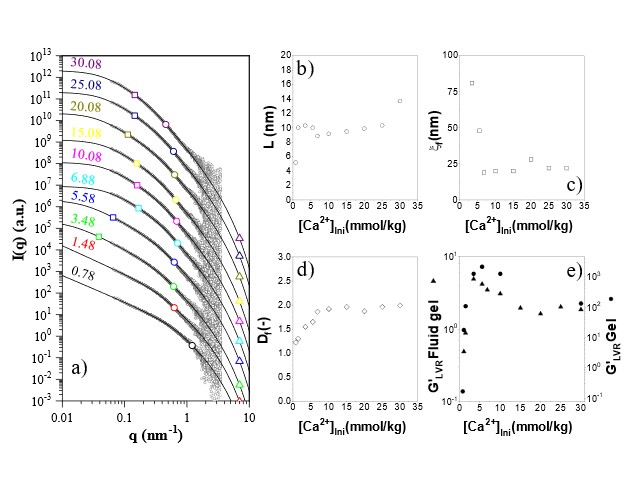
Analysis of the SAXS data, using structural modelling, identified three main changes as the calcium concentration increased: the model-derived length of the cylindrical building blocks increased sharply before stabilising at approximately 10 nm; the fractal dimension, which describes how the building blocks pack together, increased before reaching a plateau; and the fractal cut-off length, which characterises the scale over which the fractal architecture persists, decreased until the calcium concentration approached the maximum in the elastic modulus, then levelled off (Figure 1).
Click image to enlarge
Fig. 1: SAXS data for LAGG fluid gels prepared at different initial calcium concentrations, [Ca2+]Ini. a) Experimental scattering intensity, I(q), after subtraction of a constant background estimated by fitting (open symbols); colours distinguish calcium concentrations. Solid black curves show model fits. Open squares, circles and triangles indicate the q-values corresponding to the model-derived fractal-cluster size (2𝜉𝑓), cylinder length (𝐿) and diameter (2𝑅), respectively. Patterns and fits are vertically shifted on the logarithmic intensity axis for clarity. b) Model-derived cylinder length, 𝐿; (c) fractal cut-off length; (d) fractal dimension, Df, as functions of initial calcium concentration. e) Elastic modulus in the linear viscoelastic regime, G’LVR, for fluid gels (black triangles, left vertical axis) and quiescently cooled gels (black circles, right vertical axis), plotted against the initial calcium concentration. Adapted from principal publication.
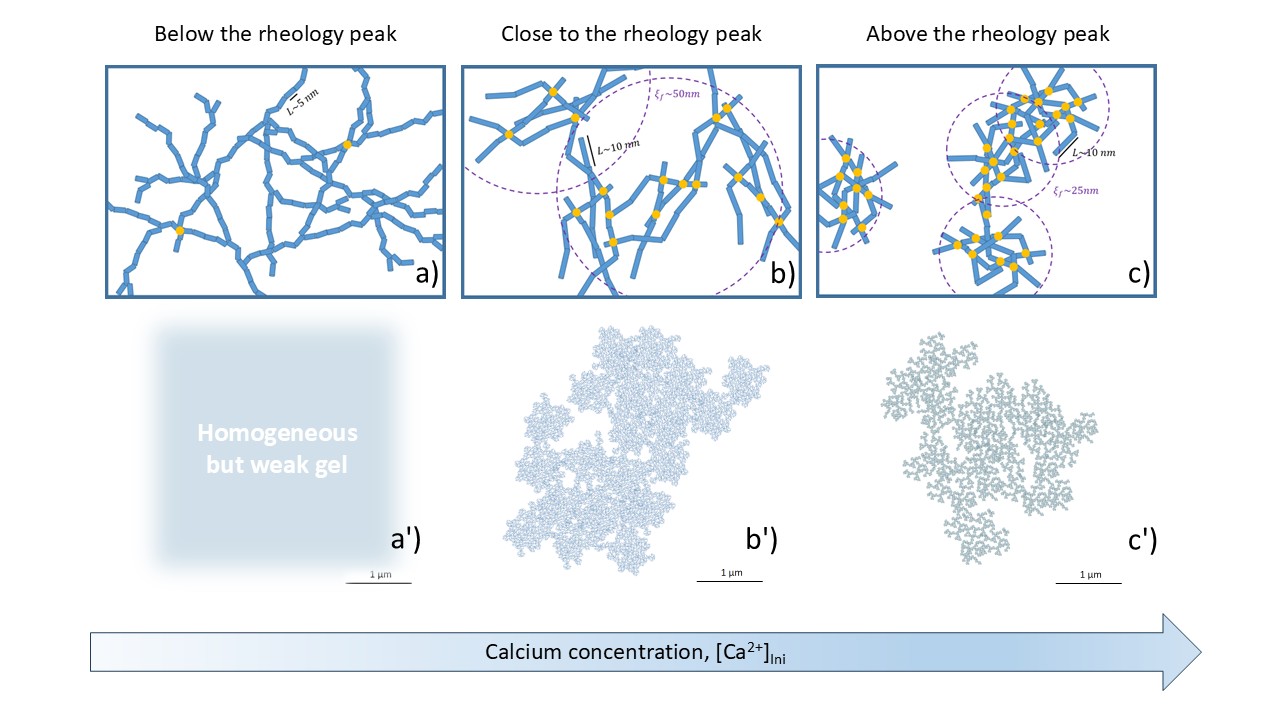
Together, these measurements linked the non-monotonic rheological response to changes in the organisation of the gel network. Below the calcium concentration corresponding to the elastic-modulus maximum, the SAXS analysis is consistent with a network of sparsely interconnected LAGG double helices. Near the maximum, the proposed structure comprises colloidal beads containing more interconnected double helices. At higher calcium concentrations, the model suggests the formation of smaller beads, with more extensive crosslinking between the double helices (Figure 2). These structural models provide a possible explanation for how calcium concentration influences network organisation at different length scales and, in turn, its mechanical properties.
Click image to enlarge
Fig. 2: Schematic representation of the LAGG gel network at initial calcium concentrations (a) below, (b) close to and (c) above the concentration corresponding to the maximum elastic modulus. Yellow dots indicate Ca2+ crosslinks between strands. The length of the cylindrical building blocks, 𝐿, is shown, while circles with diameter 2𝜉𝑓 represent the size of the fractal clusters. Panels a'), b') and c') illustrate how the building blocks at the SAXS length scale in each network may assemble into macroscopic gel particles. Adapted from principal publication.
The impact
By establishing links between supramolecular structure and rheology, this study advances understanding of how calcium concentration influences the properties of LAGG gels and fluid gels. Rather than treating calcium concentration as a simple means of increasing gel strength, the results demonstrate that its effects are associated with changes in network architecture. This structure–property relationship could help guide the formulation of gellan-based materials with tailored mechanical properties.
|
Principal publication References |
| About the beamline: BM26 |
|
BM26, part of the Dual Belgian Beamline (DUBBLE), is dedicated to small- and wide-angle X-ray scattering (SAXS/WAXS), enabling the investigation of the structure and organisation of materials across a range of length scales. Two Pilatus detectors allow SAXS and WAXS patterns to be collected simultaneously, with time resolution down to a few milliseconds per frame. The beamline supports in-situ and ex-situ grazing-incidence measurements, as well as a variety of sample environments, including heating and cooling stages. Complementary techniques, such as Raman and ultraviolet spectroscopy, can also be combined with scattering measurements. Although widely used in soft condensed matter research, BM26 also supports studies in fields including geology, mineralogy and metallurgy. |
partners


European Synchrotron Radiation Facility - 71, avenue des Martyrs, CS 40220, 38043 Grenoble Cedex 9, France.