- Home
- News
- Spotlight on Science
- Tuning spins into...
Tuning spins into a liquid-like quantum state
28-04-2026
High-pressure X-ray diffraction at beamline ID27 was used to investigate how pressure tunes the kagome magnet Y-kapellasite, establishing a direct link between subtle structural changes and magnetic interactions. The results show that pressure stabilises a fluctuating, spin-liquid-like quantum state, suggesting that geometric frustration alone can drive quantum disorder.
Share
The challenge
Magnetism has been studied for thousands of years, from natural lodestones to modern technologies. Today, it remains central to physics, especially at the quantum level, where atomic spins interact in unexpected ways. In certain geometries, competing interactions lead to “frustration”, which prevents spins from settling into an ordered pattern, even at the lowest temperatures. This can give rise to a spin-liquid quantum state, hosting emergent excitations and long-range quantum entanglement. Identifying such states remains challenging, as disorder can obscure their signatures. Y-kapellasite offers a rare, clean platform where pressure can continuously tune magnetic interactions.
A key challenge in quantum magnetism research is to disentangle the roles of disorder and intrinsic geometric frustration, which can produce similar signatures of a quantum spin liquid. Geometric frustration suppresses magnetic order and, together with quantum fluctuations, can stabilise such a state. The central question is whether a clean kagome system [1], which provides an ideal platform to isolate the role of geometric frustration, can be tuned in a controlled manner. Pressure allows continuous tuning of the balance of magnetic interactions. High-brilliance X-ray diffraction under pressure follows subtle structural changes that directly modify these interactions.
The experiment
High-pressure X-ray diffraction at beamline ID27 was combined with muon spin spectroscopy measurements at the Paul Scherrer Institute (PSI) to investigate how pressure modifies Y-kapellasite.
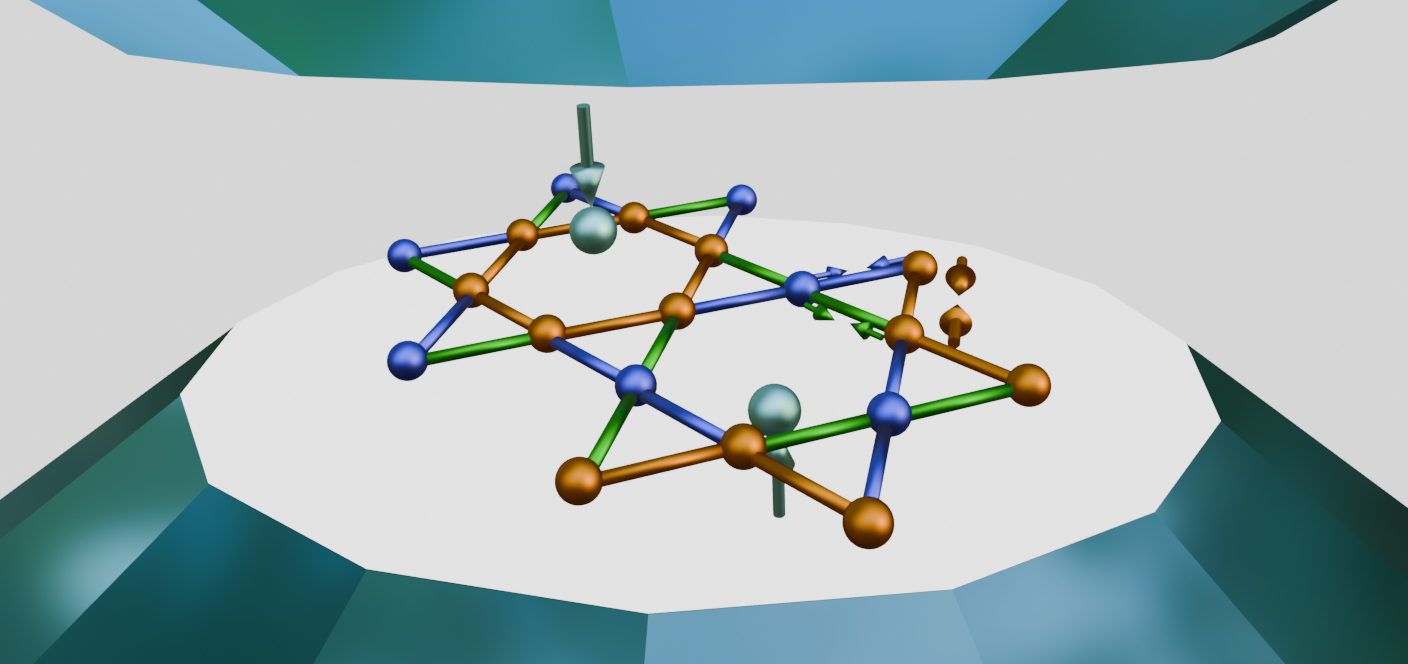
Under hydrostatic pressure, X-ray diffraction measurements reveal subtle structural changes that reduce lattice anisotropy without any structural transition, thereby continuously enhancing geometric frustration (Figure 1).
Click image to enlarge
Fig. 1: Schematic of a single kagome layer of Y-kapellasite inside a diamond anvil cell. Under pressure, the Y spacer atom is driven closer to the kagome plane, modifying the relative positions of the Cu1 (orange) and Cu2 (blue) sites and thereby tuning the magnetic interactions.
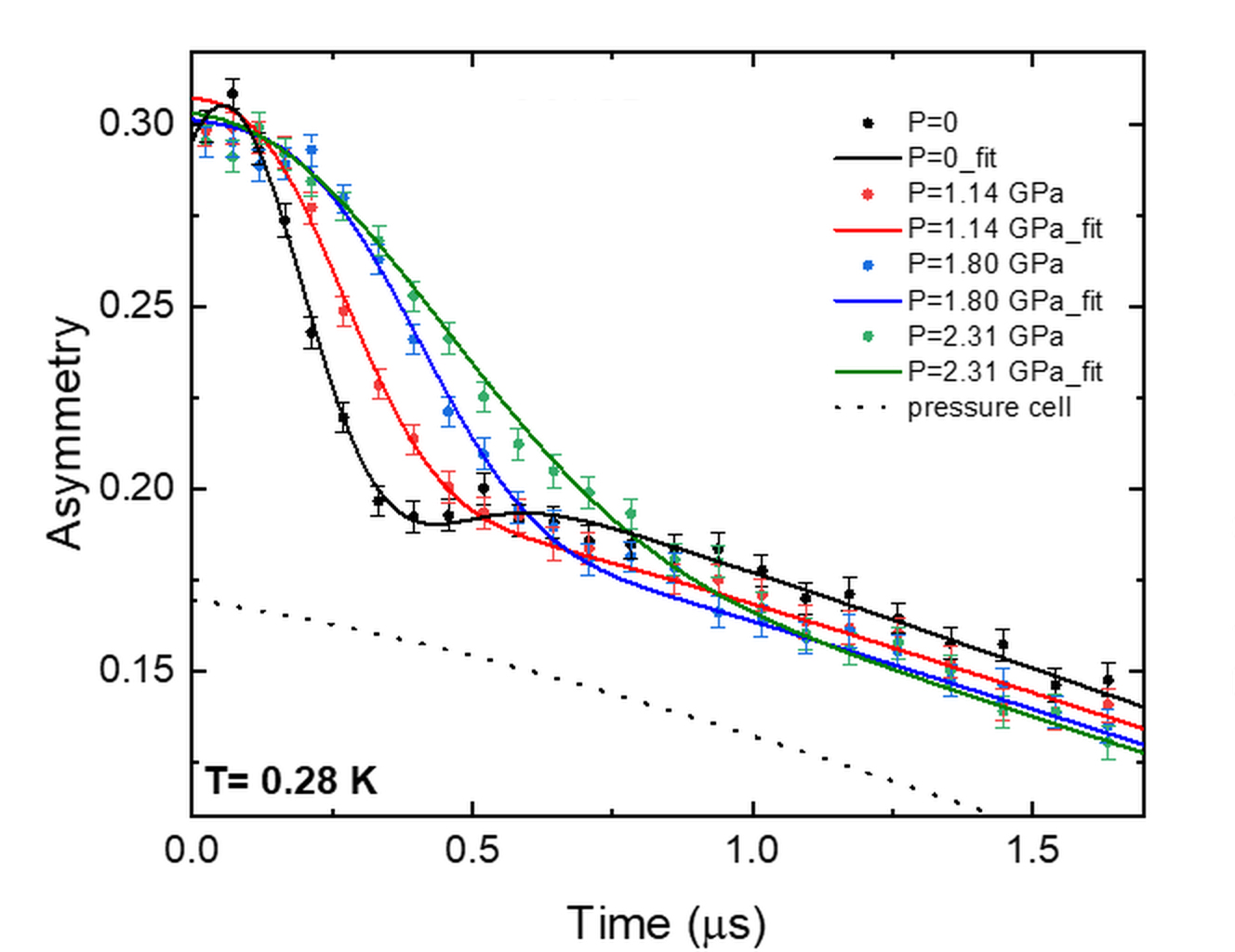
Complementary muon spin spectroscopy results from PSI show that static magnetic order is fully suppressed and replaced by a dynamic ground state (Figure 2). The absence of spin freezing is a key signature of a spin-liquid-like phase. Together, these results demonstrate that pressure tunes the underlying interactions and stabilises a fluctuating quantum state in a clean system, enabling the role of geometric frustration to be isolated without the influence of disorder, providing a clear example of “quantum disorder by design.
Click image to enlarge
Fig. 2: Zero-field asymmetries measurements at 0.28 K under increasing pressures: ambient pressure, 1.14 GPa, 1.8 GPa, and 2.3 GPa. The black dotted line indicates the contribution from the pressure cell.
The impact
These results show that spin-liquid behaviour can emerge from intrinsic geometric frustration alone, without the need for disorder. By using pressure as a non-thermal tuning parameter, the two effects can be effectively disentangled, addressing a long-standing challenge in quantum magnetism. Y-kapellasite is thus established as a model system to study frustration-driven quantum states in a controlled way. More broadly, this work demonstrates how pressure can be used to engineer and explore exotic quantum phases, advancing our ability to understand and control quantum spin liquids.
|
Principal publication References |
|
About the beamline: ID27 With increased photon flux, reduced beam sizes (down to 300 × 300 nm²), and improved detector systems, ID27 enables a new class of experiments, including ultra-high-pressure studies (P > 4 Mbar), time-resolved experiments with millisecond resolution, 2D micro-fluorescence mapping, and in-situ X-ray imaging. |
partners


European Synchrotron Radiation Facility - 71, avenue des Martyrs, CS 40220, 38043 Grenoble Cedex 9, France.