- Home
- News
- Spotlight on Science
- Synchrotron Mössbauer...
Synchrotron Mössbauer spectroscopy reveals a less oxidising past for Bennu materials
21-10-2026
Meteorites may not preserve the original iron mineralogy of their parent asteroids, limiting what they can tell us about the conditions under which these materials formed and evolved. Synchrotron Mössbauer spectroscopy at beamline ID14 characterised iron-bearing minerals in tiny samples from asteroid Bennu, suggesting that Bennu-like materials formed and evolved under less oxidising conditions than inferred from some meteorites. The findings offer new insights into the formation and alteration of primitive asteroids and help refine our understanding of the early Solar System.
Share
The challenge
Iron (Fe) is a major rock-forming element on Earth and beyond. The mineralogy and oxidation states of Fe in extraterrestrial samples help reconstruct how planetary bodies formed and evolved. Samples returned from asteroid Bennu by NASA’s OSIRIS-REx mission (~120 g in total) offer a unique opportunity to investigate a primitive body’s original composition, having been protected from the oxidising terrestrial atmosphere that alters meteorites [1]. The Fe mineralogy of Bennu samples therefore provides a window into the early history of the Solar System.
A key challenge was to characterise Fe in a small sample grain. Conventional Mössbauer spectroscopy can determine Fe speciation, but the limited amount of returned material available for analysis makes measurements difficult. A focused synchrotron beam enables measurements on small regions within these rare samples.
The experiment
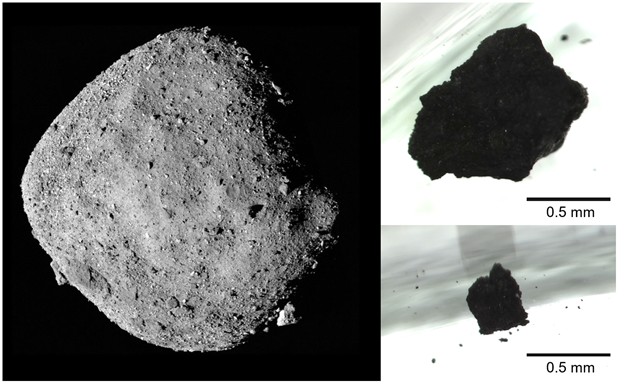
Synchrotron-source Mössbauer spectroscopy was applied to two Bennu sample grains at beamline ID14 (Figure 1). Measurements used a 10-µm beam, with X-ray path lengths through the grains of approximately 800–1000 µm and 300 µm, respectively. Together with X-ray diffraction, the spectra helped identify the minerals hosting Fe and distinguish ferric (Fe3+) from ferrous (Fe2+) iron in clay minerals, the main constituents of the samples.
Click image to enlarge
Fig. 1: Left: Asteroid Bennu, approximately 500 m in diameter, imaged by NASA’s OSIRIS-REx spacecraft. Image credit: NASA/Goddard/University of Arizona. Right: The Bennu sample grains analysed at ID14. Optical images taken at Tohoku University.
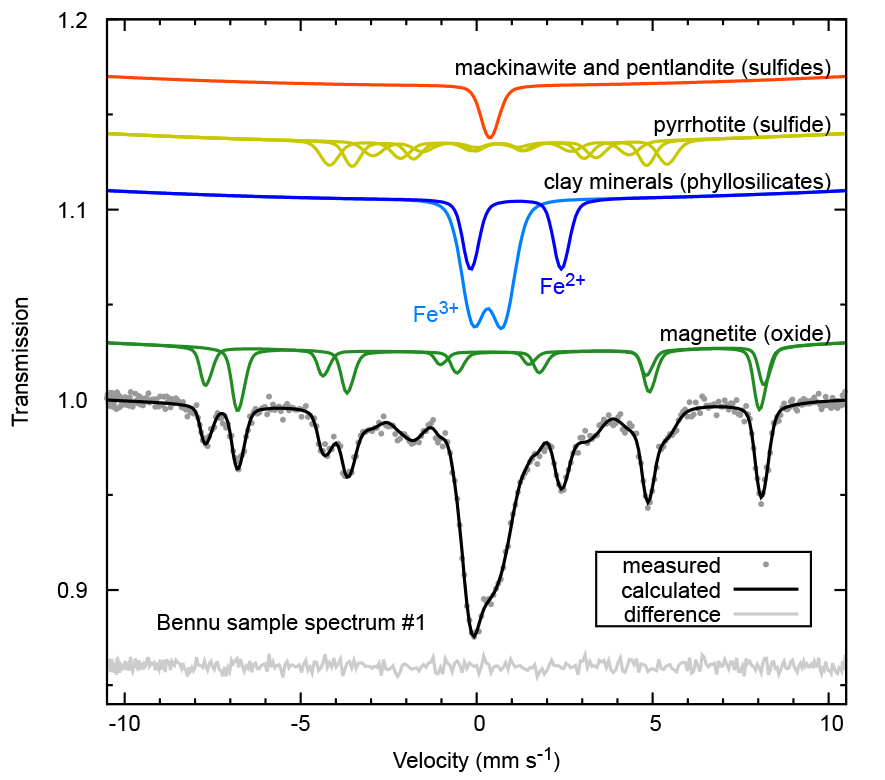
Mössbauer spectra collected from several subregions within the grains showed that Fe is hosted in clay minerals, oxides (magnetite) and sulfides (pyrrhotite, mackinawite and pentlandite), with proportions varying between regions (Figure 2). A substantial fraction of the Fe was hosted in sulfides, consistent with observations from samples returned from another primitive asteroid, Ryugu, by Japan’s Hayabusa2 mission [2].
Click image to enlarge
Fig. 2: Mössbauer spectrum of the larger Bennu grain (1 mm) measured at ID14. Spectral fitting was performed using SYNCmoss, with the sample mineralogy informed by X-ray diffraction analysis. The measured data (grey dots), fitted model (black line), residuals (light grey line) and contributions from individual Fe-bearing mineral species (coloured lines) are shown. The spectrum identifies Fe hosted in clay minerals, oxides and sulfides.
To investigate possible temperature-dependent changes in the magnetic properties of the mineral phases present, measurements at 5 K were performed. No significant contribution from ferric oxyhydroxide (ferrihydrite) in the analysed Bennu grains was detected. Ferrihydrite is the dominant Fe-bearing mineral in meteorites with bulk chemical compositions similar to those of Bennu and Ryugu samples [3]. This suggests that ferrihydrite in these meteorites formed through prolonged oxidation of submicrometre Fe sulfide particles after the meteorites reached Earth. Consequently, meteorites may not preserve the original iron mineralogy of their parent bodies, and the formation environments of Bennu-like primitive bodies may have been less oxidising than previously inferred from meteorite studies.
The impact
The study identifies mineralogical variations both within and between the analysed Bennu grains and other Bennu-like materials, including differences in clay mineral structure, Fe oxidation states, and Fe sulfide composition. These variations, which may have been overlooked in previous analyses, could reflect local or temporal differences in redox conditions during the formation and alteration of primitive materials in the early Solar System.
By characterising Fe-bearing minerals in tiny, pristine samples returned directly from an asteroid, synchrotron-source Mössbauer spectroscopy helps distinguish extraterrestrial mineralogy from changes caused by terrestrial alteration. The findings offer new insights into the complex histories of primitive extraterrestrial materials and help refine interpretations of the conditions under which Bennu-like bodies formed.
Principal publication
The iron mineralogy of Bennu samples: similarities and variations among CI chondritic materials, K. Amano et al., Geochim. Cosmochim. Acta 432, 160-177 (2026); https://doi.org/10.1016/j.gca.2026.09.011
References
[1] D. S. Lauretta et al., Meteorit. Planet. Sci. 59, 2453–2486 (2024).
[2] M. Roskosz et al., Meteorit. Planet. Sci. 59, 1925–1946 (2024).
[3] J.-C. Viennet et al., Earth Planet. Sci. Lett. 671, 119678 (2025).
| About the beamline: ID14 |
|
Beamline ID14 is dedicated to nuclear resonance scattering (NRS), enabling the investigation of the magnetic, electric and dynamical properties of materials with element-specific sensitivity. It provides optimised photon flux at selected Mössbauer resonance energies between 6.5 and 100 keV with high energy resolution, down to the millielectronvolt and nanosecond levels using electronic monochromators, and ultra-high energy resolution, down to the nanoelectronvolt level, using nuclear monochromators. The beamline also offers beam sizes as small as 300 nm and exploits the pulsed time structure of the synchrotron source. These capabilities enable studies of materials under extreme conditions, including high pressure, at low and high temperatures, and in strong magnetic fields. Applications include phonon dynamics, diffusion, magnetic and electric properties, and structural phenomena. |
partners


European Synchrotron Radiation Facility - 71, avenue des Martyrs, CS 40220, 38043 Grenoble Cedex 9, France.