- Home
- News
- Spotlight on Science
- Operando techniques...
Operando techniques reveal why nickel–gallium alloy drives selective carbon dioxide hydrogenation
25-09-2025
X-ray experiments at ID15A and BM31 have revealed why a nickel–gallium alloy is effective at converting carbon dioxide into methanol. By correlating atomic-scale structure with catalytic activity, the work provides a roadmap for designing more active, selective, and stable catalysts for carbon dioxide hydrogenation.
Share
CO2 can be converted into methanol by reacting it with green hydrogen, thereby turning a greenhouse gas into a product that can serve as a fuel or chemical feedstock. This hydrogenation reaction only proceeds efficiently with a highly active and selective catalyst, but many catalysts produce unwanted by-products, such as carbon monoxide or methane, and can also degrade over time. The challenge is to design a catalyst that is not only active, but also selective and stable.
Catalysts are complex materials that feature specific atomic-scale sites on their surfaces that are active for a given reaction. Typically dispersed on supports such as silica or alumina, these sites are difficult to control or even identify because they are present in small amounts and are often dynamic, sometimes existing only under reaction conditions. Atomic-level insight into how they function is crucial for designing more effective catalysts.
Nickel (Ni), an abundant and active metal for CO2 hydrogenation, typically favours methane production. Introducing gallium (Ga) to nickel catalysts alters the catalyst’s behaviour, steering the reaction toward methanol. The nanoscale arrangement of Ni and Ga atoms ultimately governs the catalyst’s performance.
With their capability for operando measurements, beamlines ID15A and BM31 enabled researchers to probe the active sites in Ni–Ga catalysts while converting CO2 with H2. At ID15A, high-energy X-ray total scattering revealed the atomic structure of Ni–Ga alloy nanoparticles forming in situ. Meanwhile, X-ray absorption spectroscopy (XAS) at BM31 provided element-specific insights into the local environments of Ni and Ga.
Click figure to enlarge
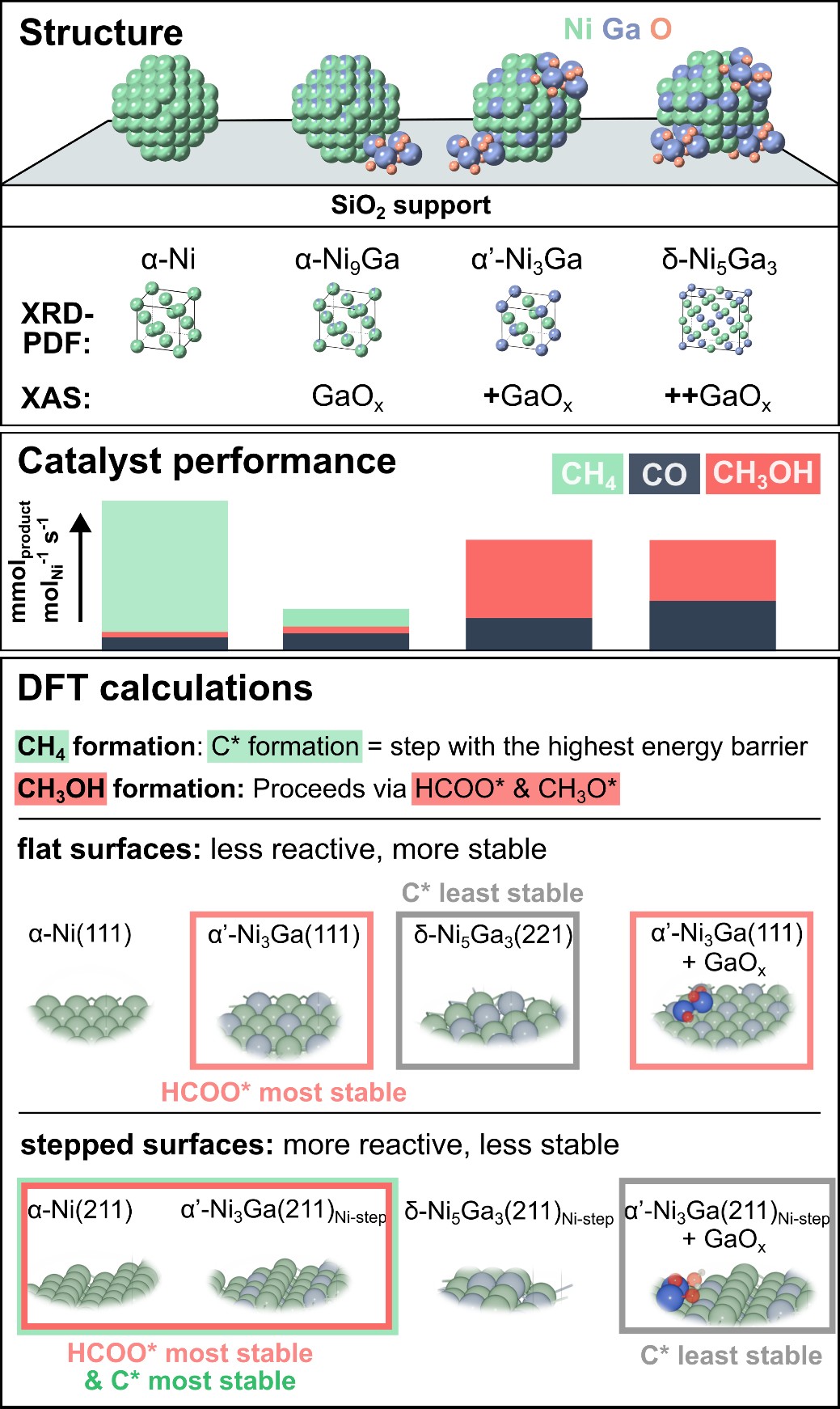
Fig. 1: Structure: Operando total scattering (X-ray diffraction and pair distribution function (PDF) analyses) reveal a nanocrystalline alloy structure. Ga K-edge X-ray absorption spectroscopy (XAS) identifies the formation of gallium oxide species (GaOx). Catalyst performance: These structures correlate with variations in methanol selectivity and productivity, with the highest methanol productivity and selectivity observed for α’-Ni3Ga nanoparticles supported on SiO2, with co-existing GaOx. Density functional theory (DFT) calculations: DFT indicates that, relative to pure Ni, Ni-Ga alloy surfaces stabilise key reaction intermediates, helping to elucidate the observed structure–activity relationships.
The catalyst precursors consisted of highly disordered phyllosilicate sheets of Ga and Ni. Upon in situ activation, these sheets transformed into Ni–Ga alloys – either ordered or disordered, depending on the Ni-to-Ga ratio – while some Ga remained as an oxide outside the alloy (Figure 1, top).
By measuring the catalytic performance and structure simultaneously, a direct link between the structure and activity of the catalysts could be established (Figure 1, middle). An ordered alloy, α’-Ni3Ga, containing well-defined Ni and Ga sites together with a small fraction of gallium oxide, was particularly efficient and selective. Complementary theoretical modelling showed that Ni-rich surface sites of the α’-Ni3Ga alloy stabilise key intermediates in CO2 hydrogenation to methanol, while gallium oxide modulates CO* dissociation to enhance methanol selectivity (Figure 1, bottom).
This research reveals how atomic-scale arrangements govern catalyst performance and highlights the unique capabilities of ESRF beamlines to capture the behaviour of elusive active sites under real operating conditions. The findings provide a blueprint for designing more efficient, selective, and durable catalysts for sustainable chemistry.
Principal publications
How Does the Ni–Ga Alloy Structure Tune Methanol Productivity and Selectivity? N.K. Zimmerli et al., ACS Catal. 15(16), 14252 (2025); https://doi.org/10.1021/acscatal.5c02008
Structural Dynamics Behind the Formation of α′-Ni3Ga Alloy Nanoparticles from a Ni–Ga Phyllosilicate Dispersed on Silica Using X-ray Probes, N.K. Zimmerli et al., Chem. Mater. 37(14), 5312 (2025); https://doi.org/10.1021/acs.chemmater.5c01040
| About the beamlines: ID15A and BM31 |
| ID15A focuses on high-energy X-ray applications in materials chemistry, employing advanced, non-destructive diffraction techniques to probe material properties across multiple length and time scales. Its capabilities include operando and time-resolved multidimensional diffraction and fluorescence, total scattering, and imaging. The beamline is designed for seamless switching between these techniques within a single experiment, enabling complementary data collection on working systems. With energies up to 120 keV, even dense or highly absorbing samples can be studied. Optimised focusing optics, combined with a single-photon-counting CdTe pixel detector, deliver high-quality data at high energy. |
| BM31 provides operando multiprobe synchrotron techniques for materials chemistry investigations. The beamline’s optics and end-station allow rapid automatic switching between configurations, facilitating simultaneous time-resolved X-ray absorption spectroscopy, powder diffraction and total scattering measurements on the same sample under identical conditions. A wide variety of sample environments supports fully automated, temperature-dependent catalysis and electrochemistry studies, complemented by an integrated gas distribution and analysis system. |
partners


European Synchrotron Radiation Facility - 71, avenue des Martyrs, CS 40220, 38043 Grenoble Cedex 9, France.