- Home
- News
- Spotlight on Science
- New 4D view of critical...
New 4D view of critical battery failure mechanisms
24-04-2026
Using high-speed 4D X-ray imaging at beamline ID19, the failure pathways of lithium-ion batteries during thermal runaway have been revealed in unprecedented detail. The findings provide new insights into the mechanisms of thermal runaway, with important implications for future battery safety across a wide range of applications.
Share
The challenge
Lithium-ion batteries are a cornerstone of the energy transition, enabling low-emission mobility and energy storage across applications ranging from electric vehicles to grid-scale storage. Although failures are rare, under abusive conditions batteries can undergo thermal runaway – a chain of exothermic reactions that rapidly generate heat and gas. This process can rupture the steel casing, eject hot material, and propagate to neighbouring cells, leading to fire. Understanding how thermal runaway initiates and propagates is essential for improving safety in large battery systems.
Sidewall rupture is among the most hazardous consequences of thermal runaway. Violent exothermic reactions within a cell during failure can breach the battery casing, increasing the likelihood that ejected material initiates cascading failure events. However, understanding the complex processes leading up to and during rupture remains limited, primarily due to the extreme speed of these events and the sealed structure of the cells. Until now, it has not been possible to visualise these internal processes in three dimensions with sufficient temporal resolution.
Over more than a decade, high-speed radiographic imaging capabilities have been applied at beamline ID19 to study battery failure. More recently, a specialised chamber developed by Fraunhofer EMI and integrated on the beamline has enabled investigation of a wide range of cell formats and chemistries, with multiple ‘trigger’ modes to induce failure under controlled abusive conditions [1]. These studies have demonstrated the value of X-ray imaging for understanding battery cell failure under mechanical, thermal, and electrochemical abuse, establishing a unique dataset that captures the internal processes that occur during such high-speed events [2].
The experiment
In this work, high-speed X-ray imaging at beamline ID19 was extended from two-dimensional radiography to four-dimensional computed tomography (three spatial dimensions resolved over time). Failure tests were performed in the specialised chamber on two commercial cell types (VCT5A and P28B), using controlled trigger methods including nail penetration, external heating, and induced internal short circuits.
Enabled by the EBS upgrade, acquisition rates of up to 40 tomographic reconstructions per second were achieved. This advance allowed the internal structure of the cell to be resolved in 4D during failure, providing direct access to the spatial evolution of damage with high temporal resolution.
Click image to enlarge
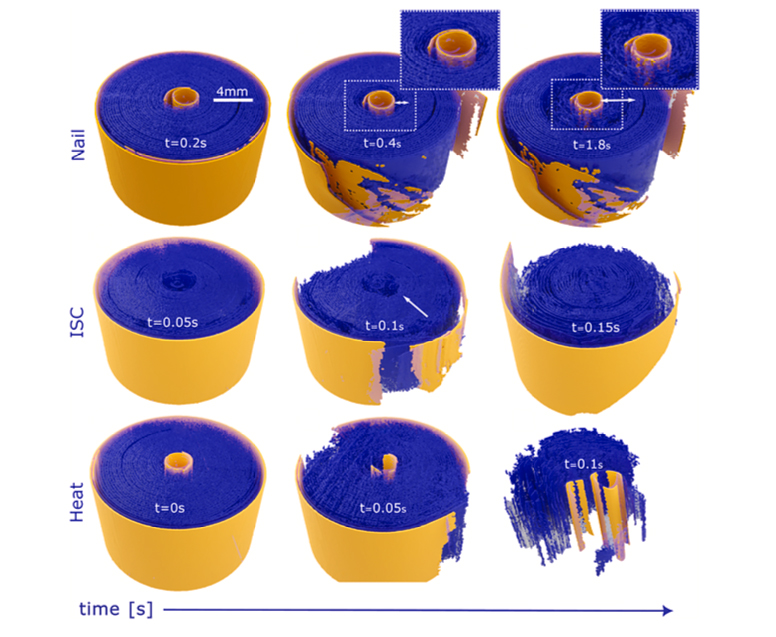
Fig. 1: 3D computed tomography renderings of sidewall rupture for different trigger modes.
A-B) Sidewall rupture occurring 0.2 seconds after nail penetration in a VCT5A cell. The layers continue to delaminate radially outward, as can be seen in (C) and indicated by arrows. D-E) Sidewall rupture during internal short circuit triggering of thermal runaway in a P28B cell. The layers delaminate radially from the external shell and inward. After 0.15 seconds, only half of the cell wall remains (F). G-H) Sidewall rupture during external heat triggering of thermal runaway in a VCT5A cell. Within 0.1 seconds, the whole cell has disintegrated, as the collapse of the jellyroll is instantaneous and leads to an aggressive and complete sidewall rupture (I). In all cells, the yellow part of the renderings corresponds to the sidewall, and in the nail and heat cases, also corresponds to the central mandrel (VCT5A model).
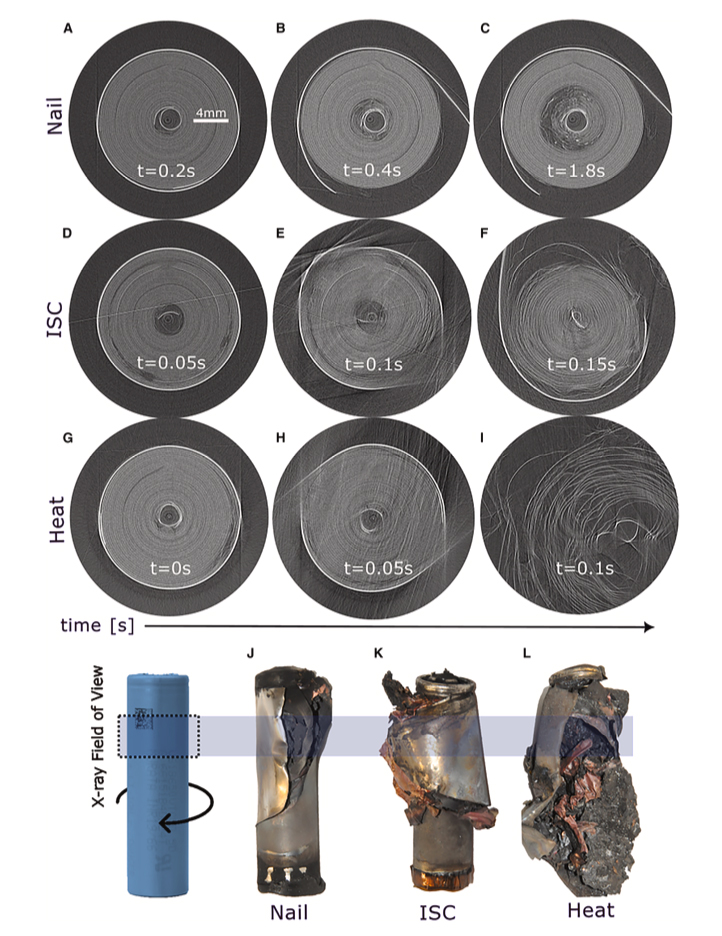
The data reveal how internal delamination initiates and propagates, leading to sidewall rupture (Figure 1), and allow direct comparison with conventional 2D radiographic sequences (Figure 2).
Click image to enlarge
Fig. 2: Corresponding 2D X-ray and post-mortem images.
X-ray sequence of layer delamination and sidewall rupture triggered by (A–C) nail penetration, (D–F) internal short circuit, and (G–I) external heating. Below, post-mortem images after (J) nail penetration, (K) internal short circuit, and (L) external heat triggering. In (A) and (G), the central mandrel is visible as the white ring in the centre of the battery.
Rupture was observed to occur at different stages of thermal runaway depending on the trigger: internal short circuit and external heating produced faster, more extensive delamination and more aggressive rupture than nail penetration. Crucially, the 4D data enabled quantification of propagation velocities and directions, linking internal structural changes to macroscopic failure. This capability, not accessible with 2D imaging, provides a new approach for analysing failure mechanisms in lithium-ion batteries.
The impact
The results provide a quantitative framework for analysing the sidewall rupture process, including the nucleation of failure and the speed and direction of propagation. Comparisons across trigger modes and cell types demonstrate the robustness of the approach and its applicability over a wide parameter space. As the database of 4D observations during failure expands, this technique could become an important tool for battery safety assessment, with implications for cell design and certification.
|
Principal publication References |
|
About the beamline: ID19 ID19 operates experimental facilities located 150 m downstream of the source. The long distance suppresses the influence of the finite source size on the image formation, thereby enabling the use of propagation-based phase contrast. Polychromatic configurations are often employed, as the increased bandwidth significantly reduces exposure times, sometimes down to the nanosecond regime for specific applications. At beamline ID19, fast tomography and ultra-high-speed radiography are frequently coupled with complex sample environments. In addition to classical tomography furnaces and a cold stage (cryo-cell), recent installations include different kinds of presses for uni-axial and tri-axial loading, dynamic compression systems such as a mesoscale gas launcher, a Split-Hopkinson pressure bar and a pulsed laser. There are also dedicated rigs for battery abuse testing and in situ additive manufacturing. |
partners


European Synchrotron Radiation Facility - 71, avenue des Martyrs, CS 40220, 38043 Grenoble Cedex 9, France.