- Home
- News
- Spotlight on Science
- In situ quantification...
In situ quantification of vapour dynamics during laser powder bed fusion additive manufacturing
23-02-2026
Synchrotron X-ray radiography, laser-induced breakdown spectroscopy, and simulations were used to quantify metal vapour formation during metal 3D printing. The powerful X-ray beam at beamline ID19 captured ultra-fast, complex laser–matter interactions. The results support the optimisation of the metal 3D printing process by minimising the loss of alloying elements, reducing defects, and improving the reliability of manufactured components.
Share
The challenge
Laser powder bed fusion (LPBF) is a metal 3D printing technology used to produce high-value components for the consumer electronics, energy, healthcare, and transport sectors. These components are built by consecutively melting thin metal powder layers using lasers. Industries are reluctant to adopt LPBF for safety-critical components, as performance varies with processing parameters such as laser power and scan velocity. High-speed X-ray imaging enables internal observation of LPBF processes, providing mechanistic insight into how these parameters influence printing behaviour and final part properties.
As the laser beam interacts with powder materials, its intense energy can vapourise the materials being processed, altering their chemistry and degrading component performance. Controlling these changes during LPBF is challenging because laser–material interactions occur on a sub-millisecond timescale, making these mechanisms difficult to observe directly. This challenge was addressed through the development of a novel instrument that integrates a physical twin of LPBF with X-ray imaging [1] and artificial intelligence [2] to detect, monitor, and optimise processing parameters to minimise spatter [3] and metal vapourisation during printing.
The experiment
Simultaneous high-speed X-ray imaging at beamline ID19 and laser-induced breakdown spectroscopy (LIBS) were conducted to analyse melting modes and vapour dynamics during LPBF. LIBS is a rapid, remote, and non-contact technology for analysing solid, liquid, and vapour composition down to atomic sensitivity, for example in the chemical analysis of Martian soil. The LIBS instrument operated 100x faster than a standard setup , enabling the capture of vapourisation events during LPBF at 1000 Hz.
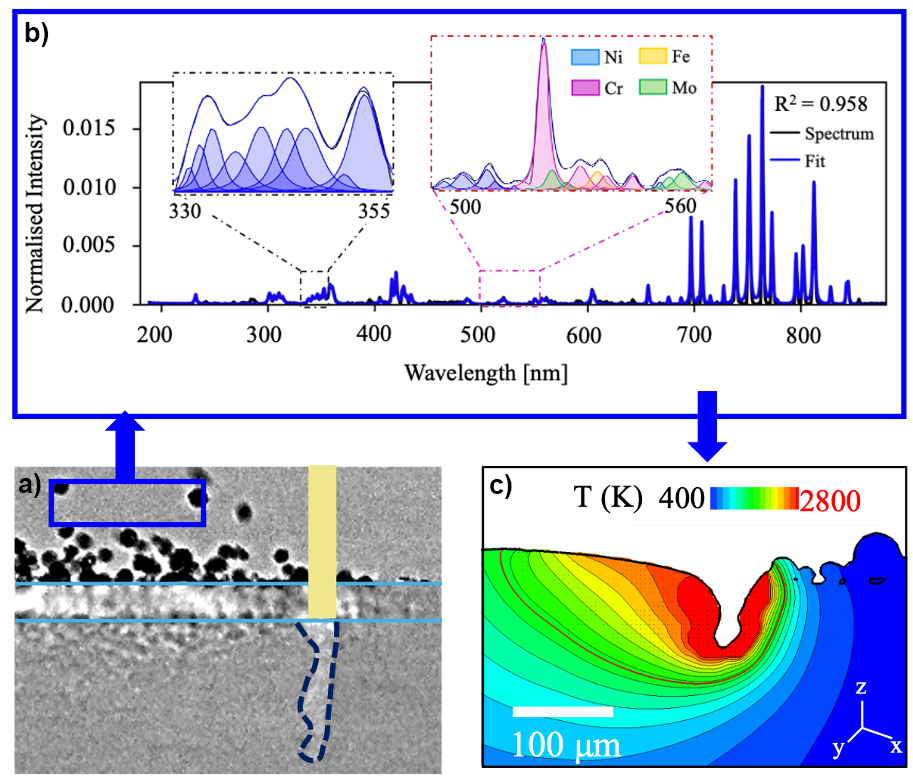
By combining the LIBS results with high-speed X-ray imaging, the influence of different melting modes, such as conduction and keyhole modes, and melt-pool dynamics on preferential vapourisation during processing was quantified. The melt pool dimension, vapour mass, and preferential vaporisation trends were used to verify and test the assumptions of three state-of-the-art LPBF process simulations (Flint et al., Ki et al./Wang et al., and Langmuir). Incorporating temperature-dependent thermophysical properties was found to improve model predictions.
Click figure to enlarge
Fig. 1: a) Simultaneous capture of melt-pool and vapour dynamics using synchrotron X-ray imaging and time-resolved laser-induced breakdown spectroscopy. The resulting data (b) are then used to calibrate high-fidelity melt-pool simulation models (c), enabling the prediction of both temperature and vapour dynamics during LPBF.
The impact
The results demonstrate that monitoring and quantifying vapour composition with LIBS provides new insights into how processing conditions influence alloy chemistry and vapour behaviour during metal 3D printing. These findings help identify the mechanisms underlying preferential vapourisation and offer a new in situ monitoring tool to improve process control. The combined X-ray and LIBS data also strengthen simulation accuracy, enabling improved prediction of melt pool behaviour (Figure 1). Ultimately, this approach supports the optimisation of laser parameters to enhance the chemical, microstructural, and mechanical performance of printed components.
|
Principal publication References |
|
About the beamline: ID19 At beamline ID19, fast tomography and ultra-high-speed radiography are frequently coupled with sample environments. In addition to classical tomography furnaces and a cold cell, recent installations include different kinds of presses for uni-axial and tri-axial loading, dynamic compression systems such as a mesoscale gas launcher, a Split-Hopkinson pressure bar and a pulsed laser. There are also dedicated rigs for battery abuse testing and in situ additive manufacturing. |
partners


European Synchrotron Radiation Facility - 71, avenue des Martyrs, CS 40220, 38043 Grenoble Cedex 9, France.