- Home
- News
- Spotlight on Science
- In situ laminography...
In situ laminography reveals particle-induced damage growth under shear
18-06-2026
Researchers have tracked damage evolution in an aluminium alloy during shear deformation using in situ X-ray computed laminography at beamline ID19. The study reveals how intermetallic particles promote rapid void growth, improving understanding of failure mechanisms in lightweight structural materials and informing future alloy and component design.
Share
The challenge
Lightweight aluminium alloys are widely used in transportation to reduce fuel consumption and improve efficiency. Improving their formability and durability is therefore important for enhancing manufacturing efficiency and extending component lifetime in sustainable mobility applications.
Microscopic features such as intermetallic particles (local microstructural heterogeneities) can strongly influence damage development and material failure. While failure mechanisms under tensile loading are relatively well understood, the processes governing damage under shear loading remain largely unclear. This is particularly relevant because many engineering materials experience shear deformation during manufacturing and service.
The experiment
This study investigated the mechanisms of damage growth in an aluminium alloy subjected to shear deformation, with particular emphasis on the role of intermetallic particles in promoting material failure. The experiment was enabled by the advanced in situ laminographic capabilities available at beamline ID19, developed in close collaboration with the Karlsruhe Institute of Technology (KIT).
X-ray computed laminography is a tomographic technique designed to investigate the three-dimensional microstructure of flat and laterally extended specimens. This approach enabled the study of a specifically designed load-path-change specimen, allowing damage nucleation in a controlled manner and subsequently its observation under simple shear loading. The sample underwent 22 incremental mechanical loading steps until failure: tension loading was applied for load steps 1–9, while for load steps 10–22 the specimen underwent shear loading.
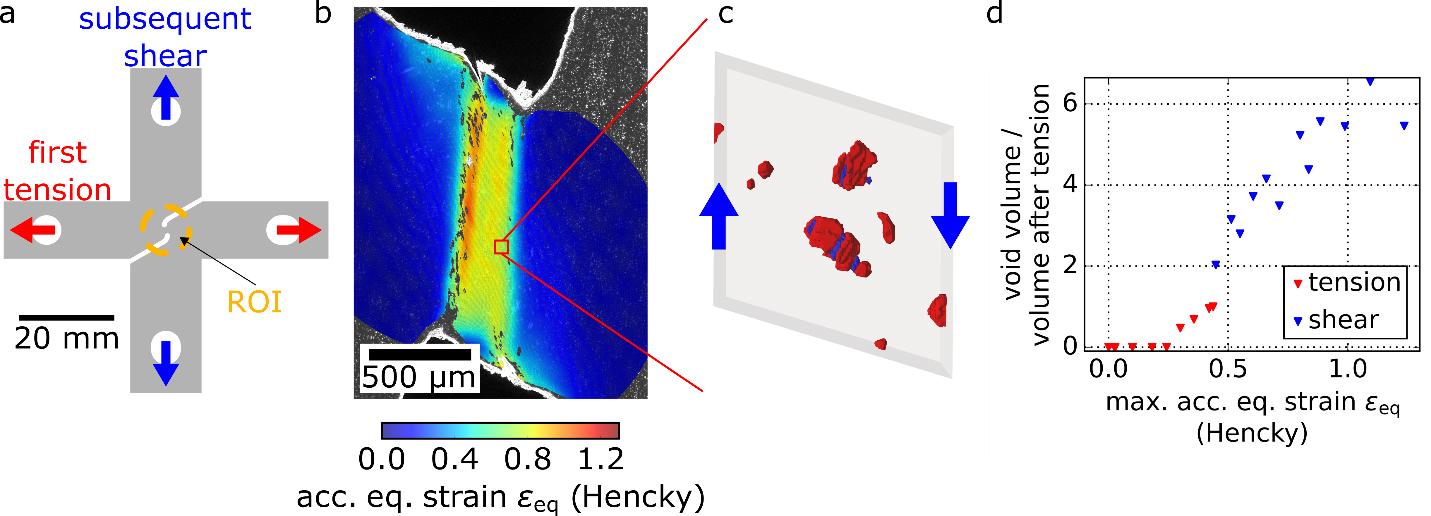
The laminographic measurements enabled the observation of mesoscale deformation and microscale morphological evolution within the material. The results show that stiff intermetallic particles promoted significant damage growth under shear loading. Microscopic voids were observed to increase in volume by more than 600% during deformation (Figure 1).
Click image to enlarge
Fig. 1: Experimental approach and observations. A load-path-change experiment is performed, enabling tensile and shear loading to be applied sequentially to the same region of interest (a). This region is monitored using in situ X-ray computed laminography during mechanical loading of the specimen. Laminography provides three-dimensional information on strain (here, accumulated equivalent strain [acc. eq. strain] is shown) (b) and on the microstructural and morphological evolution within the material. Small clusters containing intermetallic particles (red) and damage (blue) are studied during the load-path-change experiment (c). An unexpected increase in void volume of up to a factor of six is observed under shear loading (d).
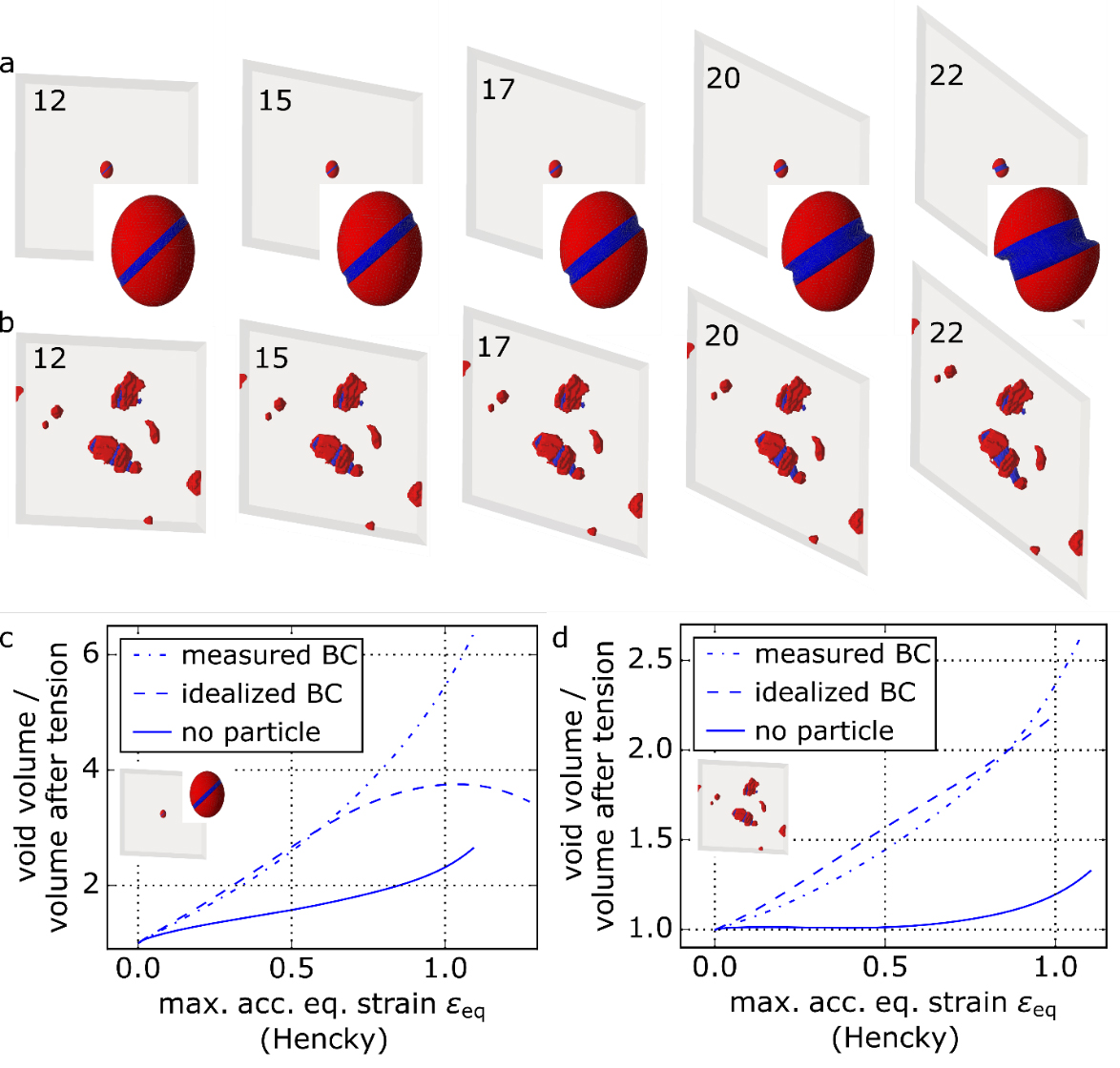
These findings were supported by advanced finite element simulations (Figure 2) based on a digital twin of the material, enabling detailed analysis of the underlying mechanisms. Key boundary conditions (BC) for the simulations, including deformation fields and the initial microstructure, were extracted from the laminographic measurements in combination with image-correlation techniques. The simulations reveal that the stiffness mismatch between the aluminium matrix and the intermetallic particles drives the pronounced damage growth observed in the material.
Click image to enlarge
Fig. 2: Simulation of particle-induced void growth under shear loading. An idealised (a) and experimentally measured (b) meshed digital twin microstructure containing intermetallic particles (red) and damage regions (blue) is shown for different load steps (the sample underwent 22 incremental loading steps until failure). Upon application of shear loading, pronounced void growth occurs within the simulated (c) and measured (d) particle clusters. Void growth is studied for different boundary conditions (BC). In the absence of such particles, void growth is strongly suppressed. (Max. acc. eq. strain: maximum accumulated equivalent strain)
The impact
The ability of in situ X-ray computed laminography to capture three-dimensional damage evolution during shear deformation provides unique insight into failure mechanisms that have remained difficult to access experimentally. A better understanding of damage mechanisms under shear loading will enable more accurate predictions of failure in mechanical components. This knowledge can subsequently be translated into improved design strategies for lightweight structural materials and components, leading to enhanced formability, durability, and reliability of structural components.
| Principal publication Particle-induced void growth under shear loading revealed by 3D X-ray laminography and finite element modeling, M. Hurst et al., Int. J. Plast. 203, 104724 (2026); https://doi.org/10.1016/j.ijplas.2026.104724 |
|
About the beamline: ID19 At beamline ID19, fast tomography and ultra-high-speed radiography are frequently coupled with sample environments. In addition to conventional tomography setups, including furnaces and a cold cell, recent installations include various presses for uniaxial and triaxial loading, dynamic compression systems such as a mesoscale gas launcher, a Split-Hopkinson pressure bar, and a pulsed laser. Dedicated setups are also available for battery abuse testing and in situ additive manufacturing. |
partners


European Synchrotron Radiation Facility - 71, avenue des Martyrs, CS 40220, 38043 Grenoble Cedex 9, France.