- Home
- News
- Spotlight on Science
- How deep-Earth glass...
How deep-Earth glass analogues compact
05-02-2026
X-ray absorption spectroscopy at BM23 was used to probe pressure-induced structural reorganisation in glassy GeO₂, a widely used analogue for deep-Earth melts. The results show that cold-compressed glasses densify differently from both crystals and high-temperature melts, with important implications for the structure of deep magmatic reservoirs and amorphous materials under extreme conditions.
Share
The challenge
Magmatic and volcanic processes play a fundamental role in the Earth’s evolution. While melts near the planet’s surface have been extensively studied, melts may also exist deep within the mantle, where pressures approach those at the core–mantle boundary. Their atomic-scale structure and physical properties remain largely unknown, as they cannot be sampled directly.
Glassy GeO2 serves as a valuable structural analogue for investigating the behaviour of deep-Earth melts under compression. A long-standing question is how amorphous materials densify under extreme pressure: whether they follow crystals-like mechanisms, melt-like behaviour, or distinct intermediate pathways. In particular, the nature of the pressure-induced transition from tetrahedral to octahedral Ge–O coordination in glasses, and the role of kinetic barriers in controlling this transformation, remain unclear.
The experiment
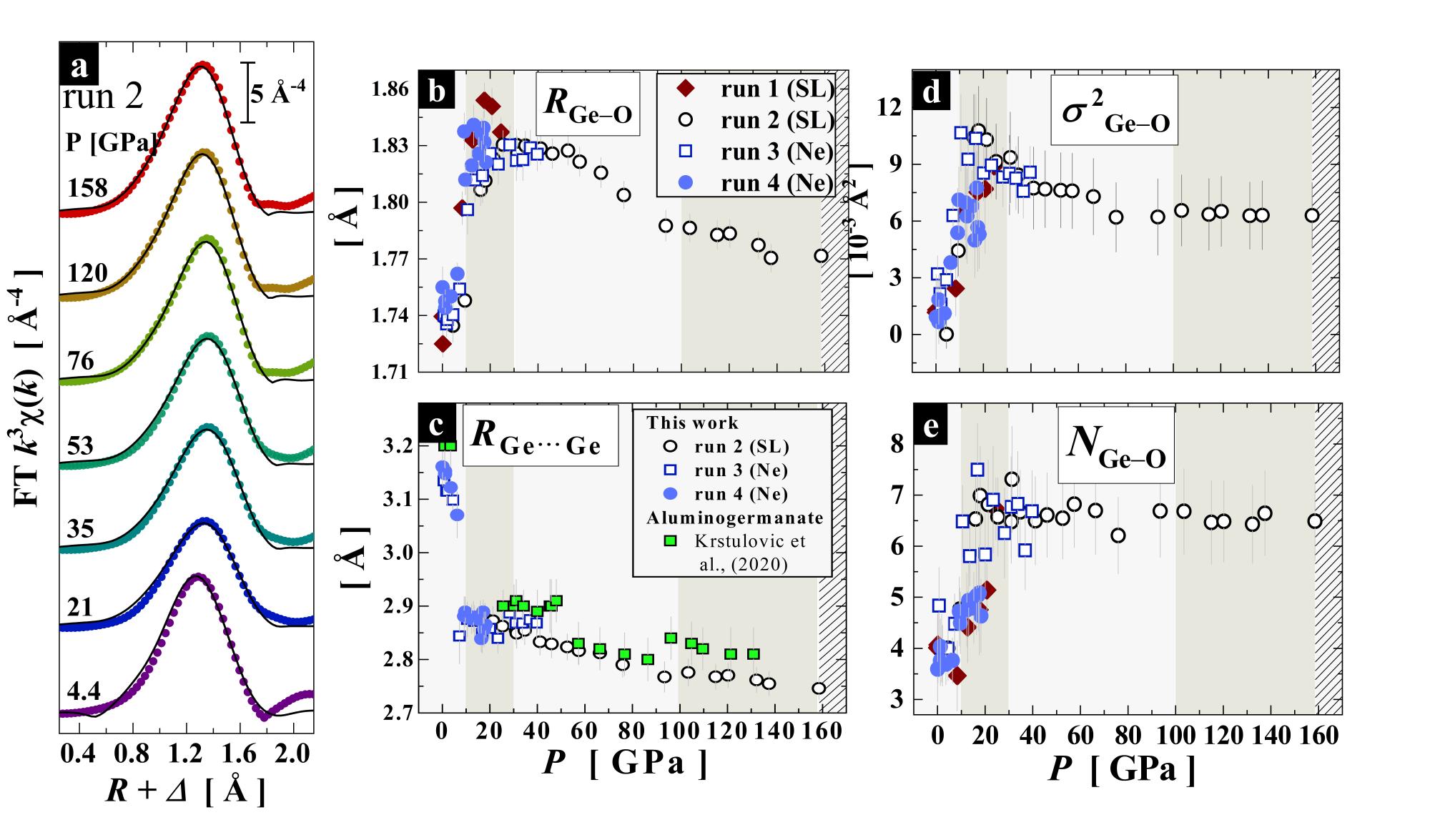
To address these questions, glassy GeO2 samples were compressed in diamond-anvil cells to pressures up to 158 GPa, exceeding those at the Earth's core–mantle boundary. X-ray absorption spectroscopy (XAS) measurements at the Ge K-edge were performed at BM23, the ESRF’s multi-purpose XAS beamline [1]. The high beam stability and signal-to-noise ratio enabled high-quality extended X-ray absorption fine structure (EXAFS) measurements, allowing subtle changes in Ge–O distances and local coordination to be resolved with high precision (Figure 1). These data enabled discrimination between bond-length variations, bond-angle distortions, coordination changes, and connectivity rearrangements during densification.
Click figure to enlarge
Fig. 1: a) Fourier-transformed EXAFS magnitudes at increasing pressure, together with best-fit models, showing the progressive evolution of local structure. b) Pressure dependence of the average Ge–O (RGe–O) first-neighbour bond distance. c) Pressure dependence of the non-bonded Ge–Ge distance (RGe…Ge), illustrating changes in medium-range order. d) Evolution of the Ge–O bond-length variance (σ2Ge–O) with pressure, reflecting increasing distortion and subsequent symmetrisation. e) Evolution of the Ge coordination number (NGe–O), exhibiting the transition from predominantly tetrahedral to octahedral environments under extreme compression.
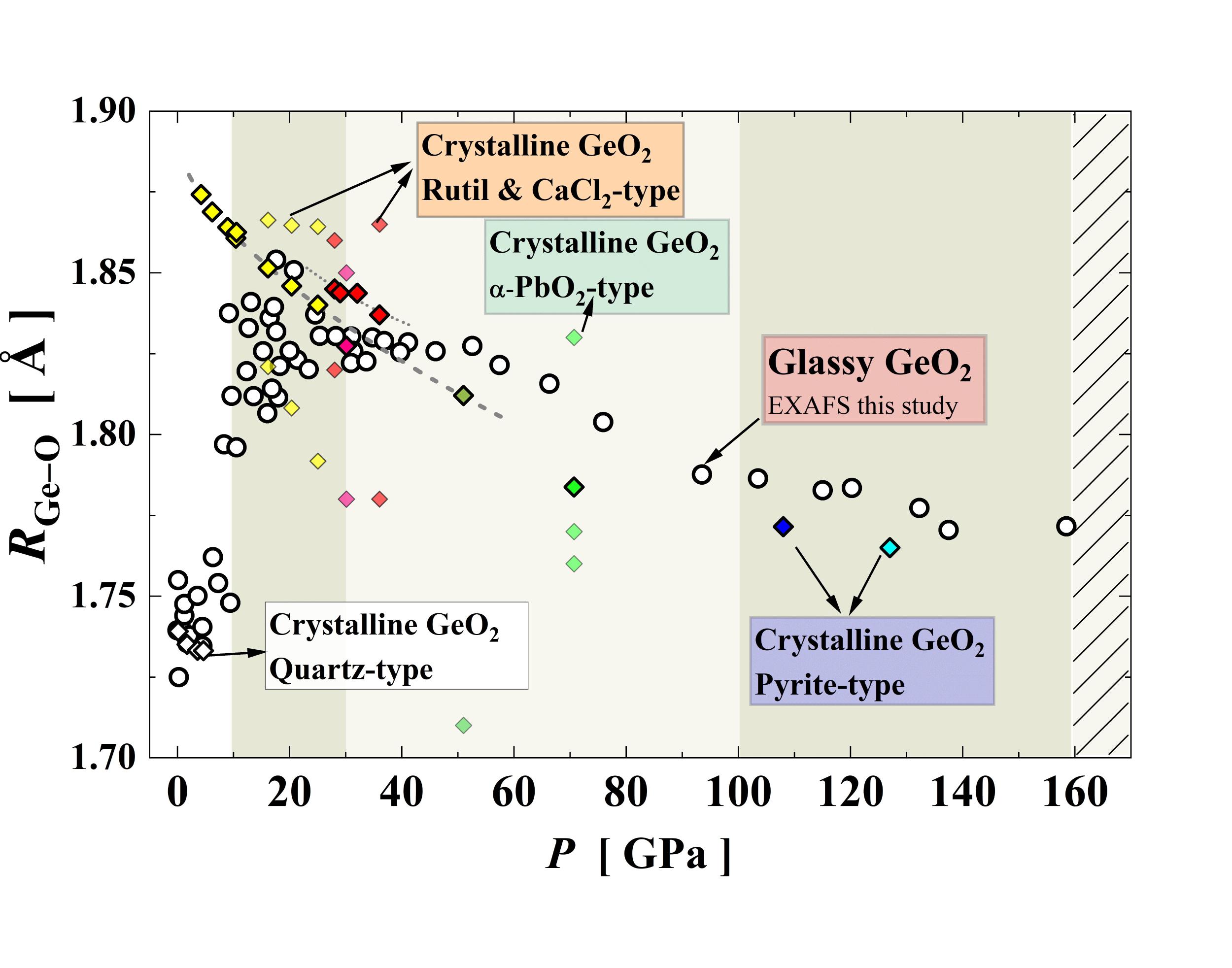
Between 10 and 30 GPa, the amorphous network exhibited pronounced variability in Ge–O distances, reflecting high structural flexibility. Above 30 GPa, edge-sharing Ge-O octahedra became dominant. Further compression to 100 GPa proceeded mainly through bond-angle distortion and structural symmetrisation, while at still higher pressures octahedral distortion emerged as the primary densification mechanism. Comparison with crystalline GeO2 polymorphs revealed that glass densifies less efficiently (Figure 2), indicating kinetic constraints that inhibit reconstructive structural rearrangements.
Click figure to enlarge
Fig. 2: Evolution of the Ge–O bond distance in glassy GeO2 under compression. Values derived from Ge K-edge EXAFS at BM23 are compared with those reported for crystalline polymorphs of GeO2. The data illustrate how the amorphous material departs from the behaviour of quartz-, rutile-, CaCl2-, α-PbO2-, and pyrite-type structures.
Overall, the results demonstrate that cold-compressed glasses do not densify in the same manner as either crystals or melts. In glassy GeO2, pressure-induced coordination changes become kinetically hindered above 40 GPa, leading to metastable densification pathways under non-hydrostatic stress. By contrast, at elevated temperature, these kinetic barriers are relaxed and structural transitions follow alternative routes.
The impact
This work resolves a long-standing debate concerning whether glasses undergo crystal-like structural evolution under extreme pressure. The findings provide new constraints on the structure of deep magmatic analogues and improve our understanding of processes occurring within the Earth’s mantle. More broadly, the study highlights BM23 as a powerful platform for ultra-high-pressure XAS, demonstrating that precise EXAFS measurements in diamond-anvil cells can reveal atomic-scale mechanisms governing densification in amorphous materials.
|
Principal publication
|
|
About the beamline: BM23 BM23 hosts a broad range of flexible sample environments, including cryostats, ovens, gas systems, chemistry cells, high-pressure cells, DRIFTS/XAS/MS setups, and dedicated user and in-house configurations. These capabilities support research across chemistry, Earth and geosciences, and hard condensed matter physics. A dedicated micro-XAS station has recently been implemented, providing enhanced mechanical precision and increased flexibility for experiments requiring micrometre-sized beam spots (e.g., cryo-DACs, large-volume presses, and external or internal RH-DAC systems). The focal spot size is below 3×3 µm2 (FWHM), with a photon flux of approximately 109 ph/s. The micro-XAS station operates over an energy range of 5 and 45 keV, and a Pilatus 1M detector is available for complementary X-ray diffraction measurements. |
partners


European Synchrotron Radiation Facility - 71, avenue des Martyrs, CS 40220, 38043 Grenoble Cedex 9, France.