- Home
- News
- Spotlight on Science
- A route to suppressing...
A route to suppressing fusion instabilities revealed by ultrafast X-rays
06-05-2026
Ultrafast X-ray imaging at beamline ID19 captured jetting driven by the Richtmyer–Meshkov instability during shock compression relevant to inertial fusion energy. The results show that optimised subsurface voids can passively suppress jet formation, offering a new strategy to control mixing and improve inertial fusion performance.
Share
The challenge
Global electricity demand rose by over 4% in 2025, driven by the rapid expansion of data centres and accelerating electrification. Inertial confinement fusion offers the prospect of contributing to this demand by producing energy through the controlled thermonuclear burn of hydrogen isotopes – the same self-sustaining reaction that powers the Sun.
On Earth, inertial fusion reactions are typically triggered by compressing fuel capsules using powerful lasers or intense electrical currents. The National Ignition Facility in Livermore, California, demonstrated a target energy gain greater than unity in 2024 [1]. Efficient fusion requires highly uniform compression, yet even small asymmetries in capsule design or fabrication can grow under compression into high-speed jets that penetrate the fuel and rapidly lower its temperature. This process is known as the Richtmyer-Meshkov instability and limits fusion performance.
The experiment
Capturing ultrafast jetting requires X-ray imaging on nanosecond timescales. The ID19 beamline enables a new experimental approach by combining high-speed X-ray imaging at up to 5.5 million images per second with dynamic compression platforms, allowing direct observation of instability-driven jet formation in well-controlled surrogate systems at lower-pressures.
The experiments, carried out within the ‘Shock’ Beam Allocation Group, employed a pulsed-power sample environment capable of discharging approximately 150,000 amperes through metal samples in just 600 nanoseconds – comparable to several simultaneous lightning strikes (Figure 1) [2]. A 12.5 μm-thick copper foil exploded under this current, launching a shock wave into a thin gelatine layer with a rippled surface. The evolution of this ripple was tracked using ultrafast X-ray imaging as the shock propagated through the material.
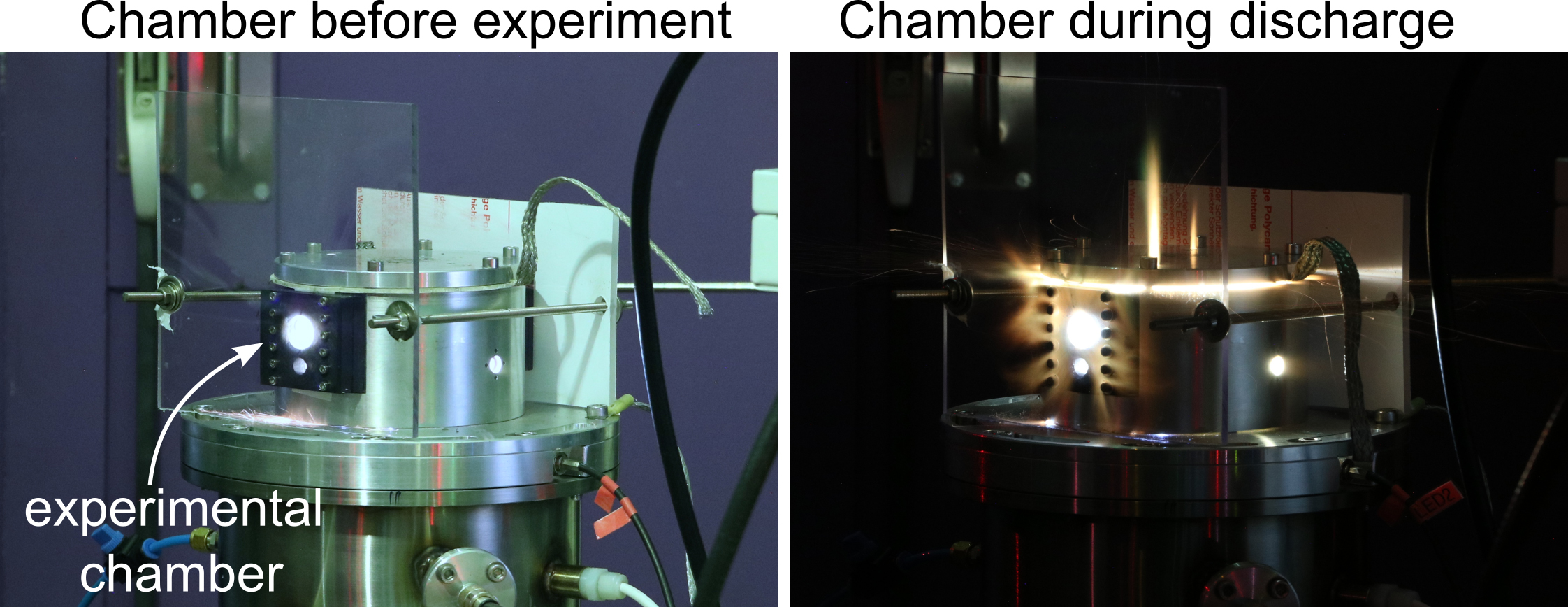
Fig. 1: Long-exposure photograph of the experimental chamber of the pulsed-power generator used at beamline ID19. During discharge, the system drives an electrical current through a thin copper foil that is comparable in magnitude to multiple lightning strikes inside the chamber. Credit: Jean-Alexis Hernandez during collaborative beamtime at ID24-ED.
After shock compression, the rippled surface accelerated to ~ 300 ms⁻¹, with unstable jets forming via the Richtmyer-Meshkov instability and travelling at speeds exceeding 600 m s⁻¹. The difference between the position of the mean interface and the jet tips – commonly referred to as the “mixing width” – is used as a measure of the instability strength. Under ideal compression conditions, as required for in inertial fusion, no mixing should occur between the accelerated surface and the surrounding fluid. Introducing small, precisely engineered voids beneath the rippled surface – designed using machine learning – reduced the growth rate of the mixing width, defined as the difference between the jetting and mean surface velocities, to just over 80 m s⁻¹ (Figure 2).
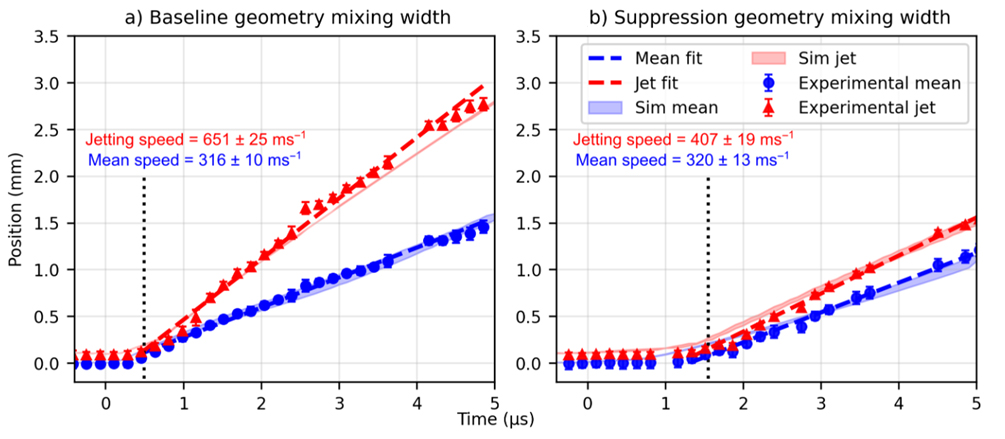
Fig. 2: a) Scatter plot shows the evolution of the mean interface and jet position in a baseline rippled configuration, while dashed line shows linear fit (speed) and shaded area shows positions predicted by numerical models. b) Equivalent plot showing significant suppression of jetting speeds in the presence of optimised subsurface voids, demonstrating the passive stabilisation mechanism. In both plots, the vertical dotted line shows the moment shock impacts the sample surface, accelerating it, and initiating jetting.
Simulations showed that collapsing voids redistribute shock pressure into multiple pulses, suppressing surface instabilities. This supports a 40-year-old theoretical prediction [3] that subsurface features can passively “freeze out” Richtmyer-Meshkov instabilities.
The impact
These findings demonstrate that carefully designed subsurface features can strongly influence fluid behaviour at material surfaces, including jet suppression. This insight suggests new strategies for controlling mixing in systems with rapid pressure and density gradients, such as inertial fusion experiments.
Ultrafast X-ray imaging at synchrotrons and XFELs provides highly controlled environments to test such concepts, enabling the identification of promising approaches for future high-energy-density studies. Recent work at ID19 has extended these studies to cylindrical implosions with sinusoidal perturbations, as seen in the video below:
|
Principal publication References |
|
About the beamline: ID19 At beamline ID19, fast tomography and ultra-high-speed radiography are frequently coupled with sample environments. In addition to conventional tomography furnaces and a cold cell, recent installations include various presses for uniaxial and triaxial loading, dynamic compression systems such as a mesoscale gas launcher, a Split-Hopkinson pressure bar and a pulsed laser. Dedicated setups are also available for battery abuse testing and in situ additive manufacturing. |
partners


European Synchrotron Radiation Facility - 71, avenue des Martyrs, CS 40220, 38043 Grenoble Cedex 9, France.