- Home
- News
- General News
- X-rays reveal hidden...
X-rays reveal hidden step in glass relaxation
04-06-2026
Nuclear resonance experiments performed at the ESRF have clarified the relationship between two types of molecular motion in liquids approaching the glass transition. The experiments show that a process known as β relaxation is not an independent type of motion, as often assumed, but part of the broader mechanism by which the liquid structure rearranges. The results are published in Nature Physics.
Share
At first glance the behaviour of liquids and glasses seems straightforward. Atoms in a liquid can move easily, while atoms in a glass are mostly unable to rearrange. Yet the reality is more puzzling. As a liquid is cooled towards its glass transition, the time required for rearrangements grows enormously, yet the atomic structure changes very little.
Physicists have long believed that several distinct relaxation processes are at work. The main one, α relaxation, corresponds to molecules escaping the temporary “cages” formed by their neighbours, and eventually allows the liquid to flow. At the opposite end of the spectrum is fast β relaxation, in which molecules rattle inside their cages over much shorter distances and timescales. Somewhere in between lies Johari–Goldstein β relaxation, named after the physicists Gyan Johari and Martin Goldstein who first identified it. The microscopic origin of this relaxation, and its relationship to α relaxation, have been debated for decades.
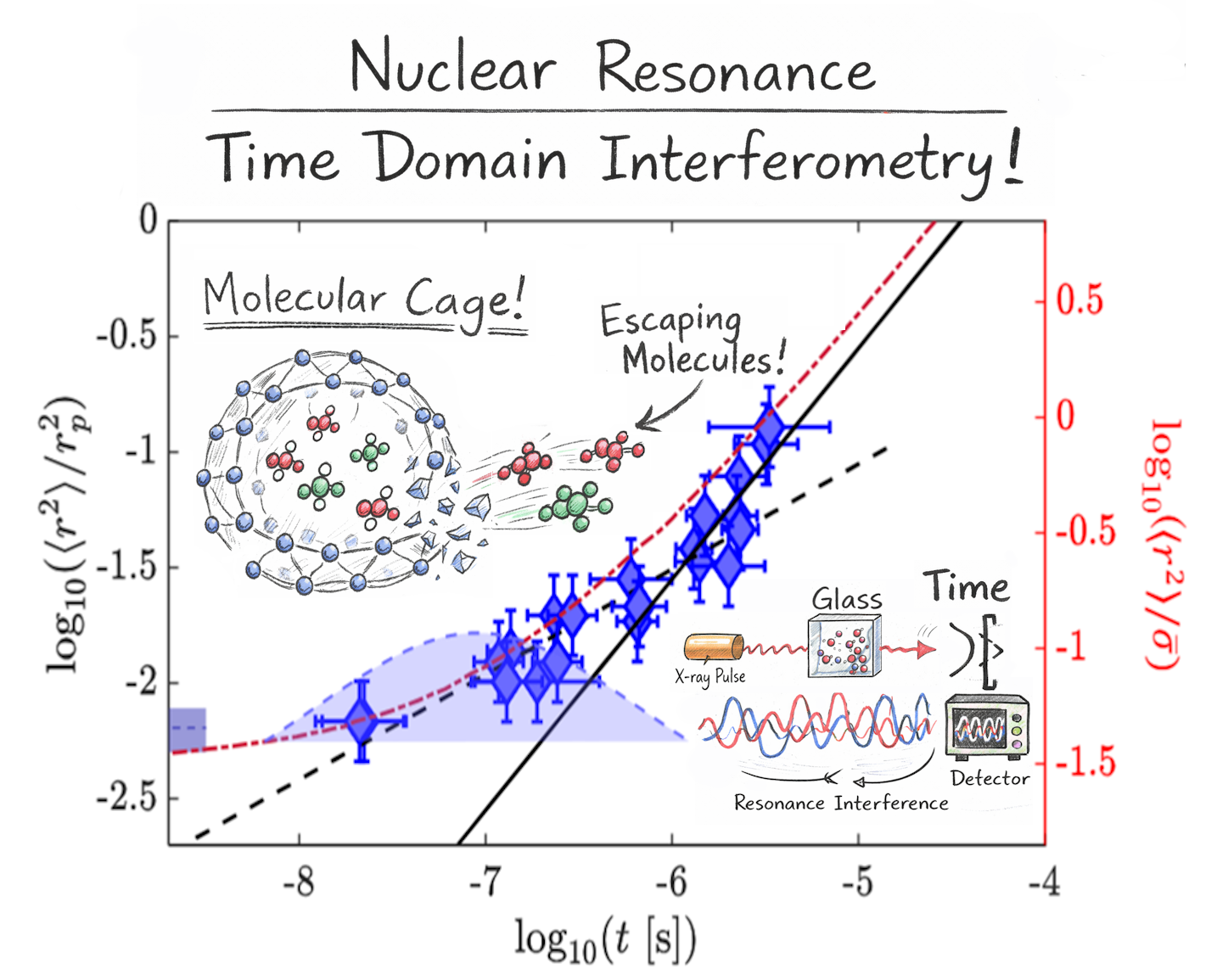
Now Federico Caporaletti at the Université libre de Bruxelles in Belgium and colleagues believe they may have resolved this question using a technique known as time-domain interferometry. Based on nuclear-resonance X-ray scattering at the ESRF’s former ID18 beamline, the technique allows them to probe molecular motions on length scales comparable to intermolecular distances and on timescales between roughly ten nanoseconds and ten microseconds – a window that is difficult to access with other experimental methods.
Working with beamline scientists Aleksandr Chumakov and Dimitrios Bessas, the ID18 users could look through this window to where the crucial dynamics occurred. Studying a well-known molecular glass former, they were able to capture the signature of Johari–Goldstein β relaxation. Their measurements showed that this process is not an independent local motion, but a precursor of α relaxation that ultimately breaks the cages formed by neighbouring molecules. “Historically, the regime preceding diffusion was attributed to microscopic motions different to the slow Johari–Goldstein β relaxation,” says Caporaletti. “No detailed, microscopic theory of the glass transition has ever postulated or derived such a result.”
The findings do not overturn previous descriptions of relaxation processes that treat α and β relaxation separately. However, they do suggest that this apparent separation does not reflect an underlying dynamical independence at the microscopic level. “Further experimental and computational studies across different glass-forming systems will be valuable to verify the generality of our new picture,” says Bessas.
 |
Besides its importance for the understanding of glass relaxation, the work highlights the growing potential of time-domain interferometry, which has been steadily developed since its introduction 15 years ago. The technique currently probes a unique window of molecular motion, but its efficiency could increase dramatically with new detector technologies.
According to Bessas, a pixelated detector capable of measuring time delays of aabout a nanosecond in each pixel could improve data collection by three orders of magnitude. Such developments would allow the method to be applied more widely, including to polymers and other complex glass-forming materials. “We’re working in this direction and we’re not far away,” says Bessas. “In summer we’ll have the first pilot measurements using a similar detector under development.”
Reference:
Caporaletti, F., Capaccioli, S., Bessas, D. et al. Crossover of quasi-localized dynamics and diffusion in supercooled liquids. Nat. Phys. (2026). https://doi.org/10.1038/s41567-026-03320-5
Text by Jon Cartwright
Top image: How far molecules move over time in a supercooled liquid approaching the glass transi-tion, as measured by time-domain interferometry at the ESRF's former ID18 beamline. At short timescales molecules remain trapped in temporary "cages" formed by their neighbours, but over slightly longer timescales – the region shaded blue – so-called Jo-hari–Goldstein β relaxation takes over. The data show that this motion is not a separate process, as long assumed, but part of the same rearrangement that eventually allows the cages to break and the liquid structure to relax.
partners


European Synchrotron Radiation Facility - 71, avenue des Martyrs, CS 40220, 38043 Grenoble Cedex 9, France.