- Home
- News
- General News
- The role of methanol...
The role of methanol in large icy moons uncovered
23-06-2025
Scientists led by the ESRF find that the volatile compound methanol in icy moons gets trapped in hydrates at high pressure and low temperature. This finding is crucial for understanding evolution of subsurface oceans and interpreting data delivered by current and future space missions. The results are out in Earth and Planetary Science Letters.
Share
Icy moons orbiting Jupiter and Saturn are some of the most intriguing bodies in our Solar System, as several of them are known to host liquid oceans beneath their frozen surfaces. Besides the Earth, these are the only places in the Universe, where the presence of liquid water has been confirmed. Subsurface oceans are the prime targets in search for extraterrestrial life and are central to several ongoing and upcoming space missions. Already launched ESA’s JUICE and NASA’s Europa Clipper missions will start exploration of Jupiter’s moons Europa, Ganymede and Callisto in less than a decade, while NASA’s rotorcraft Dragonfly will start its journey to Saturn’s moon Titan in 2028.
One of the most striking features of these icy moons is the size of their hydrospheres. For example, the largest moon Ganymede is believed to have ~1000 km deep hydrosphere, resulting in pressures at its base that are around 17 times higher than in the Earth’s ocean. Such high pressures can cause crystallization of the oceans at the bottoms. While many organic volatile compounds are expected to be present in the interior of icy moons, their fate at high pressures remains poorly understood.
 |
|
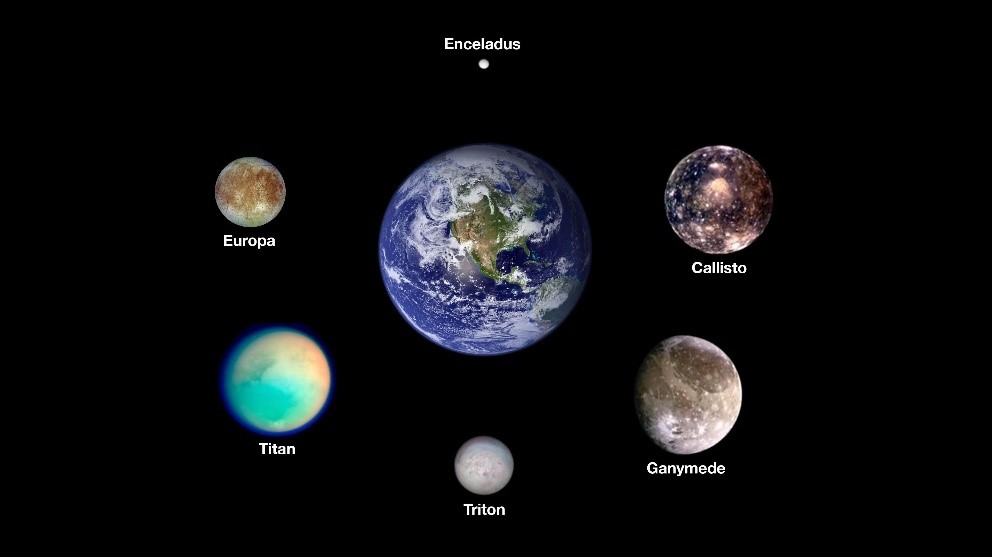
Six icy moons in our solar system may currently host oceans of liquid water beneath their outer surfaces. |
Methanol, CH3OH, is a volatile of particular interest due to due to its expected abundance and debated role in ocean crystallization. Typically, it is considered as a powerful antifreeze agent that inhibits formation of ice and hydrates and contributes to long-term survival of the subsurface oceans. However, recent studies suggested that in chemically complex environments and in presence of promoters, small amounts of methanol can be incorporated in hydrate structures at low temperatures.
.jpg) |
|
Anna Pakhomova and Baptiste Journaux in the lab. |
Now scientists led by the ESRF and in collaboration with the Laboratory of Planetology and Geosciences in Nantes (France), the University of Washington - Seattle (USA) and the University of Bayreuth (Germany) and have studied the fate of methanol in large icy moons. The team used high-pressure, low temperature, in situ single crystal X-ray diffraction on beamline ID15b.
“Our experiments show that, at high pressure, large amounts of methanol can be stored in hydrates that serve as a storage of methanol over geological timescales”, explains Anna Pakhomova, lead author and scientist at the ESRF.
Implications for the knowlege on planets
Baptiste Journaux, co-author and member of the NASA’s Dragonfly mission team, adds: “Titan has been shrouded in a decades-long mystery regarding the source of methane in its atmosphere. Crystalline hydrates hosting methanol serve as a more than sufficient source of methane through hydrothermal hydrogenolysis reactions. These reactions are capable of producing methane well beyond the age of the solar system.”. Gabriel Tobie, co-author and leader of the JUICE Interior/Geophysics working package, says: “Trapping methanol at high pressure can also explain why we do not detect it on the surface of large ocean worlds but we do in small icy worlds. Our study underlines the crucial importance of in situ experiments in understanding chemical transfer within the interiors of large icy moons and supporting the interpretation of data collected by ESA JUICE, NASA Europa Clipper and NASA Dragonfly, among other missions”.
This research is part of the ANR project High-pressure clathrate hydrates in large ocean worlds – CAGES.
Reference:
Pakhomova, A. et al, Earth and Planetary Science Letters, Volume 666, 15 September 2025, 119478 https://doi.org/10.1016/j.epsl.2025.119478
partners


European Synchrotron Radiation Facility - 71, avenue des Martyrs, CS 40220, 38043 Grenoble Cedex 9, France.