- Home
- News
- General News
- How an enzyme from...
How an enzyme from a carnivorous plant could make a difference for celiacs
04-06-2026
A newly-designed enzyme, dubbed celiacase, could potentially alleviate celiac disease. The molecule effectively degrades immunogenic peptides from gluten in the stomach, before it reaches the intestine. The research, published in EMBO Molecular Medicine, opens new doors to therapeutic adjuvants to a gluten-free diet. The structure of celiacase was solved at the ESRF.
Share
Celiac disease, an autoimmune disease with symptoms triggered by the consumption of gluten, affects >1% of the worldwide population, with detrimental consequences on daily lives. During digestion, gluten does not completely break down into smaller fragments (called peptides) in the stomach, leaving some larger peptides that can be toxic for celiac patients, dubbed gluten immunogenic peptides (GIPs). These are able to withstand the stomach’s gastric acids and reach the small intestine. When this happens, an inflammatory response is triggered in celiac patients, as well as in non-celiac gluten sensitivity and gluten allergy patients.
Despite a lot of ongoing research, there is no current treatment to manage celiac disease or gluten intolerance aside from a strict gluten free diet. Until today.
Scientists led by the Molecular Biology Institute of Barcelona (IBMB) of the CSIC (which stands for Consejo Superior de Investigaciones Científicas), the Nutrition and Food Safety Research Institute (INSA-UB) and the Faculty of Pharmacy and Food Sciences at the University of Barcelona (UB) have discovered a molecule originating from a carnivorous plant that could degrade gluten before it reaches the intestines.
Inspired by nature
The idea of using this enzyme stemmed from a 2016 study by the University of Calgary that showed that the digestive fluid from the carnivorous Nepenthes Ventrata digestive system, which includes the enzyme neprosin, could break down gluten.
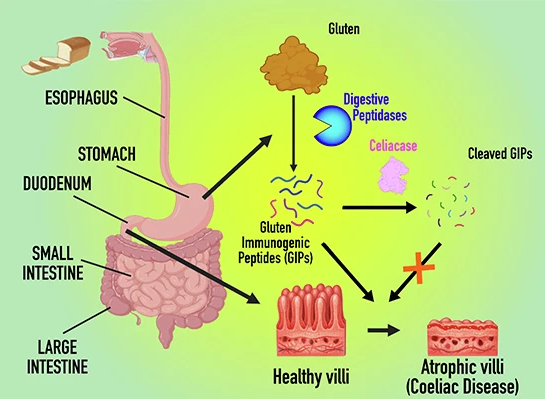
“The breakthrough of our story is that we've designed a mutant molecule, which we have called celiacase, which is effective at very low concentrations and in the acidic environment of the stomach”, explains F. Xavier Gomis-Rüth, one of the two corresponding authors of the publication. “This is a major advantage over existing ‘supplements’ in the market that are supposed to help celiac disease patients, when in fact they need large quantities and they are only effective when the gluten has arrived to the intestines and then it is already too late”, adds Francisco J. Pérez-Cano, the other corresponding author. “Another advantage of celiacase is that it is no longer active once it reaches the duodenum, so it does not interfere with other proteins in the body”.
 |
|
A schematic illustration that shows how Celiacase functions. Credits: Girbal-González, M., et al. EMBO Mol Med (2026). |
The team came to the ESRF to solve the structure of celiacase on beamline ID23-1A. “We have been studying this enzyme for five years already, and the ESRF has been a key player in solving its structure”, explains Gomis-Rüth. “We are regular users of the ESRF since many years, both of MX and cryo-EM”, he adds.
Spin-off
The molecule and its potential applications have been patented, and the team is taking the first steps towards creating a spin-off company. The goal is to take this research forward in the form of clinical trials that could lead to a potential new supplement in the market for celiac disease.
Reference:
Text by Montserrat Capellas Espuny
partners


European Synchrotron Radiation Facility - 71, avenue des Martyrs, CS 40220, 38043 Grenoble Cedex 9, France.