- Home
- News
- General News
- First-ever egg of...
First-ever egg of a mammal ancestor discovered
09-04-2026
Scientists from the University of Witwatersrand (South Africa) and the ESRF discover the first-ever egg of a mammal ancestor, a 250-million year-old proto-mammal embryo, with the help of the ESRF. The results are out now in PLoS ONE.
Share
A new discovery is shedding light on one of the greatest survival stories in Earth’s history, and answering a decades-old scientific mystery. Lystrosaurus, a hardy, plant-eating mammal ancestor, rose to prominence in the wake of the End-Permian Mass Extinction some 252 million years ago, the most devastating extinction event our planet has ever experienced. While countless species vanished, Lystrosaurus not only survived, but thrived in a world marked by extreme environmental instability, intense heat, and prolonged droughts.
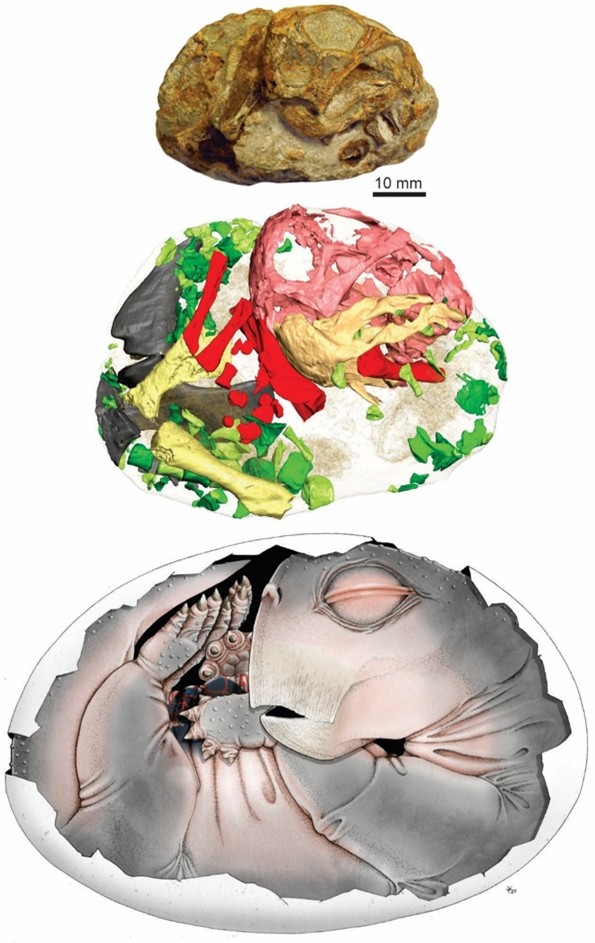
Now, new research published in PLoS ONE reveals a discovery that sheds new light on our understanding of this iconic survivor. An international team led by Julien Benoit, Jennifer Botha (Evolutionary Studies Institute, University of the Witwatersrand, South Africa), and Vincent Fernandez (ESRF ) has identified, for the first time, an egg containing an embryo of Lystrosaurus, dating back approximately 250 million years. This rare fossil represents the first-ever egg discovered from a mammal ancestor, finally answering a long-standing question: Did the ancestors of mammals lay eggs?
The answer is yes.
The researchers suggest these eggs were likely soft-shelled, explaining why they have remained elusive for so long. Unlike the hard, mineralized eggs of dinosaurs, which fossilize readily, soft-shelled eggs rarely preserve, making this find exceptionally rare. But the implications go far beyond reproduction.
“This fossil was discovered during a field excursion I led in 2008, nearly 17 years ago. My preparator and exceptional fossil finder, John Nyaphuli, identified a small nodule that at first revealed only tiny flecks of bone. As he carefully prepared the specimen, it became clear that it was a perfectly curled-up Lystrosaurus hatchling. I suspected even then that it had died within the egg, but at the time, we simply didn’t have the technology to confirm it,” says Botha.
 |
|
Lystrosaurus embryo within its partially preserved shell, photograph of the fossil (top), CT scan of the skeletal elements (middle), reconstruction of the animal (bottom). |
With the advent of advanced synchrotron tomography technique and ESRF’s bright X-rays, Benoit and Vincent Fernandez were finally able to unlock the last pieces of the puzzle. Fernandez described the experience as particularly thrilling: “Understanding reproduction in mammal ancestors has been a long-lasting enigma and this fossil provides a key piece to this puzzle. It was essential that we scanned the fossil just right to capture the level of detail needed to resolve such tiny, delicate bones.”
The scans revealed a critical clue. “When I saw the incomplete mandibular symphysis, I was genuinely excited,” says Benoit. “The mandible, the lower jaw, is made up of two halves that must fuse before the animal can feed. The fact that this fusion had not yet occurred shows that the individual would have been incapable of feeding itself.”
The study reveals that Lystrosaurus laid relatively large eggs for its body size. In modern animals, larger eggs typically contain more yolk, providing all the nutrients an embryo needs to develop independently, without parental feeding after hatching. This strongly suggests that Lystrosaurus did not produce milk for its young, unlike modern mammals. Large eggs also offer another crucial advantage: they are more resistant to drying out. In the harsh, drought-prone environment following the extinction, this would have been a critical survival trait. The findings further suggest that Lystrosaurus hatchlings were likely precocial, born at an advanced stage of development. These young animals would have been capable of feeding themselves, escaping predators, and reaching reproductive maturity quickly.
In other words, Lystrosaurus succeeded by living fast and reproducing early. This discovery not only provides the first direct evidence of egg-laying in mammal ancestors but also offers a powerful explanation for how Lystrosaurus came to dominate post-extinction ecosystems. As scientists continue to uncover the biology of ancient survivors, one thing is becoming clear: resilience, adaptability, and reproductive strategy were key to enduring Earth’s darkest chapter, and Lystrosaurus mastered them all.
Reference:
https://journals.plos.org/plosone/article?id=10.1371/journal.pone.0345016
Funding
GENUS: DSTI-NRF Centre of Excellence in Palaeosciences; National Research Foundation’s African Origins Platform; Palaeontological Scientific Trust
partners


European Synchrotron Radiation Facility - 71, avenue des Martyrs, CS 40220, 38043 Grenoble Cedex 9, France.