Deep Earth Interior
Recent research topics
ESRF researchers explore the inaccessible Earth and planetary interiors through in-situ high P/T experiments to unravel the geological processes that shape a planet.
|
|
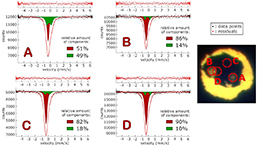
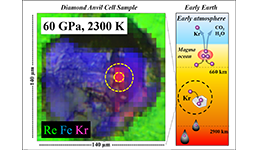
Georgios Aprilis (Post-Doc at ID18) in close collaboration with researchers from Bayerisches Geoinstitut (Bayreuth, Germany) studies the chemistry and magnetism of geomaterials at the HP/HT conditions of the deep Earth’s interior using pulsed laser heating inside the diamond anvil cell and time-resolved synchrotron Moessbauer spectroscopy. |
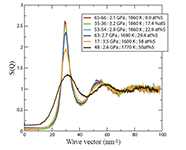 |
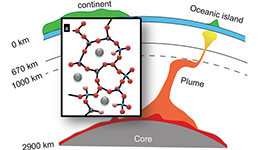
Lucie Canet (PhD student at ID27) structure of iron bearing silicate melts at Earth's lower mantle conditions. |
|
|
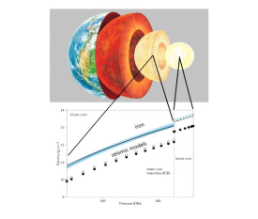
Jean-Alexis Hernandez (Junior Scientist at ID24-HPLF) investigates the structure, melting and properties of dense silicates using a combination of laser-driven dynamic compression experiments coupled to ultrafast X-ray probes and atomistic simulations. This research aims at constraining our knowledge of the early Earth and other large terrestrial planet interiors. It is done in collaboration with colleagues from ISTerre (France), LULI (France), IMPMC (France), CEED (Norway), Stanford University (USA), and Osaka University (Japan). He also investigates the structure, melting and properties of dense silicates using a combination of laser-driven dynamic compression experiments coupled to ultrafast X-ray probes and atomistic simulations. This research aims at constraining our knowledge of the early Earth and other large terrestrial planet interiors. It is done in collaboration with colleagues from ISTerre (France), LULI (France), IMPMC (France), CEED (Norway), Stanford University (USA), and Osaka University (Japan). |
|
|
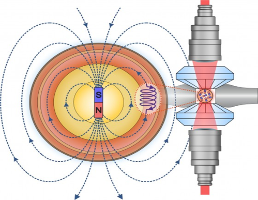
Ilya Kupenko (Scientist at ID14), George Aprilis (Junior Scientist at ID14), and Susanne Müller (Ph.D. student at ID14) are currently investigating the composition of the Earth’s core. The group is conducting Nuclear Inelastic Scattering experiments at ID14 and Inelastic X-ray scattering experiments at ID28, as well as X-ray diffraction experiments at ID15b and ID27. The measured data is combined to determine the elastic properties of the light-element-bearing iron alloys and compounds. Compared with measured seismic data, this aims to constrain the amount of the possible light element candidates (H, C, O, Si, S) in the Earth’s core. This will allow us to determine the composition of the core of our planet and will advance our understanding of the formation and evolution of planetary bodies. |
|
|
Xiang Li (Psot-Doc at ID14) is investigating the magnetic transitions in iron oxides. It is usually considered that the Earth’s mantle is non-magnetic due to its elevated temperatures being too high to retain any magnetism in the constituting minerals. We recently showed, that some iron-bearing phases retain magnetism at pressures corresponding to the Earth’s transition zone and temperatures corresponding to the “cold” regions inside the Earth, e.g. at subduction zones, and may cause deep magnetic anomalies. We are now investigating recently discovered iron oxides with unconventional stoichiometries (e.g. Fe4O5, Fe5O7) by Synchrotron Mössbauer Source spectroscopy at ID14 to trace their potential magnetic signatures inside our planet. |
 |
Yaozhu Li is a Postdoctoral Researcher at ID03, focusing on shock-induced plastic deformation in planetary materials. His research leverages microstructural analysis of crystals to unravel the deformation history of planetary bodies. Specifically, he employs dark-field X-ray microscopy to investigate distorted crystals, reconstructing their 3D deformation volumes and mapping dislocation distributions. He collaborates with ID19 to study experimentally shock-deformed olivine peridotites and with ID11 to explore scanning 3D techniques for analyzing the mineralogy and strain history of Paris carbonaceous chondrites. Additionally, he works with researchers at CNRS to conduct in-situ high-strain deformation and annealing experiments, aiming to better understand shock features in Martian basalts. |
|
|
Wolfgang Morgenroth (Scientist at ID27, Univ. Potsdam, Germany) is currently working on the stability of minerals at conditions of the upper mantle. He is part of the German BMBF project "Nano-focus end-station with double-sided CO2 laser heating for experiments at extreme conditions at the ESRF, Grenoble" (Univ. Potsdam, Univ. zu Köln) supporting the upgrade of beamline ID27 with unique nano-focus instrumentation for rapid parallel XRD and XRF. |
 |
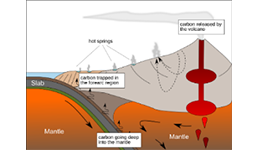
Apostolos Pantousas (PhD student ID27) is investigating the geochemical interactions of H2O with minerals of the Earth's mantle. The aim of this research is to uncover information on the deep-water-cycle and the fate of water and other volatile substances when they get to interact with the Earth's mantle through tectonic processes such as subduction of slabs from the crust. The reactions mimic the conditions of the Earth's mantle using laser-heated diamond anvil cells and the products are investigated using single-crystal X-ray diffraction at the extreme conditions beamline ID-27. |
|
|
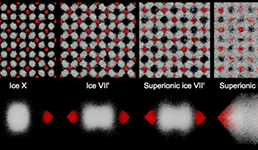
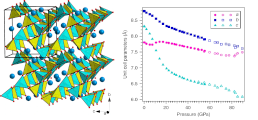
Anna Pakhomova (Scientist at ID27) studies chemical reactions and mechanical properties of crystalline geomaterials building interiors of the Earth and icy satellites. The research is largely based on in situ single-crystal X-ray diffraction with usage of diamond anvil cell technique that allows unambiguous determination of crystal structures in a wide range of pressure-temperature space. |
|
|
Angelika D. Rosa (Scientist at ID24-DCM/BM23) is presently investigating the behaviour of volatiles and fluid mobile elements at the extreme high P/T conditions of the deep Earth’s interior. Her research aims at reconstructing the evolution of the atmosphere and planetary interior dynamics by constraining large-scale volatile distribution processes since Earth’s formation (4.5 Gyrs ago). For this research she is using X-ray absorption spectroscopy and X-ray diffraction. |
|
|
Christoph Sahle (Scientist at ID20) is using non-resonant inelastic X-ray scattering spectroscopy to measure the local atomic and electronic structure of low-Z elements at pressures up to lower-mantle conditions via X-ray Raman scattering (XRS) of shallow absorption edges. Examples include the fate of silicate- and carbonate glasses and molecular systems such as supercritical liquids. |
|
|
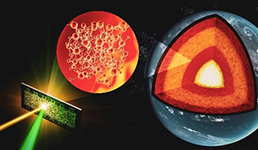
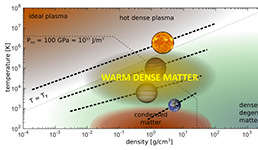
Raffaella Torchio (Scientist at ID24-HPLF) is studying geo and planetary materials up to extreme P/T conditions obtained by laser- induced dynamic compression. The aim of this research is to elucidate the Warm Dense Matter regime that is found in the interior of the Earths and other (extra solar) planets. This research is carried out in collaboration with LULI, IMPMC, ISTERRE, HZDR and CEA groups. |
partners


European Synchrotron Radiation Facility - 71, avenue des Martyrs, CS 40220, 38043 Grenoble Cedex 9, France.