Quasi-simultaneous PXRD–XANES capability for high-pressure operando studies on ID10-SURF
A new operando measurement capability at beamline ID10-SURF enables quasi-simultaneous PXRD and XANES spectroscopy within a single experiment, at pressures up to 60 bar.
Share
The challenge
Studying the structure and chemical state of a catalyst during reaction under realistic pressures and temperatures is one of the central goals of modern heterogeneous catalysis research. Synchrotron X-ray techniques are ideally suited to this challenge: powder X-ray diffraction (PXRD) reveals crystallographic phase composition, particle size, and lattice parameters, while X-ray absorption near-edge structure (XANES) spectroscopy probes the oxidation state and local coordination geometry around a target element, including amorphous and nanoscale species that are often invisible to diffraction.
Fischer–Tropsch synthesis (FTS), a key industrial process for converting natural gas, waste, or biomass into liquid fuels and waxes, relies on cobalt (Co)-based catalysts whose performance is intimately linked to their structural evolution during activation. Understanding the reduction pathway of these catalysts – from oxidised precursor to active metallic phase – requires tracking crystallographic and electronic changes throughout the reduction process. When PXRD and XANES are performed in separate experiments, transient intermediates may be missed, and sample conditions may drift between measurements, obscuring the true reduction pathway.
The development
A fast, automated beam-switching method has been developed in collaboration with the group of Prof. Irene Groot from Leiden University and Dr. Leendert Bezemer from Shell, at beamline ID10-SURF. The method interleaves PXRD and XANES acquisitions within a single experimental cycle, requiring only a few seconds to switch between the two measurement modes. It exploits the bichromatic nature of the ID10 beam, which can simultaneously deliver 7.7 keV X-rays for XANES measurements near the Co K-edge and 23.1 keV X-rays for PXRD. Two independent transfocator assemblies of compound refractive lenses (CRLs) are used to focus each energy independently. Insertion of the appropriate transfocator into the beam path takes approximately 1 s and requires no adjustment to the undulators, monochromator, or other beamline optics.
This capability is coupled with a purpose-built high-pressure reaction cell, developed in collaboration with the ESRF Sample Environment group, that enables continuous gas flow through a capillary sample at pressures up to 60 bar and temperatures up to 600°C. A rhenium-promoted Co/TiO₂-P25 catalyst was reduced under an N₂/H₂ atmosphere at 60 bar, while quasi-simultaneous PXRD patterns (recorded in about 20 s) and XANES spectra (collected in about 5 min) were continuously alternated during heating from 120°C to 400°C. The automated switching ensured that both measurements were continuously correlated throughout the reduction process.
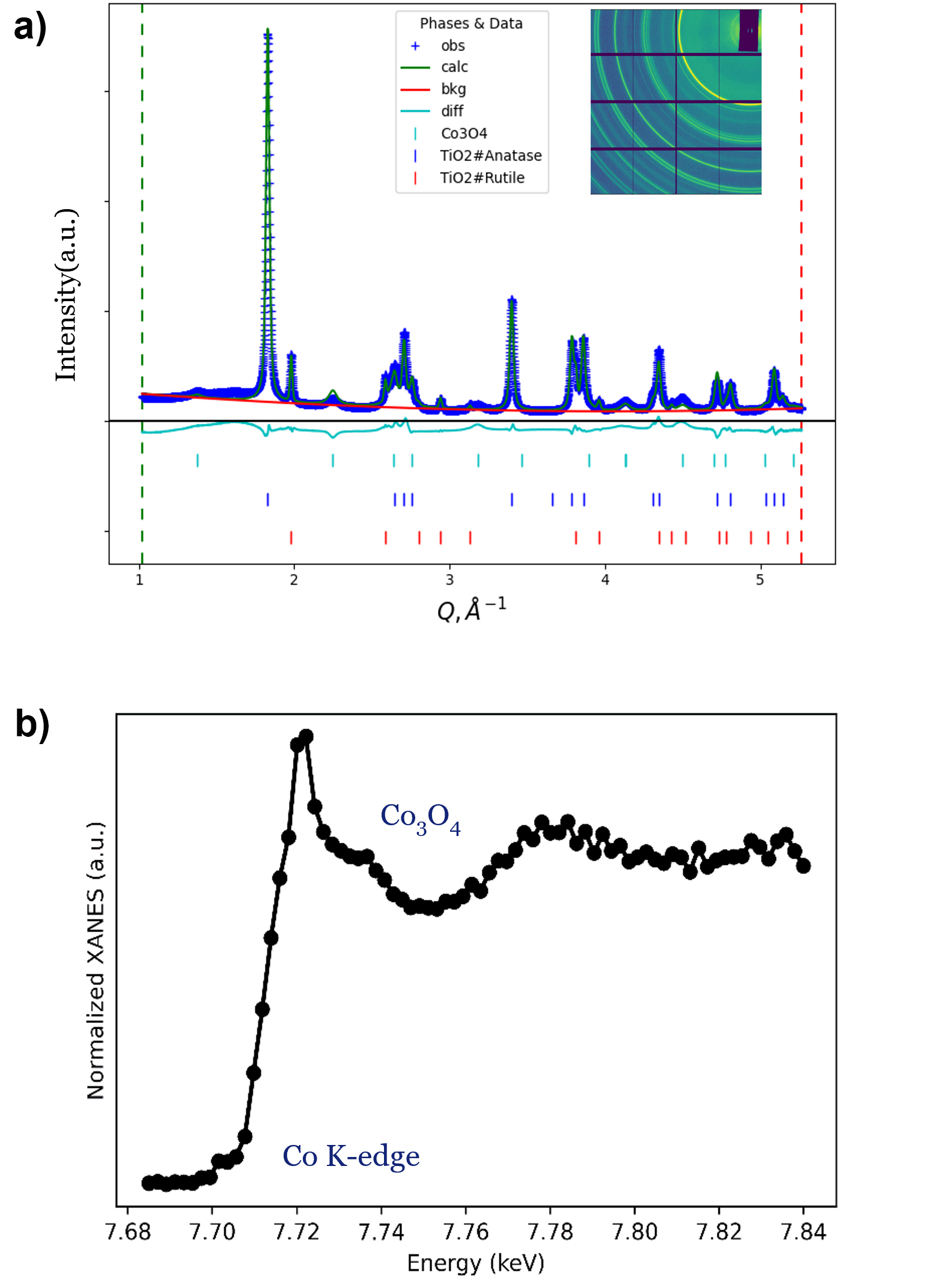
The measurements revealed a clear two-stage reduction sequence: Co₃O₄ → CoO beginning at 120°C, followed by CoO → metallic Co from 270°C onwards (Figure 1). Notably, XANES detected a thin amorphous cobalt oxide passivation layer formed at the end of the experiment that produced no signal in PXRD, directly demonstrating the complementary sensitivity of the two techniques.
Click image to enlarge
Fig. 1: a) PXRD pattern recorded during reduction of the cobalt catalyst at a beam energy of 23 keV. b) Corresponding XANES spectra acquired alternately with the PXRD measurements.
The impact
This new capability expands the scope of ID10-SURF beyond its traditional role as an X-ray scattering beamline, enabling comprehensive operando characterisation by combining crystallographic and electronic information within a single experiment.. By combining crystallographic and electronic information in a single experiment under industrially relevant pressures, it helps bridge the long-standing gap between laboratory measurements and real catalytic operating conditions.
For users, the added value is substantial. Phase transitions, short-lived intermediates, and amorphous minority phases that would be missed by either technique alone can now be monitored continuously and correlated in time. Although demonstrated here for powder catalysts, the flexible optics and diffractometer geometry of ID10-SURF open opportunities for extending the method to liquid surfaces, solid-state electrochemical systems, and thin-film materials. The combination of quasi-simultaneous PXRD and XANES at pressures up to 60 bar represents a unique capability at the ESRF, and the methodology could readily be transferred to other beamlines equipped with switchable energy-focusing optics.
| Principal publication Synchrotron beamline setup enabling quasi-simultaneous PXRD and XANES measurements: case study of Fischer–Tropsch catalyst reduction at 60 bar, L. Yao et al., J. Synchrotron Radiat. 33, 4 (2026); https://doi.org/10.1107/S1600577526003656 |
partners


European Synchrotron Radiation Facility - 71, avenue des Martyrs, CS 40220, 38043 Grenoble Cedex 9, France.