Quadrant detector
Quadrant detector operating principle
The quadrant detector is an extremely useful detector for the collection of isotropic scattering patterns, but unsuitable for the detection of samples with known or unknown preferred orientations like for instance the popular sample cell window material Mylar.
For the collection of accurate data it is essential that the quadrant detector is positioned correctly with respect to the scattering pattern. A short description and the logic behind the alignment procedure is given here.
|
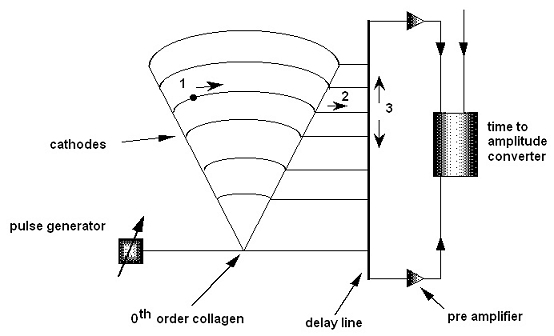
The figure above is a schematic description of the quadrant detector. X-rays create ion-electron pairs in the detector gas. Due to the high voltages between the detector planes this generates an 'avalanche' of electrons which is collected on the cathode (1). This charge moves towards the delay line (2) and splits up into two parts moving in opposite directions (3). After that the electronics measure the run time difference between these two pulses and calculate from that where on the line the event has taken place. The advantage of the quadrant detector is that the collecting elements are getting larger towards higher angles. This compensates partially for the decrease in scattering intensity towards wider scattering angles. This should clarify the fact that there is no two dimensional information available from a quadrant detector, but the count rate characteristics are similar to an area detector. Radial integrations, necessary with area detectors when dealing with isotropic scatterers, are performed in the hardware.
(The text and the figure of this page originate from: SRS)
partners


European Synchrotron Radiation Facility - 71, avenue des Martyrs, CS 40220, 38043 Grenoble Cedex 9, France.