New cryogenic sample environment for synchrotron microtomography
A new sample environment setup is now available at BM18 for large-field, non-destructive sample characterisation at 77 K.
Share
The challenge
Non-destructive imaging using micro-computed tomography (CT) has become a valuable tool for studying materials and devices. Combining micro-CT with controlled sample environments extends its capabilities and provides new insight into material behaviour. Cryogenic micro-CT remains experimentally challenging and comparatively unexplored because of significant technical constraints. Achieving both very low temperatures and high spatial resolution is still challenging.
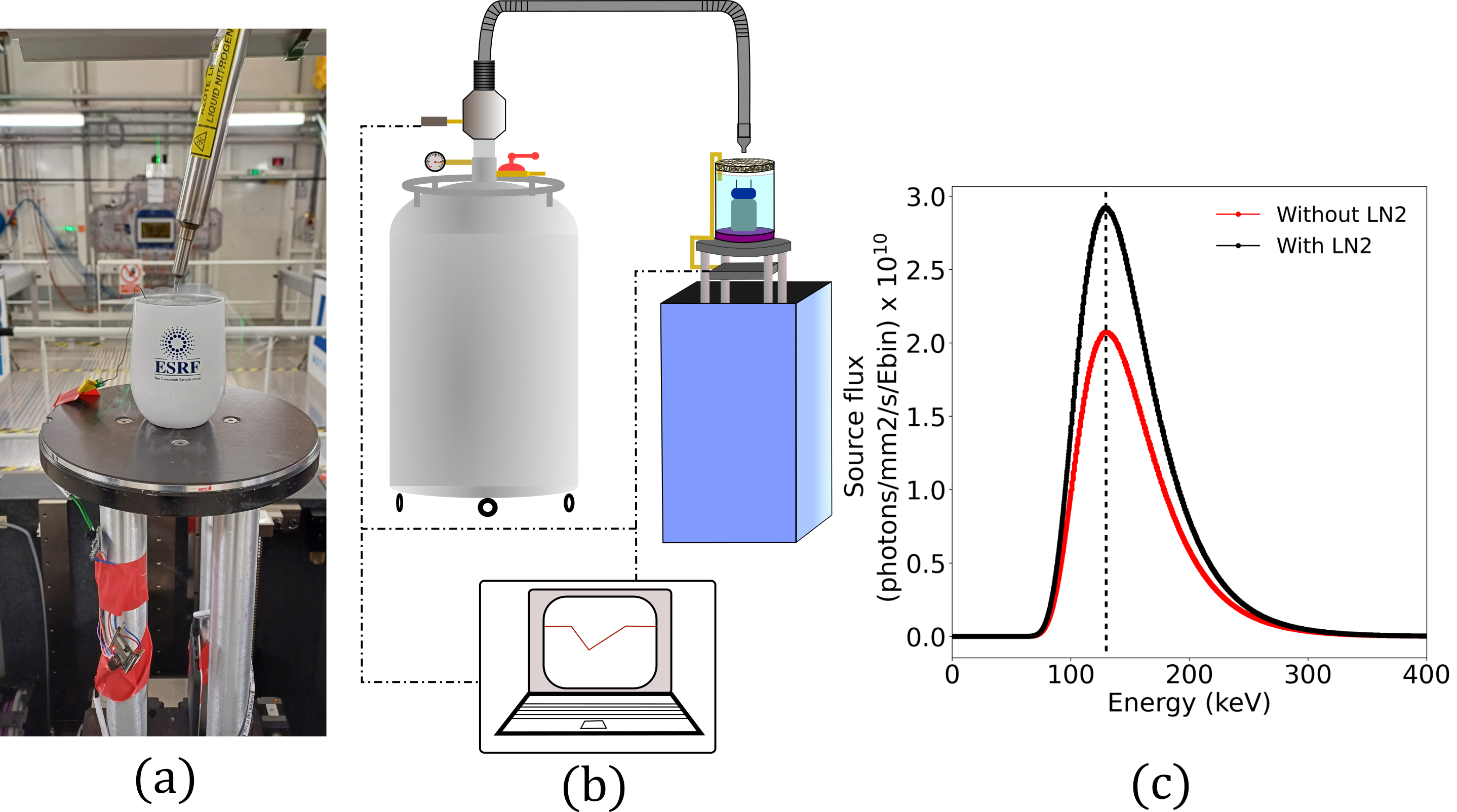
The ESRF Sample Environment Group developed a new setup at BM18 for characterising samples up to 15 cm in diameter at 77 K while fully submerged in liquid nitrogen, with a spatial resolution of 3-5 µm (Figure 1). Proof-of-concept studies demonstrated its capability to reveal how microstructure influences physical properties at cryogenic temperatures – an essential requirement for the development of materials for deep-space and cryogenic applications.
Click image to enlarge
Fig. 1: (a) Photograph of the setup mounted on the BM18 sample stage. (b) Schematic of the cryo-microtomography setup, including a PC/microcontroller, liquid nitrogen pump, and sensor connected to the container to maintain the liquid nitrogen level during measurements. (c) Change in beam flux with and without liquid nitrogen, showing no spectral shift and approximately 15% attenuation.
The experiments
The studies explored: (1) the origin of capacitance changes in commercial capacitors at low temperatures, and (2) the low-temperature performance of PbZrTiO3 (PZT) ceramics with different ferroelectric hardness. The microstructural changes observed at BM18 provided direct correlation with changes in electrical properties measured independently using a cryostat at BM28, a relationship that had not previously been explored.
Capacitors contain dielectric materials, typically produced from powders that are later sintered into a solid structure. The capacitance of such capacitors decreases with temperature, and this behaviour is usually attributed to crystallographic changes. Although single-crystal dielectrics can undergo phase transitions at low temperatures that may explain capacitance changes, the results show that the behaviour in powdered and sintered dielectrics is more complex. Capacitance changes were found to arise from asymmetric thermal contraction, which creates strain within the microstructure and affects the electrical properties (Figure 2a) [1].
PZT ceramics are key components in piezoelectric motors requiring nanometre-scale precision. Their applications are often determined by their ferroelectric hardness. At BM18, measurements of a commercial-grade lead-based ceramic showed how ferroelectric hardness and porosity influence low-temperature performance (Figure 2b). Intergranular and extragranular porosity, together with their thermal contraction at low temperature, affect ferroelectric and piezoelectric switching, which in turn influences device functionality [2].
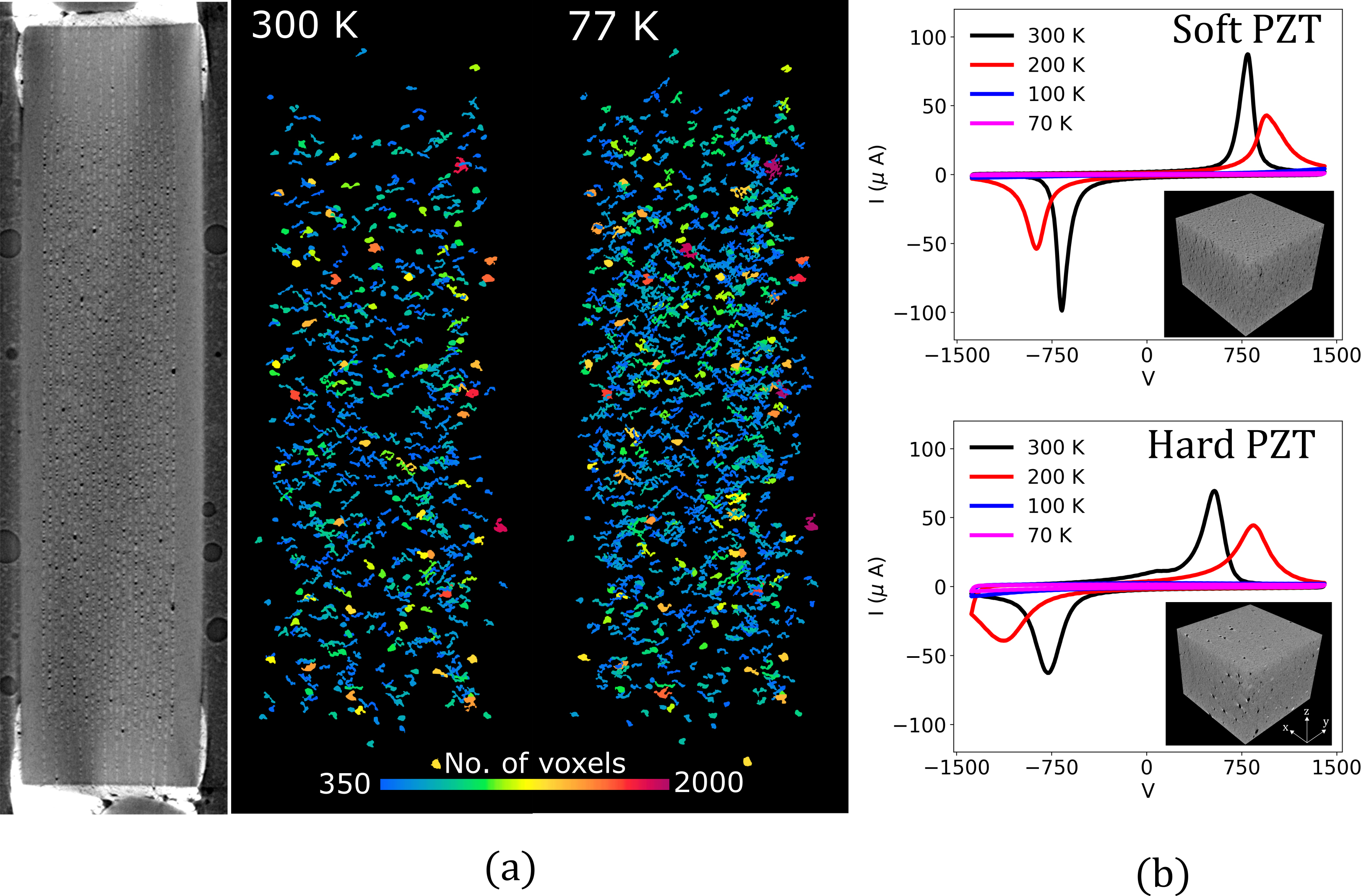
Fig. 2: (a) Cross-section of a multilayer capacitor. Pores within the capacitive structure experience strain, leading to the formation of new pores and an increase in porosity at 77 K. (b) Example of temperature-dependent electrical switching behaviour in hard and soft PZT measured at BM28 and subsequently correlated with micro-CT images obtained at BM18.
The impact
Cryogenic synchrotron microtomography enables direct correlations between microstructure and physical properties at low temperature. The proof-of-concept studies of capacitors and ceramics showed that asymmetric thermal contraction, driven by porosity and interfaces between different materials, is a key factor in determining low-temperature properties. These findings highlight the need for improved material engineering and device design.
Although the present proof-of-concept studies focused on electronic materials, the technique can also be applied to metal alloys, additively manufactured metals, fibre composites, materials for cryogenic fluid storage, and quantum computing components. Thanks to the high photon flux and energy of the Extremely Brilliant Source, samples can be fully submerged in liquid nitrogen at 77 K, which is difficult to achieve in laboratory systems or on lower-energy beamlines. The setup is now available to users and is compatible with ESRF tomography beamlines, opening new opportunities for low-temperature materials research.
|
Principal publications [1] Dielectrics and Capacitors at cryogenic temperature revealed by synchrotron cryo-X-ray microtomography, J. Vijayakumar et al., J. Eur. Ceram. Soc. 46, 4, 117966 (2026); https://doi.org/10.1016/j.jeurceramsoc.2025.117966 [2] The internal microstructure of lead zirconium titanate ceramics at ambient temperature and 77K by synchrotron phase contrast X-ray microtomography, J. Vijayakumar et al., Mater. Des. 265, 116043 (2026); https://doi.org/10.1016/j.matdes.2026.116043 |
partners


European Synchrotron Radiation Facility - 71, avenue des Martyrs, CS 40220, 38043 Grenoble Cedex 9, France.