- Home
- News
- General News
- A highly stable...
A highly stable and effective gold complex proves promising for anticancer treatment
02-04-2025
Chemists have discovered a highly stable gold complex in both model conditions and intracellular environment that triggers mitochondrial damages and hence could be used as an anticancer treatment. They came to the ESRF to characterize the complex on two beamlines. The results are out in Angewandte Chemie International Edition.
Share
In ancient medicine, gold was used in Chinese medicine to treat various ailments. The Egyptians ingested gold for purification, while medieval alchemists sought its elixir for longevity. In the 20th century, gold compounds were developed to treat rheumatoid arthritis, marking transition into modern medicine.
“The discovery of medicinal properties of platinum complexes has led to the development of novel anticancer metallodrugs with unique mechanisms of action, but toxic side effects and drug resistance from the body are pushing us to study other candidates, and in our case we focus on the design of ‘organogold’ complexes”, explains Hester Blommaert, researcher on beamline BM16 and first author of the publication.
The team, from the Sorbonne University, The Université Grenoble Alpes, the CNRS, the INSERM and the ESRF, has explored seven different gold compounds and used different synchrotron techniques at the ESRF to map how the gold compounds interact with cells. “This is a multidisciplinary team, including chemists, physicists, engineers and biologists”, says Jean-Louis Hazemann, group leader of the FAME-UHD BM16 beamline.
Toxic at low concentrations
“First, the team in Sorbonne University designed and synthesized the gold molecules and found that one of these compounds was very toxic towards cancer cells at low concentration, which is very promising”, explains Olivier Proux, scientist in charge of BM16.
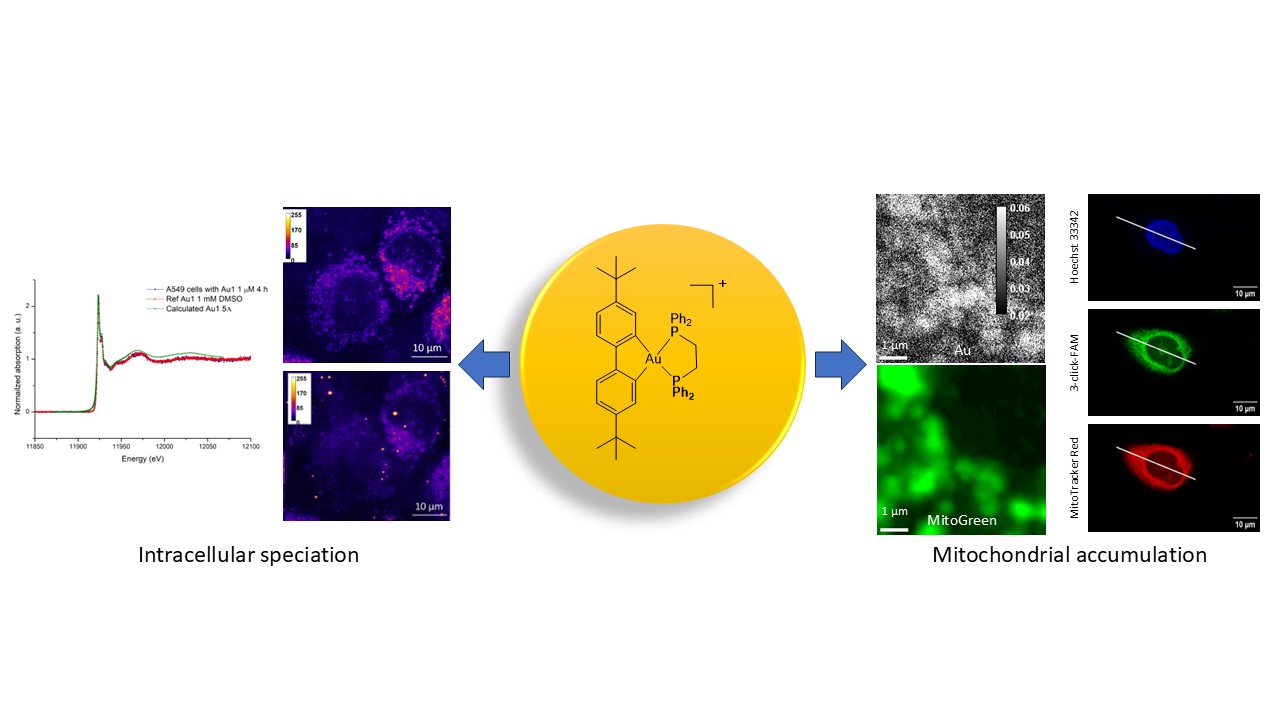
At the ESRF, they used cryo-X-ray fluorescence microscopy on ID16A to pinpoint the precise intracellular location and quantity of gold in whole cells, without any sectioning and without the need for fluorescent dyes, and X-ray absorption spectroscopy on BM16 to gather information about the oxidation state and molecular transformations of gold within the cells. In particular, on BM16 they could solve spectra with a very high resolution for very low concentrations of gold, which is biologically relevant.
Sylvain Bohic, researcher at INSERM and part of the team, explains how the ESRF techniques allowed them to acquire their results: “We aimed to understand the compound's mechanism of action at the subcellular level and assess its stability under biologically real-life conditions. While these compounds hold great potential against cancer, they cannot advance in drug development without a comprehensive understanding of their behavior within tumor cells, which is crucial for advancing novel chemotherapies. The application of these cutting-edge sensitive synchrotron techniques provided at ESRF is a critical first step toward achieving this goal”.
 |
|
Intracellular determination of the speciation of and mitochondrial accumulation of a [(C^C)Au(P^P)]+ complex. |
They discovered that a specific gold complex with a diphosphine ligand is exceptionally stable within cells and builds up specifically in mitochondria. Since mitochondria are crucial for energy production and cell survival, they are a key target for anticancer drugs.
This is the first study to map the distribution and transformation of a gold complex in cancer cells, offering new insights into the potential of gold-based therapies for cancer treatment. “Our next step is to see what happens when the complex is used in in vivo models and to inspect its interactions more closely”, concludes Blommaert.
Reference:
Text by Montserrat Capellas Espuny
partners


European Synchrotron Radiation Facility - 71, avenue des Martyrs, CS 40220, 38043 Grenoble Cedex 9, France.