- Home
- News
- General News
- A hidden form of...
A hidden form of rare earth element cerium identified in fossil fish bones under the sea
25-06-2025
Scientists have found how the rare earth element cerium, often used in technology like mobile phones, is sequestered in abyssal sediments. The experiments took place in the newly built ID24-DCM. The results are out in Communications Earth & Environment.
Share
Rare earth elements and yttrium (REY) are essential to modern technologies, yet we know little about how they concentrate at the Earth’s surface, particularly in marine sediments, which hold vast reserves.
REY are enriched in deep-sea mud by several billion times compared to seawater, and, from a fundamental perspective, determining the chemical forms of REY is critical to understanding one of the highest levels of metal partitioning on Earth.
 |
|
The boat used to get the samples. Credits: T. Schoening. |
The sedimentary component hosting REY consists of biogenic and authigenic fluorapatite (FAp, Ca5(PO4)3F). When fish die, their bones and teeth accumulate on the seafloor, allowing biogenic FAp to adsorb REY from seawater and pore fluids over extensive periods, ranging from hundreds of thousands to millions of years, during the diagenesis process. Until now, scientists thought cerium just replaced calcium atoms in the bone structure. However, scientists led by the ESRF have found otherwise.
 |
|
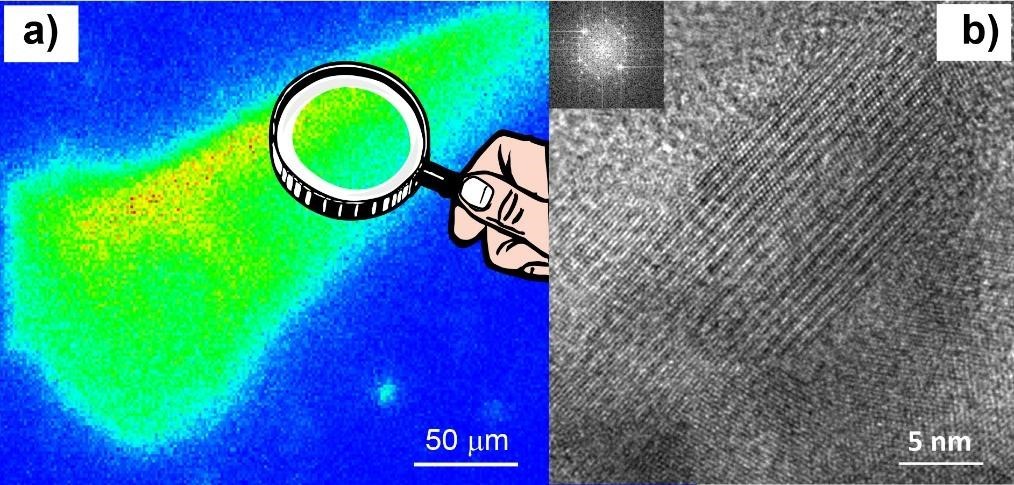
Fossilized fish tooth from marine sediment. (a) X-ray fluorescence map of the distribution of Ce. Pixel size = 1 µm. (b) Electron microscopy image of a bioapatite nanocrystal in an amorphous matrix. |
ESRF scientist Alain Manceau and his team, in the framework of his ERC Advanced Grant Deep-SEE, analysed several tens of fossil bones and teeth handpicked at 1.94 and 4.70 meters depth below the seafloor in a sediment core (16GC) collected in the Pacific Ocean's Clarion-Clipperton Fracture Zone. They found that cerium actually forms a completely different local structure within the fish remains, separate from that of calcium. This structure is a new kind of cerium-phosphate compound precipitated in an amorphous phase at the surface of FAp nanocrystals.
The team used the techniques of X-ray fluorescence mapping, to see the location of cerium, and high-energy-resolution fluorescence-detected X-ray absorption spectroscopy (HERFD-XAS), to track how the cerium atoms bond to other atoms nearby, in the newly built ID24-DCM.
 |
|
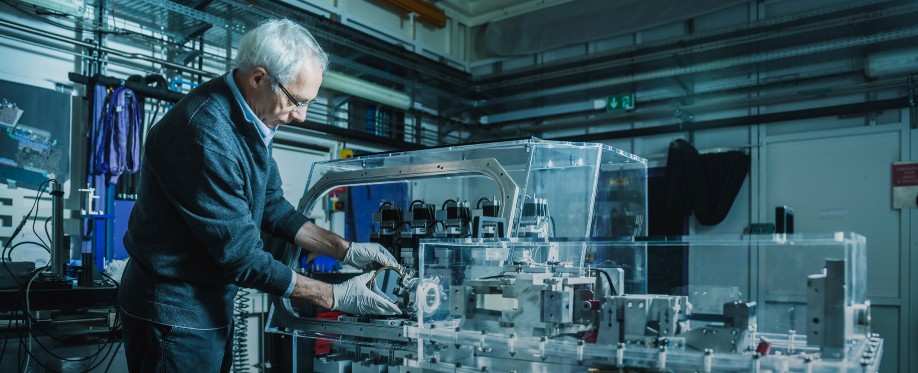
Alain Manceau on the beamline. Credits: S. Candé. |
Instead of sitting in the same place as calcium in the FAp structure, cerium had its own unique surroundings: it is bonded to oxygen, phosphorus, and other cerium atoms in a way that create a new mineral structure.
Alain Manceau, researcher at the ESRF and corresponding author of the publication, explains the implications of the discovery: “Understanding how cerium and the other REY are locked into fossil bones helps us better trace their path through the environment and provides us with clues about their recovery”.
This study emphasizes the advanced capabilities of the newly built ID24-DCM beamline, and lays the groundwork for identifying the chemical forms of other REY, which is vital for geochemical investigations.
Reference:
Text by Montserrat Capellas Espuny
Top image: A fossil tooth under an optical microscope. Credits: A. Manceau
partners


European Synchrotron Radiation Facility - 71, avenue des Martyrs, CS 40220, 38043 Grenoble Cedex 9, France.