- Home
- Users & Science
- Find a beamline
- ID16B - Nano-analysis Beamline
- Technical Details
Technical Details
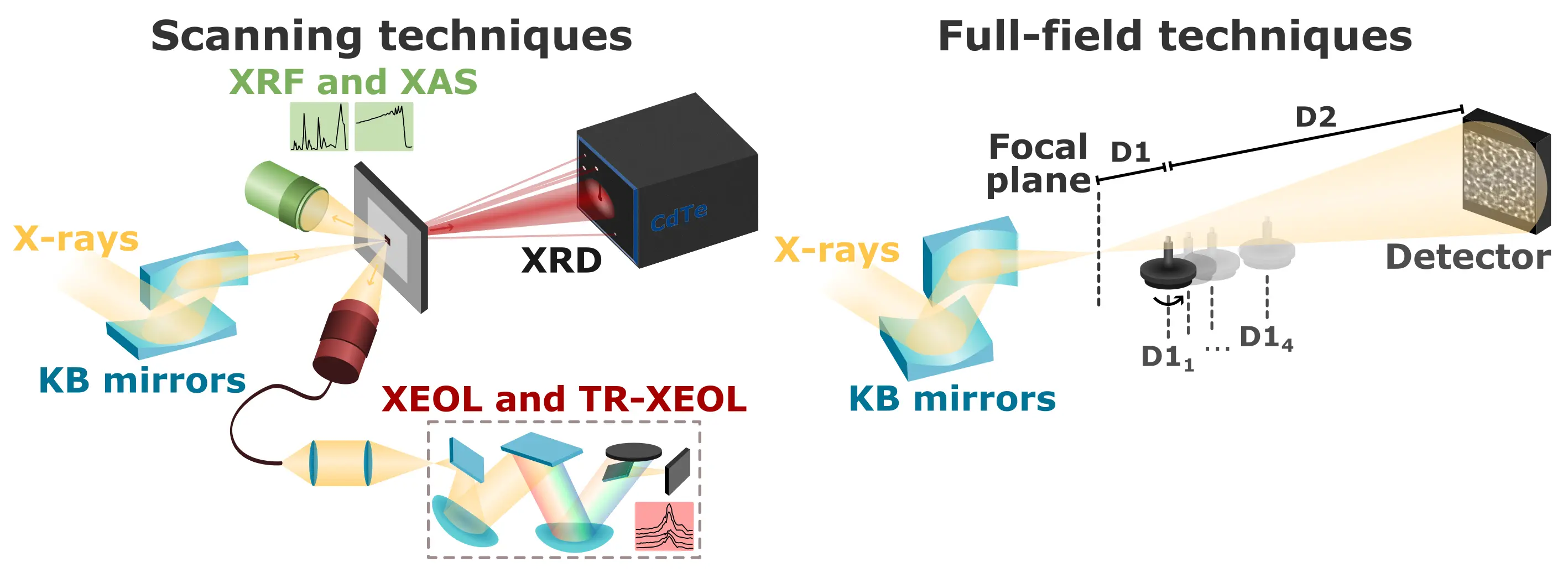
Beamline ID16B is dedicated to hard X-ray nano-analysis. It offers a versatile and unique combination of 2D and 3D techniques: X-ray fluorescence (XRF), X-ray absorption spectroscopy (XAS), X-ray excited optical luminescence (XEOL & TR-XEOL), X-ray diffraction (XRD), X-ray Beam Induced Current (XBIC) and 3D/4D X-ray nano-imaging (nano-tomography). These techniques can be employed individually or simultaneously within a multimodal 2D and/or 3D framework to investigate, in a non-destructive manner, nanostructures, trace-element distributions, phase composition and behavior, microstructures, and functional properties. With a wide energy range of 5–33 keV and beam sizes routinely reaching 50 nm, the instrument supports cutting-edge research in materials science, nanotechnology, Earth and environmental sciences, and biomedical applications, including studies of energy materials, additive manufacturing, and bio-inspired materials.
The experimental set-up can accommodate sample environments (furnace, cryostat, electrochemical cells…) providing unique in situ and operando nano-analysis capabilities.
Video presentation of the beamline:
https://www.youtube.com/watch?v=QPp1O2mMQog
Techniques available:
- 2D/3D nano X-ray fluorescence (XRF)
- Nano X-ray absorption spectroscopy (nano-XAS)
- 3D phase-contrast nano-imaging (holo-tomography)
- 2D/3D nano X-ray diffraction (nano-XRD)
- 2D & Time-resolved Nano X-ray excited optical luminescence (nano-XEOL/TR-XEOL)
- Nano X-ray beam induced current (nano-XBIC)
Beam modes:
- Pink beam (from 17 to 33 keV): ∆E/E=10-2 , flux = 1011-1012ph/s
- Monochromatic beam (from 6 to 14 and 17 to 33 keV): ∆E/E=10-4 , flux = 1010-1011 ph/s
Energy range:
- Nano-XRF, nano-XAS, nano-XRD, nano-XEOL: from 6 to 33 keV
- Nano-tomography: 17 or 33 keV
Beam size:
- Pink or Monochromatic mode (from 17 to 33 keV): 50x50 nm2
- Monochromatic mode (from 6 to 14 keV): from 80 to 100 nm2
Detectors:
- One single element Si Drift Detector
- One 3-element Si Drift Detector
- One 7-element Si Drift Detector
- PCOedge 4.2 (2048 × 2048 px) - PCOedge 5.5 (2560 × 2160 px) cameras
- Dectris CdTe Eiger1M
- QEPro and Hamamatsu spectrometers for XEOL
- Streak camera for TR-XEOL
In-situ environments*
*If your experiment requires a user-provided sample environment, you must contact the beamline staff before submitting your proposal. This discussion is essential to assess whether your sample environment is compatible with the beamline. Without prior consultation with the beamline staff, your proposal will be automatically rejected as not technically feasible. It will not be evaluated for scientific merit and no beamtime will be allocated.
The beamline has specific setups (list below) and can also accommodate others developed by users. Please get in touch with the beamline staff for more details.
- 2D mapping environments:
- He-cryostat for scanning techniques (fixed temperature down to 5-50K)
- Nitrogen high-stability Cryostat (under development)
- Micro-heater
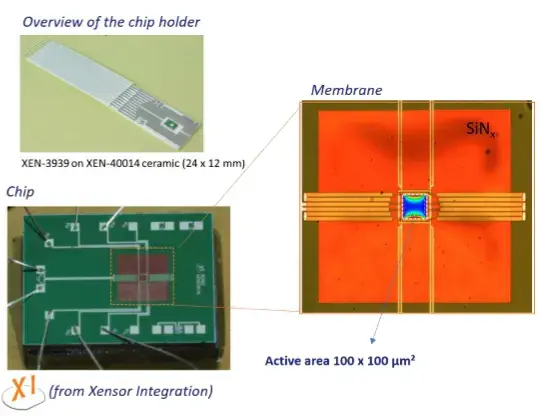
XRF & XANES compatible setups: nano-calorimeter adapted for the specialized operation of ID16B in close collaboration with Martin Rosenthal. General overview of the sensor holder; and close-up view of the commercial XEN-3933 chip, highlighting the SiNx membrane with integrated resistive heating elements and differential thermopiles. (Segura-Ruiz et al. Journal of Alloys and Compounds, 2025)
- 3D imaging environments:
- High Temperature furnace for in-situ nanotomography
- Battery cycling cell [Vanpeene et al. ACS Nano, 2025]
partners


European Synchrotron Radiation Facility - 71, avenue des Martyrs, CS 40220, 38043 Grenoble Cedex 9, France.