- Home
- Users & Science
- Find a beamline
- ID11 - Materials science beamline
- User Guide
- Sample preparation and height
Sample preparation and height
Sample preparation
Should I polish my sample?
For single diffraction experiments or tomography, you don't need to.
For a grain mapping experiment (DCT, scanning 3DXRD), it is better to have a smooth surface area.
Can I prepare my sample on site?
The idea is to stick your sample onto a brass pin or a threaded nut that will be mounted on the magnetic mount.
To fix the samples, we have:
- UV glue.
- red and white waxes (melted with an iron solder).
- Ceramic glue (up to 1500 K, needs curing at 150 degrees for a few hours).
Sample height (TDXRD)
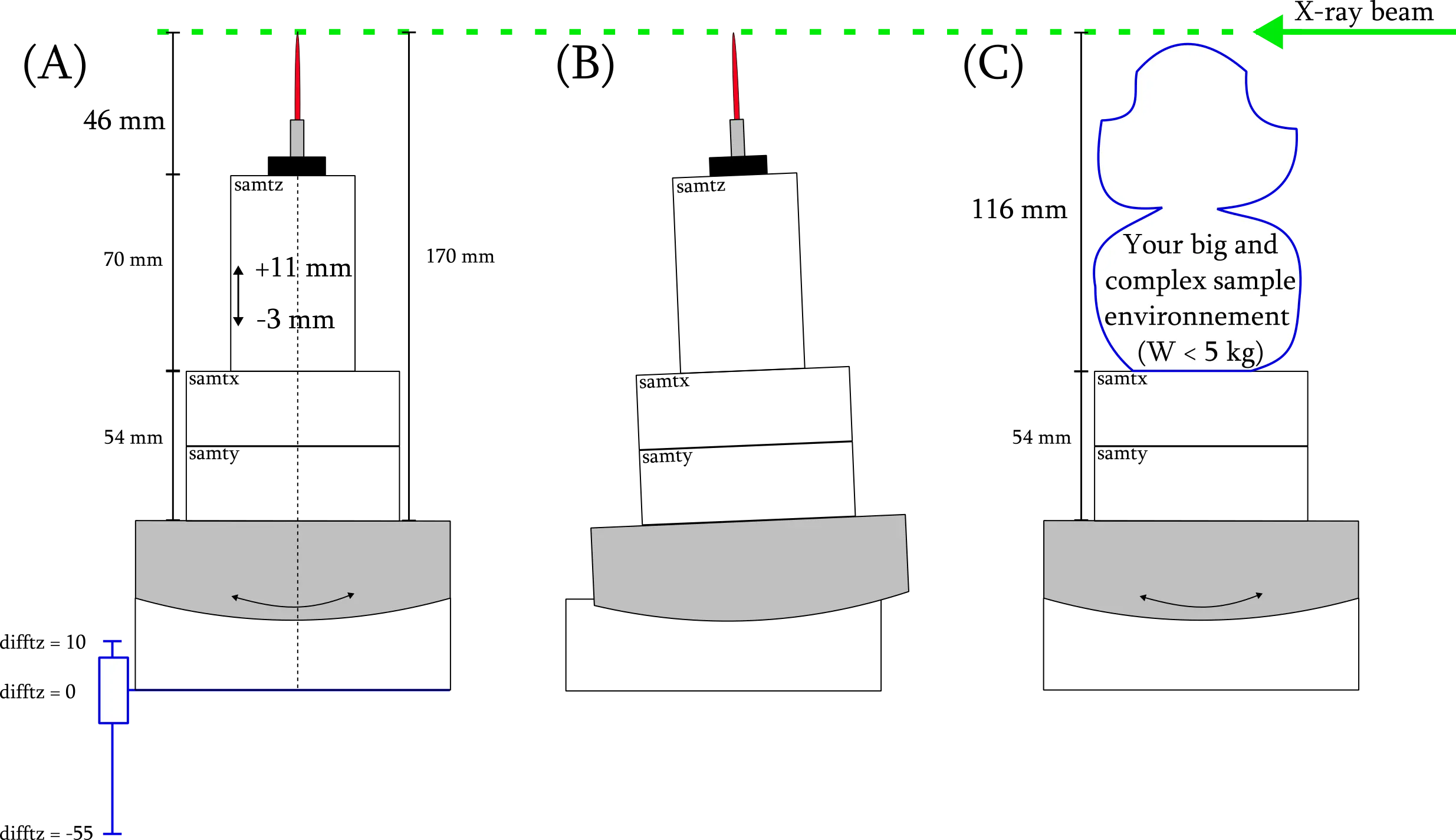
Best height for standard experiments ((including the magnetic mount, 6.1 mm): 46 mm
Maximum size (including the magnetic mount, 6.1 mm): 101 mm
Minimum size (including the magnetic mount, 6.1 mm): 36 mm
- (A) : Basic configuration, with 3 translations (x,y,z). When samtz is at 0, the sample height is 46 mm.
- (B) : Tilted configurations. The tilt center of rotation is in the beam only when difftz is at 0. Difftz is not affected by this tilt.
- (C) : Homemade sample environement. If you come with your own sample environement (weighted less than 5 kg), you might need more freedom in the vertical direction. In that case, we can remove the samtz stage and you gain 70 mm.
Sample height (NSCOPE)
Best height for a standard experiment (including the magnetic mount 6.1 mm): 50 mm
- (A) : Piezo stage configuration. The piezo stage is a translation table (x, y, z) with very high precision (picometers). It has a 100 pm range in the 3 directions. The vertical translation stage is mounted above to position the sample in the beam.
- (B) : No piezo configuration A. For bigger samples, that requires a bigger range in x and y for alignment, we can replace the piezo stage with an aluminum spacer and mount 2 translation stages above.
- (C) : No piezo configuration B. The big spacer is replaced with a smaller one in this configuration to get more space for the sample positioning (useful for Nanox experiments for instance).

partners


European Synchrotron Radiation Facility - 71, avenue des Martyrs, CS 40220, 38043 Grenoble Cedex 9, France.