Copper-based pigments
Copper-based pigments (verdigris, azurite and emerald green)
|
S. Carboni Marri, L. Monico, F. Rosi, C. Miliani, R. Vivani, K. Janssens, S. De Meyer, O. Mathon, M. Cotte, M. Burghammer, J. Garrevoet, G. Falkenberg, E. Avranovich Clerici, A. Rios-Casier, G. Van der Snickt, A. Romani, "Discovering the dual degradation pathway of emerald green in oil paints: The effects of light and humidity", Science Advances, (2025). |
|
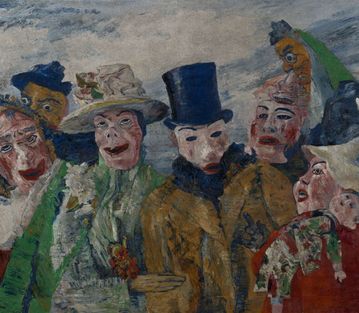
Emerald green, a copper acetoarsenite pigment, enriched the 19th-century and 20th-century artists’ palettes and caused darkening and fragilities in paintings. The accepted alteration mechanism involves the oxidation of triarsenite ions [(As3O6)3−] to arsenates (AsO43−), although questions about the promoting factors and the origin of the oxidized arsenic remain unanswered. This study investigates the primary environmental parameters inducing alteration in the oil binder and elucidates the associated degradation pathways through a multiscale analytical approach, including noninvasive spectroscopic techniques and synchrotron radiation–based x-ray methods. By combining results from a historical oil painting by James Ensor (1860 to 1949) and artificially aged paint mock-ups, we identified ultraviolet A–visible light and humidity (relative humidity ≥ 95%) as key driving factors, inducing a dual degradation pathway: Light promotes surface-stratified arsenic oxidation (As3+ → As5+) resulting in amorphous As5+-rich compounds, whereas a dark, high moisture environment favors arsenolite (As2O3) crystallization. In addition, a noninvasive analytical strategy is proposed for monitoring the conservation state of emerald green paints in historical artworks.
 |
S. Prati, I. Bonacini, G. Sciutto, A. Genty-Vincent, M. Cotte, M. Eveno, M. Menu and R. Mazzeo, "ATR-FTIR microscopy in mapping mode for the study of verdigris and its secondary products", Applied Physics A, 122, 10 (2015). |
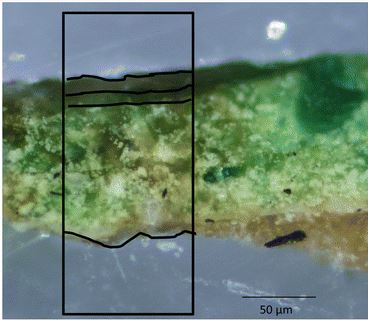
To study degradation processes occurring on painting materials, the use of high-resolution micro-analytical techniques is highly requested since it provides a detailed identification and localisation of both the original and deteriorated ingredients. Among the various pigments recently studied, the characterisation of verdigris has received a major interest. This pigment has not a unique chemical formula, but its composition depends on the recipe employed for its manufacturing. Moreover, verdigris paints are not stable and are subject to a colour change from blue-green to green, which occurs in the first few months after the application. In this paper, we focused our attention on the use of ATR-FTIR mapping as a useful method to identify verdigris secondary products and pathways. Several mock-ups and real samples have been analysed, and the correlation among the detected compounds and their spatial location, obtained by the application of ATR-FTIR microscopy in mapping mode, allowed formulating some hypotheses on the degradation pattern of verdigris, which may feed the discussion on the transformation and stability of this pigment. From an analytical point of view, we showed how FTIR mapping approaches may be extremely useful both for the identification of compounds in complex matrix in which single spectra may limit the exhaustive characterisations due to bands overlapping and for the study of degradation pathways by taking into consideration the relative distribution of degradation products.
 |
Lluveras, S. Boularand, A. Andreotti and M. Vendrell-Saz, "Degradation of azurite in mural paintings: distribution of copper carbonate, chlorides and oxalates by SRFTIR", Applied Physics A: Materials Science & Processing (2010). |
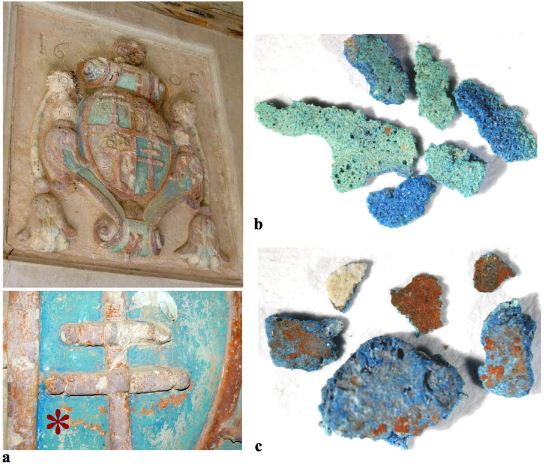
This article illustrates the analysis by synchrotron micro-analytical techniques of an azurite painting presenting greenish chromatic degradation. The challenge of the experiments was to obtain the spatial distribution of the degradation products of azurite. Copper hydroxychlorides, carbonates and copper oxalates have been mapped by SR FTIR imaging of cross sections in transmission mode. To complement the information, Py/GC/MS and GC/MS techniques were applied in order to characterize the binding media and organic materials present as well as their degradation products. Results contribute to a better understanding of the decay of blue areas in ancient paintings not only from the particular point of view of azurite weathering, but also by adding information regarding the oxalates’ formation and their distribution in painting samples. Synchrotron radiation demonstrates its capability for the mapping in painting cross sections.
partners


European Synchrotron Radiation Facility - 71, avenue des Martyrs, CS 40220, 38043 Grenoble Cedex 9, France.