Overview
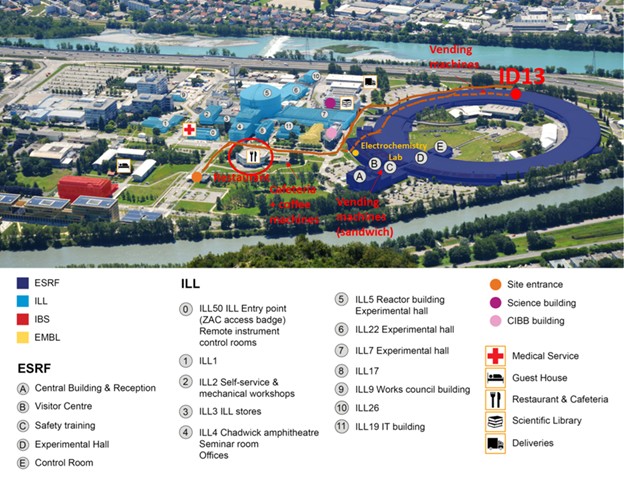
The beamline ID13 at the ESRF is a microfocus beamline built for high-spatial-resolution diffraction and small-angle X-ray scattering with a highly focused monochromatic X-ray beam. It is especially suited to investigating how structure, phase, and composition vary across complex materials, biological tissues, fibers, polymers, and functional materials, including under in situ or operando conditions. What makes ID13 unique is its two distinct end-stations, a microbranch and a nanobranch, which allow users to work seamlessly from micron-scale scanning diffraction to nanodiffraction with beam sizes down to the sub-100 nm range.
What it is for?
ID13 is designed to produce micro and nano X-ray spots for diffraction and scattering and fluorescence, enabling experiments on tiny, heterogeneous, or spatially complex samples. It supports single-crystal diffraction, scanning diffraction/scattering/fluorescence, and in situ or operando studies with specialized sample environments such as microfluidics, humidity control, deformation setups, and nano-calorimetry. In practice, this makes it useful whenever structural or compositional information is needed at microscopic to nanoscopic length scales.
Scientific questions
The beamline addresses questions about structure, phase composition, texture, crystallinity, particle size, and nanoscale heterogeneity across many materials systems. It is used for biomaterials and tissues, fibers, polymers, food, semiconductors, nanocomposites, coatings, and cultural heritage samples, often under controlled environmental or stress conditions. A key strength is that it can map how structure changes across a sample, turning diffraction into a real-space imaging approach.
What makes ID13 unique
Its main distinction is the combination of two separate end-stations: the microbranch for micrometre-scale scanning and routine microcrystallography, and the nanobranch for nanodiffraction with beam sizes down to the sub-100 nm regime. ID13 is also notable for its flexibility: it combines high-brilliance micro- and sub-micrometre beams, fast detectors, simultaneous fluorescence capabilities, and a broad set of in situ sample environments.
partners


European Synchrotron Radiation Facility - 71, avenue des Martyrs, CS 40220, 38043 Grenoble Cedex 9, France.