Instrumentation
Optics
This is a short description of the optical elements. For more details, see the Confluence page.
Mirror M1
- Objectives: vertical collimation + harmonic rejection.
- Rh-coated Si rod.
- Flat bendable.
- Incidence angles: 0-7mrad.
- Optical surface: 1400x70mm.
- Water cooled.
- Escaped when working at energy higher than 22keV.
Monochromator
- Objectives: energy selection + horizontal focusing, in the range 4 - 40keV.
- Double crystal, variable exit height.
- Equiped with Si[220] (but Si[111] also possible).
- Nitrogen cooled first crystal with a setpoint at -165°C.
- Permanent feedback for parallelism optimization.
- Bendable second crystal.
Mirror M2
- Objectives: vertical focusing + harmonic rejection.
- Rh-coated Si rod.
- Flat bendable.
- Incidence angles: 0-7mrad.
- Optical surface: 1400x65mm.
- Escaped when working at energy higher than 22keV.
EXAFS end-station
Sample positionning
- Height position adjusted versus the monochromator angle (precision better than 1µm) via the table height. Beam position on the sample is thus constant during an EXAFS scan.
- Sample holder allows:
- transverse and vertical translations
- rotation (360°)
- goniometric rotations (±7°)
- possible load up to 100kg
Detection
- Transmission mode: diodes collecting photons scattered by air in a black chamber for both incident and transmited intensity measurements.
- Fluorescence mode: 16-element Ge detector.
Sample environments
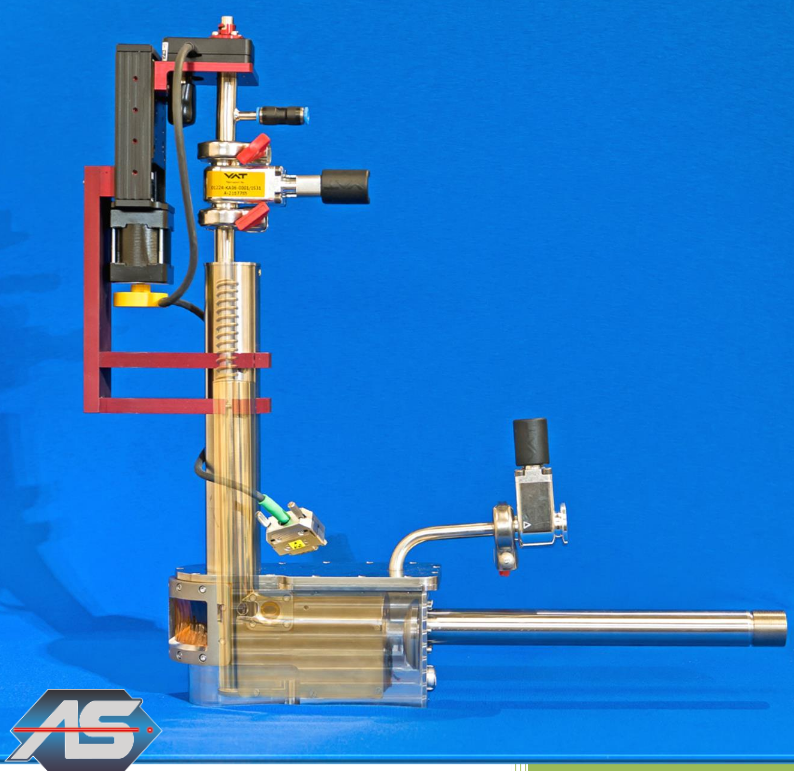
Helium cryostat
|
|
|
HP/HT vessel
 |
|
Catalysis
 |
HT reaction cell for operando characterizations
|
 |
Remote controlled gas distribution system
|
 |
Cell for air sensitive samples
|
 |
Mass spectrometer
|
Gas blower furnace
- Maximum temperature: 1000°C
- Atmosphere: nitrogen
- Borrowed from the ESRF sample environment loan pool.
Other sample environments
On the classical XAS station, any system weighting less than 100 kg, with convenient windows, can be used, after discussion with us and the safety group. On the ptychography station, space and supported weight are much more limited.
partners


European Synchrotron Radiation Facility - 71, avenue des Martyrs, CS 40220, 38043 Grenoble Cedex 9, France.