- Home
- News
- Spotlight on Science
- Sublattice-selective...
Sublattice-selective magnetoelastic coupling in a frustrated cryogenic magnet
15-09-2026
Understanding how magnetism couples to the crystal lattice in GdMn₂O₅ is key to explaining its promising performance as a cryogenic magnetic refrigerant. X-ray powder diffraction at ID22 and element-selective X-ray absorption spectroscopy at BM23 tracked structural changes around the Mn and Gd magnetic sublattices across the magnetic transition. The measurements reveal a soft Mn–Gd interface that acts as a local magnetoelastic ‘hinge’, providing a route to tune the material’s magnetic response while keeping its optimal operating temperature.
Share
The challenge
Cooling to only a few Kelvin is essential for technologies ranging from quantum devices to space instrumentation, yet conventional refrigeration becomes increasingly inefficient at cryogenic temperatures. Magnetic refrigeration offers an attractive alternative: a magnetic material can exchange heat with its surroundings when a magnetic field changes, without relying on conventional gas-compression cycles.
GdMn2O5 is a particularly promising candidate because it combines a large, nearly isotropic Gd3+ magnetic moment with a frustrated network of Mn3+ and Mn4+ magnetic ions. The central challenge is that its crystal structure shows no global structural phase transition over a broad temperature range, even though its magnetic state changes dramatically. This raises the question of how magnetism communicates with the lattice, and which part of the structure actually responds. The answer matters because magnetocaloric performance depends not only on the size of the magnetic moment, but also on how efficiently magnetic entropy can be manipulated near the operating temperature.
The experiment
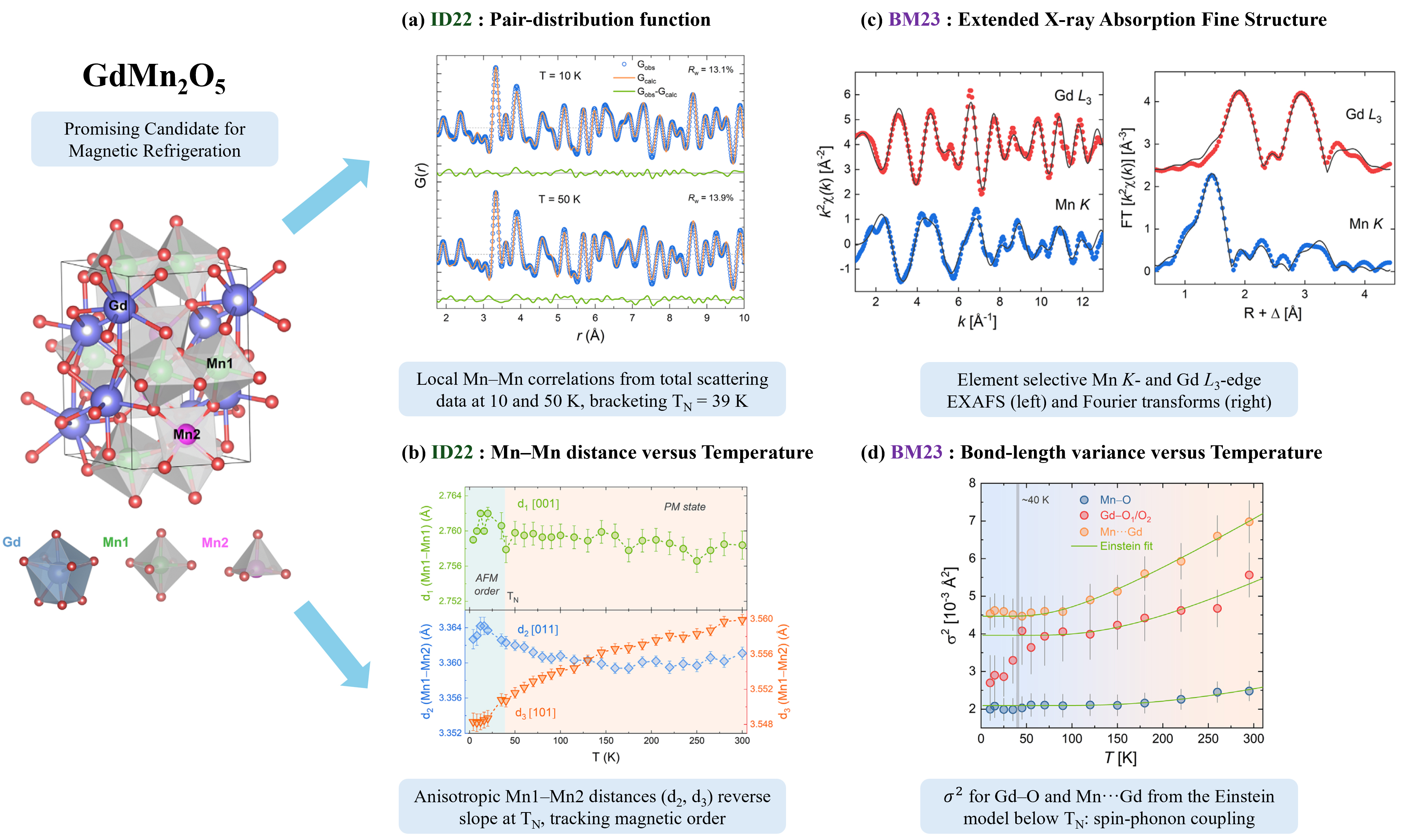
This study combined two complementary ESRF experiments that probe the structure at different length scales and with different chemical selectivity. At ID22, high-resolution synchrotron powder X-ray diffraction followed GdMn2O5 from 4 to 300 K. The measurements revealed anisotropic thermal expansion, including unusual contraction along the b axis, with clear anomalies around the Mn magnetic ordering temperature. Pair-distribution-function (PDF, in Figure 1a) analysis of total scattering at 10 and 50 K then showed that the nearest-neighbour Mn–Mn distances respond anisotropically across the magnetic transition. This provides a local signature of exchange striction, i.e., a change in interatomic distances caused by magnetic interactions, that is not apparent from the average crystal structure alone (Figure 1b).
At BM23, temperature-dependent X-ray absorption spectroscopy at the Mn K-edge and Gd L3-edge provided an element-selective view of the local structure (Figure 1c). The Mn–O framework was found to be remarkably rigid, whereas the Gd coordination environment and, most strikingly, the Mn–Gd intersite pathway were much more compliant. The extended X-ray absorption fine structure (EXAFS) analysis established a hierarchy of local stiffness, θE(Mn–O) ≈ 759 K > θE(Gd–O) ≈ 516 K > θE(Mn–Gd) ≈ 287 K, where θE is the Einstein temperature, a measure of the characteristic vibrational energy of the local atomic environment. The largest spin-phonon coupling anomaly occurs at the Mn–Gd interface, identifying it as the principal structural transducer of the magnetoelastic response (Figure 1d).
Click figure to enlarge
Fig. 1: a) PDF data at 10 and 50 K. b) Temperature-dependent nearest-neighbour Mn1–Mn2 distances along the [001], [011], and [101] directions. c) Mn K- and Gd L3-edge EXAFS data recorded at 10 K. d) Bond-length variance (σ2) obtained from Einstein-model fits to the temperature-dependent EXAFS data.
The ID22 and BM23 measurements connect the macroscopic lattice response to a specific local pathway: the magnetic Mn network is coupled to the softer Gd environment through a frustrated Mn–Gd interface. The main result is a sublattice-selective magnetoelastic mechanism. The strongly covalent Mn–O framework remains essentially unchanged, while the softer Gd–O environment and Mn–Gd interaction respond strongly to magnetic ordering. In other words, the lattice does not respond uniformly: the magnetoelastic ‘hinge’ is localised at the interface between the Mn and Gd magnetic sublattices.
The paper’s central result is that, although the long-range crystal structure of the material remains unchanged, the short-range order changes significantly. Below the Néel temperature (TN), small shifts in bond lengths are accompanied by departures of the bond-length variance (σ2) from the Einstein baseline. These departures are negligible for Mn–O but pronounced for Gd–O and Mn–Gd, revealing spin-phonon-mediated magnetoelastic coupling concentrated at the Mn–Gd interface.
This microscopic picture is also consistent with the unusual response to pressure. Hydrostatic compression produces opposing trends: the Mn ordering temperature TN decreases, consistent with a weakening of Mn–O–Mn super-exchange, whereas the Gd ordering temperature TGd increases, indicating enhanced coupling of the Gd moments to the Mn-derived molecular field. Remarkably, the temperature of maximum magnetocaloric response remains essentially unchanged.
The impact
These findings suggest a new design principle for frustrated magnetic materials: different magnetic sublattices can respond differently to the same external stimulus. Pressure and potentially chemical substitution may, therefore, be used to tune one magnetic subsystem while preserving the optimal operating temperature of the refrigerant.
The structural insight has a direct functional consequence. GdMn2O5 exhibits a conventional, second-order magnetocaloric response, with a maximum magnetic entropy change of about 16.1 J kg-1 K-1 for a 0–7 T field change near 8 K. The corresponding relative cooling power reaches about 272 J kg-1, while the adiabatic temperature change reaches approximately 2.6 K under 0–8 T. The maximum magnetic entropy value improves substantially on previous reports for GdMn2O5 and places the material among promising oxide-based magnetocaloric candidates for cryogenic operation. The combination of a large, isotropic Gd3+ spin, frustrated Mn magnetism, and a compliant Mn–Gd structural interface provides an unusual route to concentrating magnetic entropy release in the few Kelvin regime.
More broadly, the study demonstrates how synchrotron measurements can identify the microscopic structural “switch” that controls a macroscopic refrigeration response, and suggests a route toward engineering future cryogenic refrigerants by tuning magnetic sublattices independently.
Principal publication
Sublattice-Resolved Magnetoelastic Coupling and Opposing Pressure Responses in the Frustrated Magnetocaloric GdMn2O5, R.S. Silva Jr. et al., Adv. Sci. e77490 (2026); https://doi.org/10.1002/advs.77490
| About the beamlines |
|
ID22 The beamline has an in-vacuum undulator as source providing X-rays in the range 6–75 keV. ID22’s principal characteristic is very high angular resolution as a result of the highly collimated and monochromatic beam, coupled with a 13-channel Si 111 multi-analyser stage between the sample and an Eiger2 X 2M-W CdTe pixel detector. A complementary medical-imaging detector is additionally available for faster, lower-resolution data, often used at X-ray energies of 60–70 keV for PDF analysis, although PDF is also possible in high-resolution mode by scanning to high angle at 35 keV. There is a selection of sample environments, allowing sample temperatures from 4–1800 K, a capillary cell for non-corrosive gas atmospheres in the range 0–100 bar, and another cell allowing studies under gas flow. A sample-changing robot can accommodate up to 75 capillary samples and is compatible with the temperature range of 80 K to 950°C. |
|
BM23 A dedicated micro-XAS station provides enhanced mechanical precision and increased flexibility for experiments requiring micrometre-sized beam spots (e.g., cryo-DACs, large-volume presses, and external or internal RH-DAC systems). The focal spot size is below 3×3 µm2 (FWHM), with a photon flux of approximately 109 ph/s. The micro-XAS station operates over an energy range of 5–45 keV, and a Pilatus 1M detector is available for complementary X-ray diffraction measurements. |
partners


European Synchrotron Radiation Facility - 71, avenue des Martyrs, CS 40220, 38043 Grenoble Cedex 9, France.