- Home
- News
- Spotlight on Science
- Structured X-rays...
Structured X-rays speed up 3D elemental mapping
05-10-2026
3D X-ray fluorescence mapping provides quantitative elemental information but conventionally requires extensive point-by-point scanning. A new ghost tomography approach uses structured X-ray illumination and direct volumetric reconstruction to map elements from far fewer measurements. At beamline ID19, the method reduced the number of measurements 43-fold while maintaining a spatial resolution of 20–30 µm, enabling faster 3D chemical mapping of complex samples.
Share
The challenge
X-ray fluorescence (XRF) microscopy is a powerful method for quantitative chemical mapping. When a sample is irradiated with X-rays, the characteristic fluorescent photons emitted by its constituent elements provide element-specific contrast. This makes XRF valuable across a range of applications, from studying active states in battery materials to identifying trace elements in biological tissue.
Extending XRF microscopy to three dimensions, however, presents a significant measurement challenge. Conventional XRF tomography relies on raster scanning: a tightly focused ‘pencil beam’ is moved point-by-point across the field of view, with the scan repeated at each tomographic rotation angle. For complex, heterogeneous samples containing millions of voxels, this sequential acquisition results in a very large number of measurements and correspondingly long acquisition times. This can be difficult to accommodate within the limited beamtime available at synchrotron facilities. Concentrating the X-rays into a small focal spot can also increase the local radiation dose, potentially causing heating, deformation or radiation damage in sensitive samples.
Computational ghost imaging (CGI) has recently been applied to reduce the number of XRF measurements required. However, existing 3D approaches reconstruct each 2D projection independently before assembling the projections into a volume. This process does not fully exploit the structural information contained in the complete 3D object, limiting the extent to which data can be compressed.
The experiment
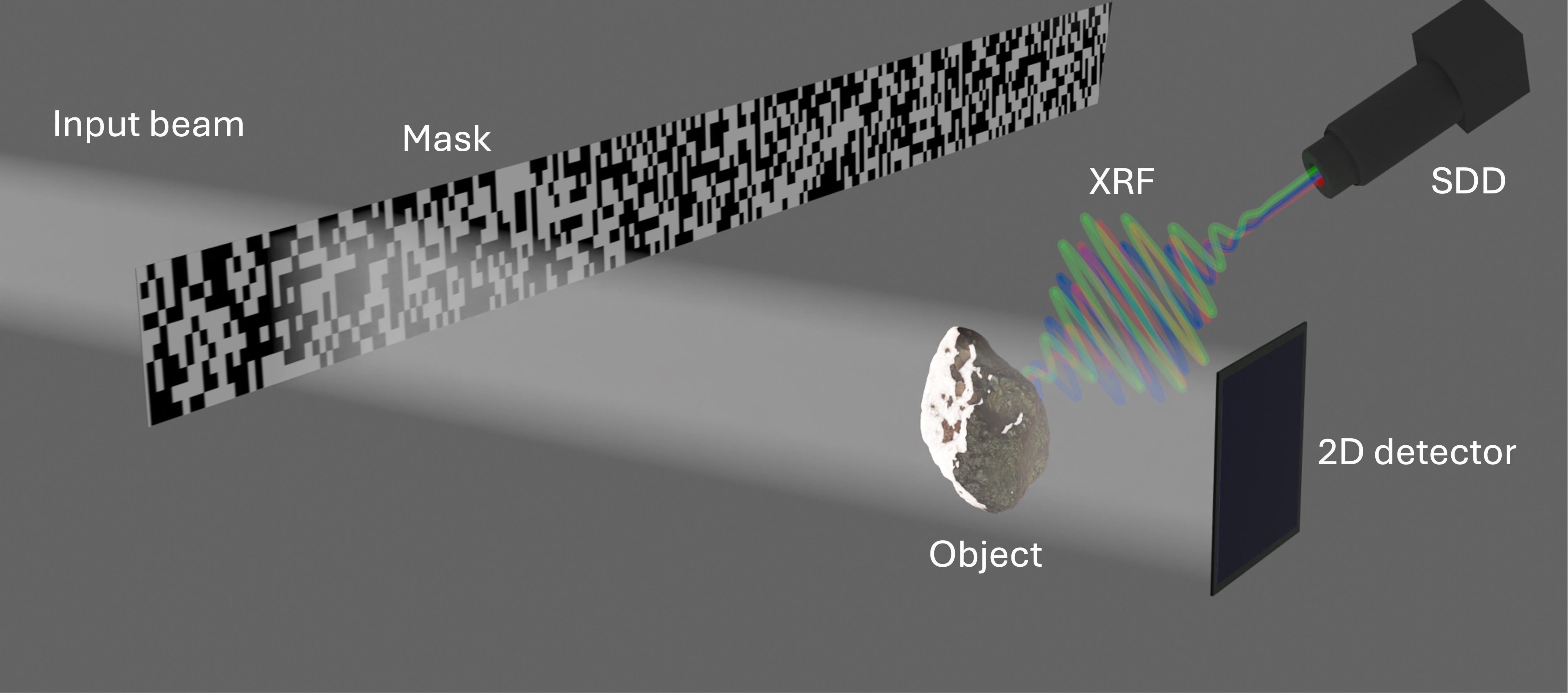
To address this limitation, the intense, broadband parallel X-ray beam at ID19 was used to implement direct volumetric X-ray fluorescence ghost tomography (XRF-GT). Rather than focusing the beam to a small scanning point, a broad beam was modulated by a monolayer of randomly distributed tungsten powder. The mask acted as a filter, generating spatially structured, high-contrast illumination patterns across the sample, which consisted of copper wires, zirconium sheets, and silver particles embedded in resin (Figure 1). For each mask position, the sample was rotated through 360 degrees. A silicon drift detector recorded the fluorescent signal from the entire illuminated region simultaneously, rather than collecting measurements point-by-point.
Click image to enlarge
Fig. 1: The experimental setup for X-ray fluorescence ghost tomography at beamline ID19. A broad, parallel incident beam passes through a tungsten powder mask, casting a random, structured illumination pattern onto the sample. As the sample rotates, a silicon drift detector (SDD) collects the emitted fluorescence globally, allowing the elements to be reconstructed computationally rather than through physical point-by-point scanning.
The key advance was the reconstruction approach. Following a method proposed by A. M. Kingston et al. [1], a direct volumetric inverse problem was formulated that incorporated the multiplexed measurements from all rotation angles simultaneously. Sparsity was imposed directly on the 3D domain, rather than on individual 2D projections. Because the complete 3D object contains structural redundancy that is not captured when projections are reconstructed independently, this approach enabled the elemental distributions to be recovered from substantially fewer measurements.
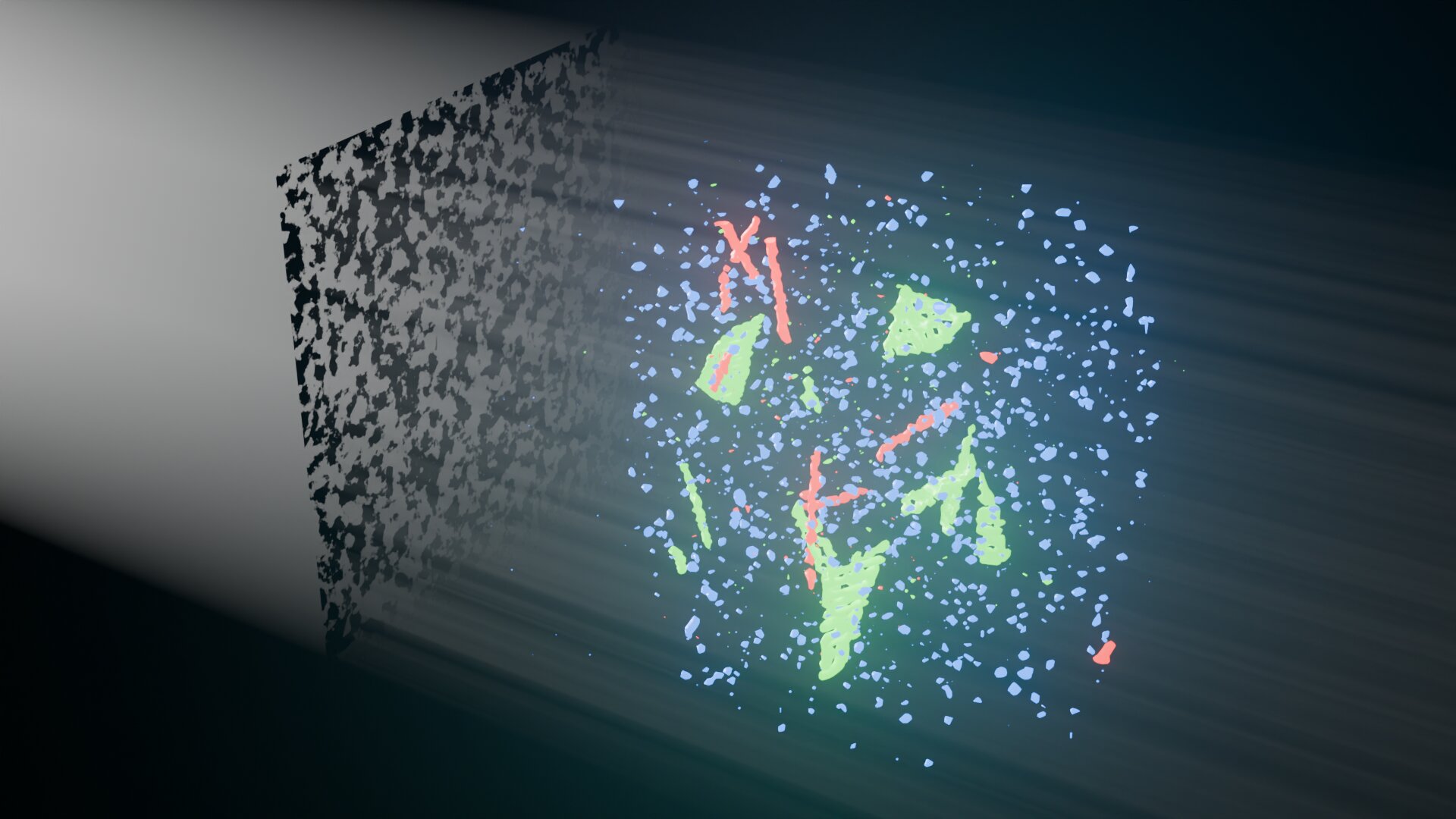
The method was demonstrated by reconstructing a 2.8-million-voxel 3D elemental map using 400 mask positions per angle (Figure 2). In total, 110,400 measurements were required, compared with 4,752,720 measurements for a conventional full-resolution raster scan. Thus, the approach reduced the number of measurements by a factor of 43 while maintaining a spatial resolution of 20–30 µm, comparable to that of the corresponding transmission tomograms.
Click image to enlarge
Fig. 2: A 3D cinematic rendering of the reconstructed elemental volume interacting with the structured X-ray beam. By applying a direct volumetric inverse problem to the data, copper (red), zirconium (green), and silver (blue) structures were accurately mapped with a 43-fold reduction in measurements compared with conventional raster scanning.
The impact
The results indicate that direct volumetric reconstruction can substantially reduce the measurement burden of 3D XRF tomography while retaining quantitative elemental information. The reduction in acquisition time and measurements may also lower radiation exposure, supporting volumetric elemental mapping of larger and more complex biological, geological and industrial samples.
|
Principal publication
|
|
About the beamline: ID19 At beamline ID19, fast tomography and ultra-high-speed radiography are frequently coupled with sample environments. In addition to conventional tomography setups, including furnaces and a cold cell, recent installations include various presses for uniaxial and triaxial loading, dynamic compression systems such as a mesoscale gas launcher, a Split-Hopkinson pressure bar, and a pulsed laser. Dedicated setups are also available for battery abuse testing and in situ additive manufacturing. |
partners


European Synchrotron Radiation Facility - 71, avenue des Martyrs, CS 40220, 38043 Grenoble Cedex 9, France.