- Home
- News
- Spotlight on Science
- A new form of superionic...
A new form of superionic ice under extreme conditions in planetary interiors
11-09-2026
X-ray diffraction has revealed a new hexagonal close-packed (hcp) ice structure under extreme ice-giant interior conditions. High-brilliance X-rays and advanced diamond anvil cell laser-heating techniques at beamline ID27 resolved structural transformations at extreme pressures and temperatures. The observations are consistent with hcp ice becoming thermodynamically more stable than the known face-centred cubic (fcc) phase in the superionic regime, with implications for modelling ice-giant planetary interiors.
Share
The challenge
Water is ubiquitous throughout the Solar System, from Earth to the ice giants Uranus and Neptune and their icy satellites. Remarkably, H2O can adopt at least 20 crystalline ice phases across a wide range of pressures and temperatures. The discovery of these phases has continually driven advances in high-pressure and crystallographic techniques.
In recent years, superionic ice phases have attracted considerable attention. In these phases, oxygen ions remain on a crystalline lattice, while hydrogen ions diffuse through the oxygen framework in an almost fluid-like manner, giving rise to protonic conductivity. Superionic ice can form under extreme conditions, at pressures above ~15 GPa and temperatures above ~900 K. Beyond their fundamental interest, such phases are expected deep within Uranus and Neptune, where they may contribute to the planets’ unusual magnetic fields, which have challenged planetary models since the Voyager 2 flybys in the 1980s.
Previous experiments revealed two distinct superionic ice phases with different oxygen sublattices: body-centred cubic (bcc) at lower pressures and face-centred cubic (fcc) above ~40 GPa and 1500 K [1-3]. This raised the question of whether other forms of superionic ice become stable under more extreme conditions. A hexagonal close-packed (hcp) oxygen sublattice was predicted to be nearly as stable as fcc, while recent shock-compression experiments reported mixed close-packed structures and stacking disorder [4].
The present study therefore investigated whether an hcp form of superionic ice becomes stable in the superionic regime at the extreme pressures and temperatures relevant to ice giant interiors, using static compression techniques.
The experiment
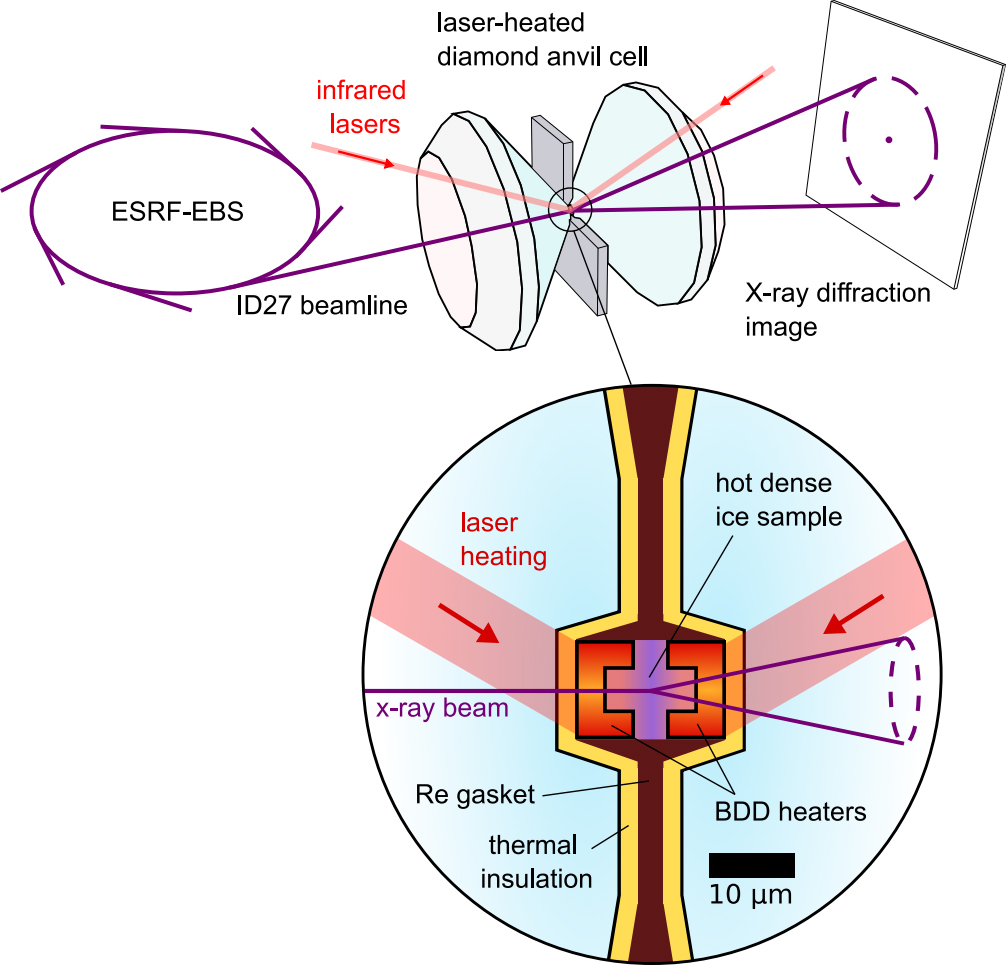
An advanced heating setup was implemented at the ID27 beamline, combining two-sided laser heating with radiometric temperature measurements, a highly sensitive Eiger 9M detector, and a high-brilliance X-ray beam focused to below 1 µm. A micrometre-sized H2O sample was compressed in a diamond anvil cell containing two boron-doped diamond laser heaters and heated indirectly from opposite sides by infrared lasers (Figure 1). This micro-oven geometry enabled efficient indirect heating of the sample with improved temperature homogeneity, allowing high-quality X-ray diffraction data to be collected. Diffraction patterns were recorded across a range of pressure–temperature conditions to probe structural changes beyond the known bcc and fcc superionic phases.
Click image to enlarge
Fig. 1: Schematic of the experiment. In-situ X-ray diffraction is performed in the laser-heated diamond anvil cell (DAC) at the ID27 beamline. The inset shows the DAC chamber with the developed sample assembly: the ice sample is confined between two opposing boron-doped diamond (BDD) laser heaters, each with a central cavity. Central pits in the diamond anvils accommodate the BDD absorbers, while Al2O3 layers (yellow) provide thermal insulation.
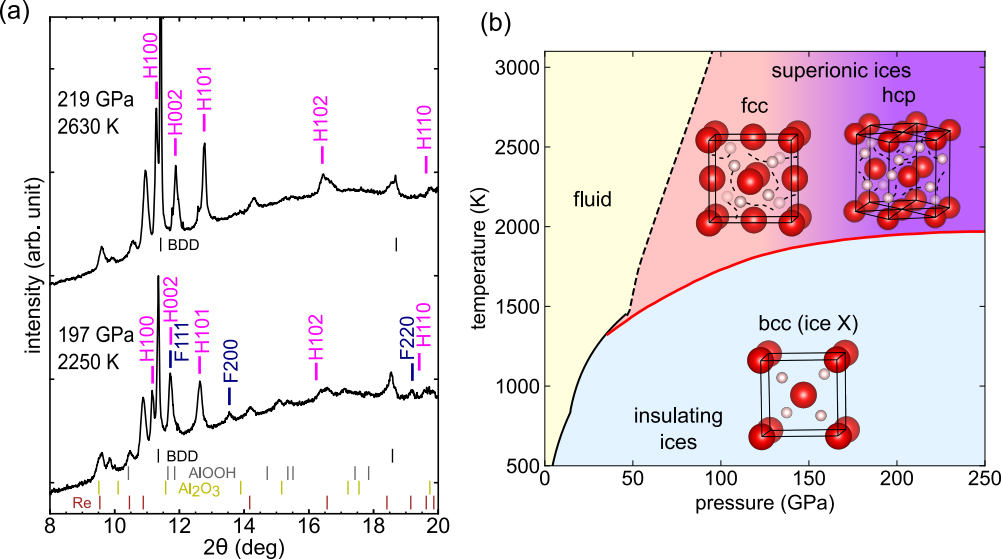
Starting from fcc superionic ice at 80 GPa, cooling produced stacking faults and transient hcp signatures as the structure reverted towards bcc. Between 160 and 200 GPa, hcp diffraction features were clearly observed alongside fcc, and increased in intensity with further compression and heating. At 219 GPa, hcp became the dominant structure, consistent with increased thermodynamic stability above 200 GPa at high temperature (Figure 2a).
The anomalous thermal expansion observed at high temperature is consistent with the hcp phase entering the superionic regime. Its hexagonal structure could also give rise to anisotropic proton conduction, although this was not measured directly. Together, the observations identify a new hcp ice phase and support an fcc-hcp martensitic transition spanning approximately the 130–200 GPa range within the superionic regime (Figure 2b). Above ~200 GPa at high temperature, hcp ice may become thermodynamically more stable than fcc and could therefore be relevant to the deep interiors of ice giants.
Click image to enlarge
Fig. 2: a) XRD patterns collected at 197 GPa and 2250 K (bottom) and 219 GPa and 2630 K (top). Peaks indicating the hcp sublattice are highlighted in pink. Hcp coexists with fcc superionic ice at 197 GPa, while it dominates at 219 GPa. Diffraction signals from the sample assembly are indicated by small coloured lines at the bottom. b) Phase diagram of warm dense H2O illustrating the results of this study. Above the red boundary line, fcc and hcp ice phases in the superionic regime are shown. The red-to-violet gradient between 130 and 200 GPa represents the broad martensitic transition between them. At lower temperatures, insulating ice X is shown, exhibiting a bcc oxygen sublattice.
The impact
The experiment reveals an hcp oxygen sublattice closely related to the previously known fcc phase, differing only in the stacking sequence of close-packed oxygen layers and connected to it through a martensitic transition within the superionic regime. More broadly, this behaviour is consistent with proton delocalisation that relaxes structural constraints imposed by hydrogen bonding, leading to hard-sphere-like behaviour of oxygen ions.
The coexistence of hcp and fcc over a broad pressure–temperature range, together with the increasing relative stability of hcp above 200 GPa, suggests that hcp ice may occur deep inside ice-giant interiors. If stable under such conditions, its mechanical and ionic transport properties may need to be incorporated into models of Uranus, Neptune, and ice-giant exoplanets.
Principal publication
Observation of hexagonal close-packed water ice at conditions in ice giant planetary interiors, A. Forestier et al., Phys. Rev. Lett. 137, 114101 (2026); https://doi.org/10.1103/sdrk-3m4t
References
[1] M. Millot et al., Nature 569, 251 (2019).
[2] J.A. Queyroux et al., Phys. Rev. Lett. 125, 195501 (2020).
[3] A. Forestier et al., Phys. Rev. Lett. 134, 076102 (2025).
[4] L. Andriambariarijaona et al., Nat. Commun. 17, 374 (2026).
|
About the beamline: ID27 With increased photon flux, reduced beam sizes (down to 300 × 300 nm2), and improved detector systems, ID27 enables a new class of experiments, including ultra-high-pressure studies (P > 4 Mbar), time-resolved experiments with millisecond resolution, 2D micro-fluorescence mapping, and in-situ X-ray imaging. |
partners


European Synchrotron Radiation Facility - 71, avenue des Martyrs, CS 40220, 38043 Grenoble Cedex 9, France.