- Home
- News
- Spotlight on Science
- Tracing structural...
Tracing structural distortions in a pressurised nickelate
12-10-2026
The structural evolution of trilayer lanthanum nickelate under pressure and temperature is important for understanding its superconductivity, but key aspects have remained debated, including the proposed intermediate orthorhombic phase. Complementary X-ray diffraction measurements at beamlines BM01, ID15B and ID28 tracked the temperature- and pressure-dependent structural evolution and probed the density-wave state. The results clarify the structural phases associated with superconductivity and provide direct evidence of density-wave order in flux-grown crystals.
Share
The challenge
The discovery of high-temperature (high-Tc) superconductors is a major achievement in modern condensed-matter physics, with potential technological applications that could reduce energy consumption. This has motivated extensive efforts to discover new superconducting materials and understand the microscopic mechanisms underlying high-Tc superconductivity, which are not fully described by conventional Bardeen-Cooper-Schrieffer (BCS) theory [1]. The high-Tc cuprates remain the most prominent example. With the discovery of superconductivity in their isoelectronic counterparts, the Ruddlesden-Popper nickelates have emerged as another platform for exploring unconventional superconductivity [2].
This study focused on the trilayer lanthanum nickelate La4Ni3O10, whose structure comprises three successive layers of corner-sharing NiO6 octahedra forming perovskite-like trilayer blocks separated by LaO rock-salt layers. At ambient pressure, La4Ni3O10 exhibits incommensurate density-wave order below approximately 135 K [3]. Above 15 GPa, superconductivity emerges in the tetragonal structure, with Tc reaching 30 K. Determining the crystal structure is essential for understanding superconductivity, as the crystal symmetry, Ni-O bonding and NiO6 octahedral geometry influence the electronic pathways within the NiO2 planes. In the tetragonal phase, linear Ni-O-Ni bonds can favour orbital overlap and electronic hopping.
However, the structural evolution has remained debated: the ambient-pressure structure is already pseudotetragonal, making the subtle monoclinic distortion difficult to identify, while an intermediate orthorhombic phase [4] has also been proposed. Establishing the sequence of structural phases under pressure and temperature is therefore essential for understanding the relationship between crystal structure, density-wave order and superconductivity.
The experiment
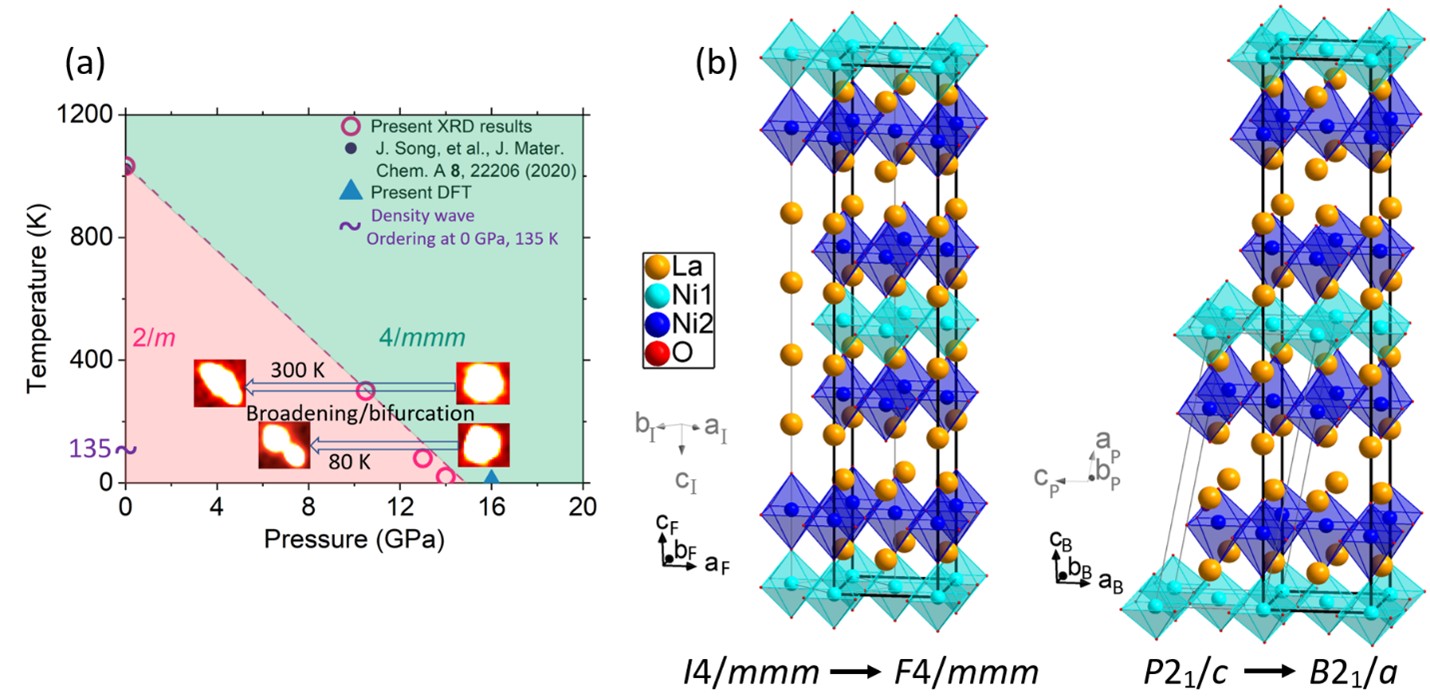
Complementary pressure- and temperature-dependent X-ray diffraction experiments were carried out at beamlines BM01, ID15B and ID28. High-temperature powder X-ray diffraction at BM01 established the ambient-pressure structural transition, pressure- and temperature-dependent single-crystal diffraction at ID15B mapped its evolution under pressure, and low-temperature measurements at ID28 probed the weak density-wave satellites at ambient pressure. The combined results are summarised in the pressure–temperature phase diagram (Figure 1a), which shows that the tetragonal-to-monoclinic transition temperature decreases nearly linearly from about 1030 K at ambient pressure to about 20 K at 14 GPa.
Click image to enlarge
Fig. 1: (a) Pressure–temperature phase diagram of La4Ni3O10 showing the tetragonal-to-monoclinic transition (dashed line). Bragg reflections measured at room temperature and 80 K show the broadening and anisotropic splitting associated with the monoclinic phase. (b) Tetragonal and monoclinic structures represented in non-standard settings that make their relationship and the structural distortion directly comparable. Thin lines indicate the standard settings; black lines indicate the non-standard settings.
A recurring difficulty in establishing the structural evolution of La4Ni3O10 has been the lack of a direct crystallographic comparison between its low- and high-symmetry phases. In their conventional settings, the monoclinic P21/c structure is difficult to compare directly with the parent tetragonal I4/mmm structure. The primitive tetragonal cell and large monoclinic β angle can give a misleading impression of substantial distortion. This can be overcome by transforming I4/mmm to F4/mmm and P21/c to B21/a as displayed in Figure 1b. These non-standard settings preserve the relationship between the lattice parameters and provide a direct representation of the structural distortion.
Its magnitude and evolution can then be assessed through complementary crystallographic approaches, notably by resolving the splitting of Bragg reflections associated with twinning, as illustrated in Figure 1a. Complete structural refinements provide the decisive criterion for determining the symmetry. Together, these analyses support a direct tetragonal-to-monoclinic transition, with no crystallographic evidence for the proposed intermediate orthorhombic phase.
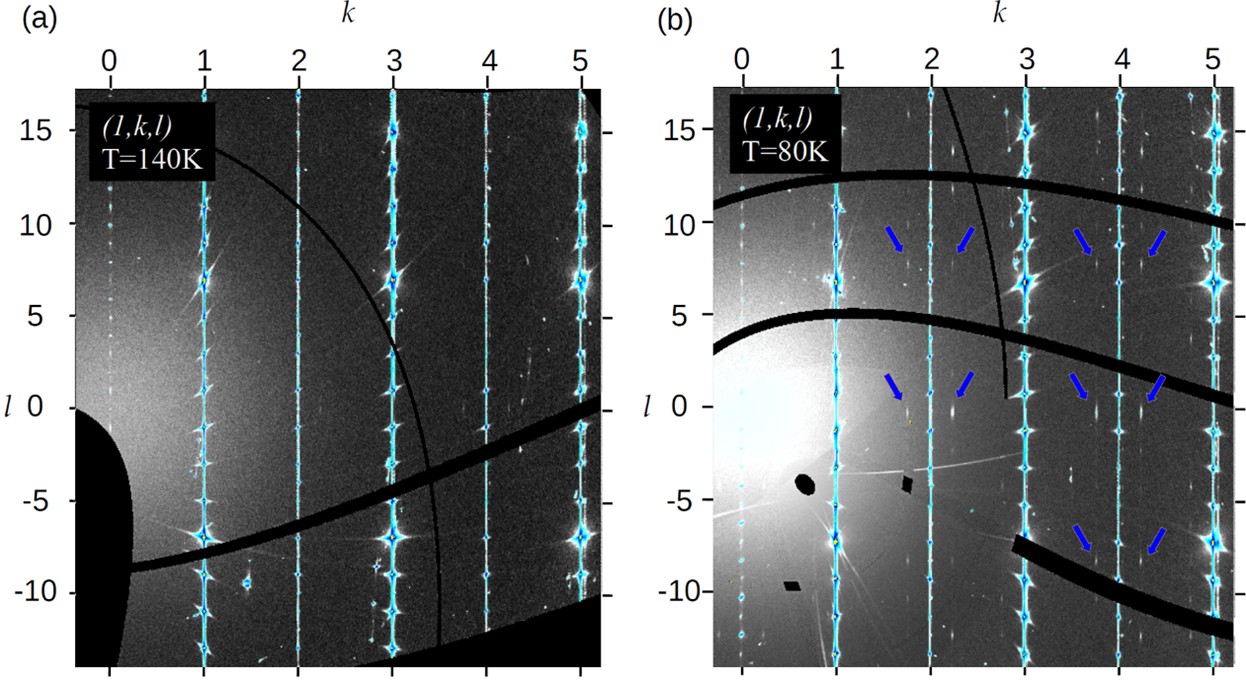
A second key observation concerns the density-wave order (Figure 2). While transport measurements provide indirect signatures of such transitions, incommensurate satellite reflections offer direct evidence of the modulation and allow its evolution to be tracked under pressure. Importantly, the satellites are observed irrespective of the method of synthesis, whether by floating-zone or flux growth. This represents the first observation of these incommensurate satellites in flux-grown crystals and supports the conclusion that the density-wave order is not specific to the crystal-growth method.
Click image to enlarge
Fig. 2: Reciprocal-space reconstruction of the (1kl) plane of La4Ni3O10 in the B-centred setting, showing weak incommensurate satellite reflections (blue arrows) at q = 0.76b*+1c*. The satellites provide direct evidence of density-wave order in a flux-grown crystal measured at 80 K and ambient pressure.
The impact
The results establish a direct tetragonal-to-monoclinic structural transition in La4Ni3O10, ruling out the proposed intermediate orthorhombic phase on crystallographic grounds. This provides a clearer structural framework for interpreting the emergence of superconductivity under pressure and for understanding how changes in symmetry and Ni-O bonding affect the electronic structure of this nickelate. The observation of incommensurate satellite reflections in flux-grown crystals further demonstrates that the density-wave order is intrinsic to La4Ni3O10 rather than dependent on a particular synthesis route. Together, these findings provide important structural constraints for models of the competing and potentially intertwined electronic orders in pressurised trilayer nickelates.
Principal publication
Tracing the horizon of tetragonal-to-monoclinic distortion in pressurized trilayer nickelate La4Ni3O10, S. Ramakrishnan et al., Commun. Mater. 7, 248 (2026);
https://doi.org/10.1038/s43246-026-01297-5
References
[1] C. W. Chu et al., Phys. Rev. Lett. 58, 405 (1987).
[2] P. Puphal et al., Nat. Rev. Phys. 8, 70 (2026).
[3] J. Zhang et al., Nat. Commun. 11, 6003 (2020).
[4] F. Li et al., Adv. Mater. 37, e07365 (2025).
| About the beamlines |
| Beamline ID15B is dedicated to studying the structural properties of solids under high pressure using angle-dispersive X-ray diffraction with diamond anvil cells. It operates at a photon energy of 30 keV for high-pressure experiments, delivering a flux of 1012 photons/s at 200 mA. The typical beam size at the sample position can be adjusted from collimated to focused, down to 5 × 5 µm2, and can be further reduced to 1 × 1 µm2 for experiments at megabar pressures. The station is equipped with a variety of sample environments, including multiple membrane-driven diamond anvil cells (0 – 100 GPa), a liquid helium-cooled cryostat enabling high-pressure experiments at low temperatures (down to 4 K), and external resistive heating equipment for temperatures up to 1200 K. Additionally, an external Nd:YAG laser system is available for high-temperature annealing of samples inside the diamond anvil cell. |
| Beamline ID28 is dedicated to investigating phonon dispersion in condensed matter, focusing on momentum and energy transfers associated with the collective motion of atoms. It uses inelastic X-ray scattering (IXS), a technique particularly well-suited for studying systems that are difficult or impossible to probe with inelastic neutron scattering. ID28 also enables investigations of materials under extreme pressure conditions, up to 100 GPa, including geophysical relevant phases, dense liquids and metals. In addition, it provides access to lattice dynamics in thin films and at interfaces. The diffraction station of ID28, complementary to the inelastic X-ray scattering spectrometer, enables fast and efficient mapping of reciprocal space, providing information about correlated disorder, encoded in the diffuse scattering. Identification of regions of interest for subsequent inelastic scattering studies largely improves the performance of the inelastic scattering station. |
| BM01 provides a wide range of synchrotron diffraction techniques, including powder, single-crystal, and grazing-incidence diffraction, high-resolution reciprocal space mapping, small-angle scattering, and multimodal approaches. The beamline is primarily dedicated to in-situ and operando studies of energy-related materials and processes. It operates as part of the CRG Swiss-Norwegian Beamlines (SNBL). |
partners


European Synchrotron Radiation Facility - 71, avenue des Martyrs, CS 40220, 38043 Grenoble Cedex 9, France.