


|
|
|
TANGO |
Revision: 1.1.1.1 - Author: vedder_bruno
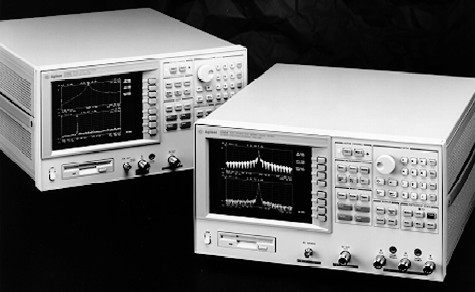
The Agilent 4395a is a multi purpose device. It can be used as network analyzer, spectrum analyser and impedance analyzer. This device server handles Network and Spectrum analyzer modes only. For technical specifications and other various informations related to the 4395a, see Agilent's website and type "4395a" into the search combo box on the top of the page.
Since there is a huge collection of parameters to control on this device and seen that we do not need all of them , we made some choice to skip certain unused-for-us parameters:
-Impedance analyzer functionnalities are totally skipped.
-We only use the first channel for parameters.
-Spectrum are return into 32bits float array which is enough for accuracy,
and smaller than large ASCII transfert.
-Defaut Spectrum input is A, A/R in network mode.
-All rare operation like Calibration should be done manually.
About the GPIB chain: The device is controled through it's gpib (IEEE 488.2) interface. The Agilent4395a tango device server does not access directly the 4395a. It's a client of another device server, the generic GpibDeviceServer. This architecture was choosen due to problem with concurrent access to the gpib bus, which wasn't enough secure, using lock/unlock commands. The GpibDeviceServer uses Tango serialisation mechanisms to avoid such conditions.
Here is the basic GPIB architecture used:
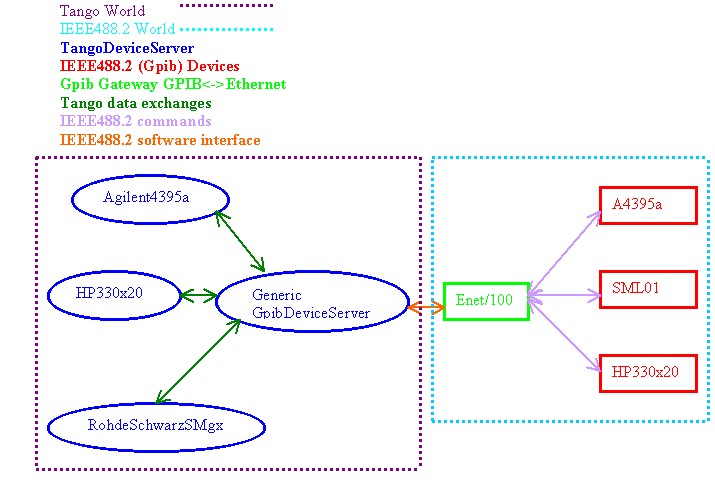
The Generic device server can handle multiples differents gpib devices.
The Agilent4395a is one of them.
This device server has been tested on Linux (x86/Suse82) and solaris
9. Problem related to cpu endianness for interpreting spectrum array is
solve by #defining -DLITTLE_ENDIAN for X86 architectures. If not defined,
CPU (spark for example) is assume to use BIG_ENDIAN memory storage
model (see Makefile).